The Forts and Palaces of Rajasthan are spectacular sights and marvelous monuments.
Besides being exemplary architectural wonders, they are the setting for the various historic and dramatic episodes and wars waged here.
The extensive use of marbles, stain glass, gold and silver and metal inlaid work makes the palaces breathtaking sights. The women's quarters were beautifully done up with teak and marble jail work.
The forts of the state were constructed to be impregnable garrisons. The tall walls, ramparts and moats still stand testimony to the military genius of the Rajput warriors.
Most of these forts have withstood many attacks and sieges.
Guerilla warfare was common in the state and these forts are known to have secret gateways and hidden tunnels for effective use in case of an invasion.
Rajasthan Forts & Palaces
Taragarh Fort

The enormous fort has six gates. It has massive reservoirs that were carved out of solid rocks and was used for watering the nearby towns in the past. The fort also encloses the biggest battlement or the stone tower known as the Bhim Burj that housed the famous cannon called Garbha Gunjan, the second largest cannon in India.
Bikaner Fort

History- This imposing fortress was raised in1593 A.D by Raja Rai Singh, the illustrious general of the Mughal Emperor Akbar's Army. Raja Rai Singh was also the sixth ruler of the city of Bikaner who ruled from 1571 to 1612 AD. Only, Kamaran who was able to capture the fort couldn't even retain his triumph for more than 24 hours.
Description- The Bikaner fort is surrounded by deep moats and an elevated wall. The fort is guarded by 37 citadels and has two gates- the Suraj Pol(sun gate) and the Karan Pol for providing access in its interior.
Amber Fort
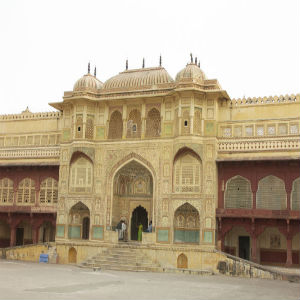
Dunlod Fort
Dunlod is a beautiful village in the Shekawati, 7 km from Nawalgarh. The Dunlod Fort was constructed by Kesari Singh in 1750 A.D. While the exteriors combine the Rajput and Mughal styles of architecture tastefully, the interiors of the Fort are done up using traditional Rajasthan and European artifacts.
Suraj Pol is the main gateway of the Fort and leads to the Bichla Darwaza while the Uttar Pol leads to the chief courtyard from where majestic a flight of stairs take us to the Diwan Khana.
The Diwan-i-Khas or the Hall Of Private Audience comprises a mustard or flax colored arcade. While the stain glass windows impart warm colors to the chamber, the Louis XIV furniture and library housing a rare collection of books add to the olde worlde charm of the Fort. A jail or lattice work gallery called the duchatta in the Diwan-i-Khas allowed the womenfolk to observe the proceedings in Purdah without revealing themselves.
City Palace
The City Palace is a stunning sample of architecture in the royal city of Jaipur. The foundations of the palace were laid by Maharaja Jai Singh II Kacchawaha Rajput king of Amber in the 18th century. The beautifully caved marble interiors, magnificent pillars, jali or lattice work and inlaid ornamentations make the palace a cherished tourist attraction. Jaleb Chowk and Tripolia Gate are the two main entrances to the City Palace Jaipur. The architect of this opulent structure Colonal Jacob has successfully combined the Mughal, Rajput and European styles of architecture.
Chittaurgarh Fort
Termed the 'Pride Of Rajasthan', the Chittaurgarh Fort holds a unique place among the forts of Rajasthan. Built atop a hill, Chittaurgarh Fort encompasses a sprawling 700 acre area and is believed to be the brain child of the Mauryan rulers.
While the foundations were laid down as back as the 7th century, renovations and additions were made by the rulers of Mewar. Thrice conquered, the Chittaurgarh Fort has stood witness to many battles. Seized by Allauddin Khilji in1303, by Sultan Bahadur Shah in 1535 and lastly by Akbar in 1567, the erstwhile bastion tells tales of Rajput valor. The Badal Pol, Bhairon Pol, Hanuman Pol and Ram Pol are the important gateways to this fort. The Vijay Sthamba erected in 1440 by Rana Kumbha, holds testimony to the Rajput win over Malwa and Gujarat.Chittaurgarh Fort also houses Rana Kumbha's Palace. The Kirti Sthamba or the Tower of Fame is a 12th century Jain monument. Rani Padmini's legend is intimately associated with this fort.
Last Updated on: May 12, 2026
Travel to Rajasthan
