
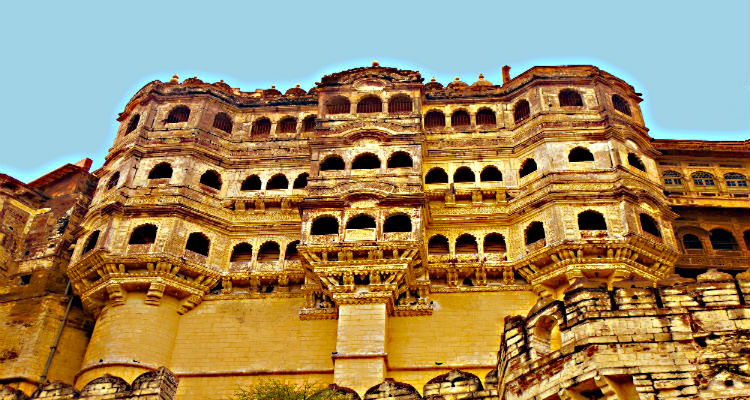
About Mehrangarh Fort
The fort was built by Rao Jodha in 1459 when he transferred his capital from Mandore. Subsequently more additions were made by the other rulers of Jodhpur with passing time. The marks of canon balls from the past skirmishes are still prominent on the second gate of the fortress. The palm imprints that are smeared with vermilion paste and paper-thin silver foil on a gateway leading to the funeral pyre site, reminds the tourists of the princesses and the queens who committed self-immolation or Jawhar for the sake of their consorts.
The magnificent craftsmanship of the Jodhpuri craftsmen is exhibited in the fascinating sandstone palaces within the Mehrangarh Fort. The Mehrangarh Fort houses grand palaces like the Moti Mahal or the Pearl Palace that houses the royal throne of Jodhpur known as the Sringar Chowki, the Phool Mahal whose ceiling is adorned by gold filigree work, the Rang Mahal and the Chandan Mahal. Other mansions are the Umaid Villas that showcases the Rajput miniature paintings, the Ajit Villas displays the musical instruments and the royal attires and the Maan Villas.
Currently the fort encloses the Mehrangarh Fort Museum where all the decorated rooms of the palaces and villas are exhibited along with the royal palanquins, miniature paintings, furniture, and historic armory and etc.
Location
The Mehrangarh Fort, one of the colossal and majestic forts of India is located atop a 150 m elevated hill lying at a distance of 5km from Jodhpur in.
var planes = [ ['Mehrangarh Fort, Jodhpur, Rajasthan',26.297653, 73.018650], ]; var map = L.map('map').setView([26.297653, 73.018650], 6); mapLink = 'OpenStreetMap'; L.tileLayer( 'http://{s}.tile.openstreetmap.org/{z}/{x}/{y}.png', { attribution: '© ' + mapLink + ' Contributors', maxZoom: 18, }).addTo(map); for (var i = 0; i < planes.length; i++) { marker = new L.marker([planes[i][1],planes[i][2]]) .bindPopup(planes[i][0]) .addTo(map); }
Mehrangarh Fort - Entry Fee, Timing, Address, Official Website | |
|---|---|
| Address | P.B # 165, The Fort, Jodhpur 342006, Rajasthan |
| Entry Fee for Mehrangarh Museum: | Entry Fee for Indians : 60 Rs . Entry Fee for Indians (Children and Sr. Citizen) : 30 Rs . Fee for audio guide for Indians : 150 Rs. Fee for audio guide for Indians (Children and Sr. Citizen) : 100 Rs. Entry Fee for Foreigners with audio guide: 500 Rs. Entry Fee for Foreigners (Children and Sr. Citizen) with audio guide : 400 Rs. Fee for Chokelao Garden per person: 30 Rs. |
| Camera Fee : | 100 Rs. |
| Video Camera Fee : | 200 Rs. |
| Entry Fee for Jaswant Thara : | Entry Fee for Indians : 15 Rs. Entry Fee for Foreigners : 30 Rs. Entry Fee for Children & Sr. Citizen is free. |
| Camera Fee : | 25 Rs. |
| Video Camera Fee : | 50 Rs. |
| Timings : | Visiting Hours - 9:00 AM - 5:00 PM |
| Phone No (Official) | 91-291-2548790/2548992/2541447 |
| Official Website | www.mehrangarh.org |
| Photography allowed or not | Allowed |
| Nearest railway station | Raika Bagh Railway Station |
Last Updated on : September 29, 2016
Travel to Rajasthan
