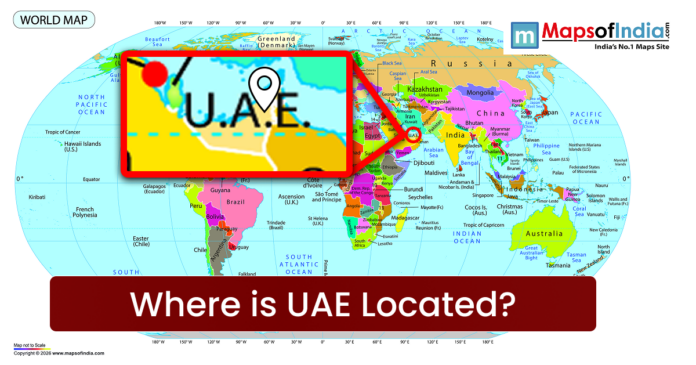
The United Arab Emirates is situated along the southeastern part of the Arabian Peninsula in the Western part of Asia. It borders Oman to the southeast and Saudi Arabia to the south and west, respectively. The country has a coastline to the north, which is against the Persian Gulf, and a minor part of the eastern coast borders the Gulf of Oman. Such a strategic location puts the UAE at a junction point between Europe, Asia, and Africa, and is one such important connection to global trade and travel.
As a geographical location, the UAE is located in the desert region characterized by massive sand dunes and dry climate conditions. The Rub al Khali or Empty Quarter is one of the largest uninterrupted deserts of sand in the country. Although the UAE is a desert country, mountains are also present in the eastern parts of the country, especially in the southern part of the border with Oman. These mountains create a contrasting effect to the flat coastal plains and inland deserts.
The country is composed of seven emirates, namely Abu Dhabi, Dubai, Sharjah, Ajman, Umm Al Quwain, Ras Al Khaimah, and Fujairah. The capital city of Abu Dhabi is situated in the western region of the country, on the Persian Gulf coast, whereas Dubai is situated slightly northeast of the same coast. Fujairah is special among all emirates since it does not have any connection with the Persian Gulf; instead, it has an attachment to the Gulf of Oman.
The location has been one of the significant factors contributing to the rapid development of the UAE. It is close to major shipping lanes and air routes, which connect the world successfully, becoming an international business, tourist and financial centre. Its geographical location still defines its economic and cultural value in the area.