


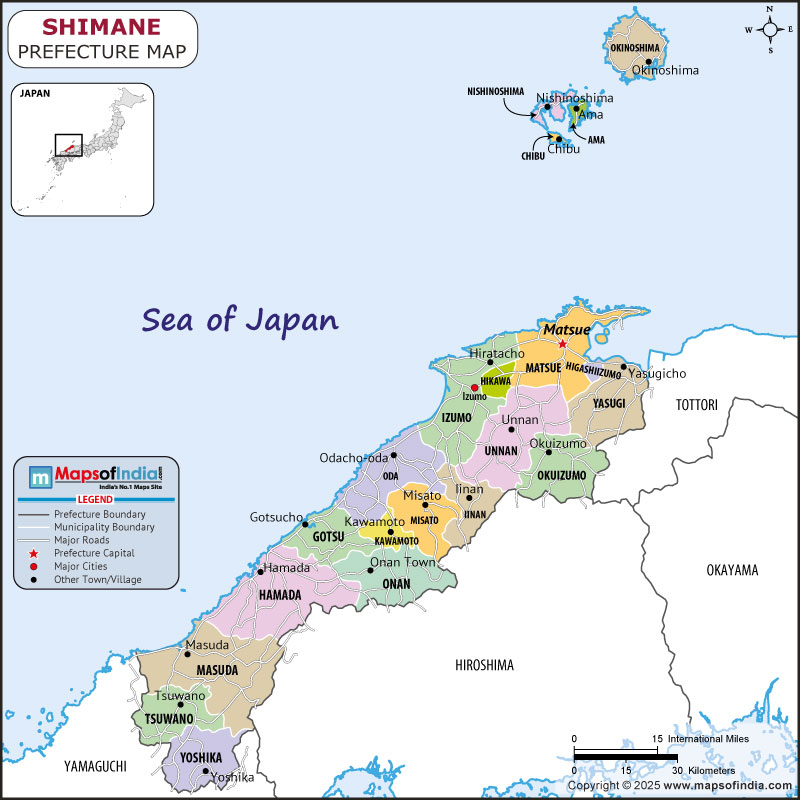



Shimane is a prefecture comprising Honshu prefecture in the Chugoku region and the Oki Islands at its northern end of Honshu, which borders the sea of Japan. It has its main city at Matsue followed by other major centres like Izumo, Hamada and Masoda. About 6,700 km2 of area and one of the least densely populated prefectures in Japan is here. Shimane has strong Japanese mythological roots, it is called a Land of Gods, as it is famous in ancient mythology and temples. There is also still a strong cultural influence here with well-preserved castle towns, original wooden castles (such as Matsue Castle) and a historical reminder of silver mining (especially Iwami Ginzan). Natural beauty is surrounded by rocky shorelines, calm lakes, hot springs as well as mountainous interiors.
History
The history of humans in Shimane goes back in time. Archeological remains of stone tool usage and cultural evidence have also been found in Yayoi periods and Kofun periods of the Izumo region where people lived in the Paleolithic. The Izumo Plain evolved to be a major petty pre-historic hub, popular in mythology and archaeology because of the massive burial piles there and prominence as a religious center.
The Ritsuryo system dominated in the classical era in which the region was subdivided into ancient provinces or Oki, Iwami, and Izumo (among others). Mythology Shimane and mythology of the Izumo Taisha shrine is included in Japanese early literature including the Kojiki and Nihon Shoki.
The feudal (Sengoku and Edo) system was the one that ruled in Izumo and Iwami, with power being held with the local clans, like the Amago. For exile the Oki Islands (part of the prefectural area) was used, where the emperors Go-Toba and Go-Daigo were exiled. In 1607-1611 Matsue Castle was erected by Horio Yoshiharu, then inherited by Kyogoku and then Matsudaira clans, in Matsue Domain which was to control much of central Shimane.
The old terms of province and feudalism came to an end when the Meiji restoration occurred in 1868. The ex-provinces transformed to be modern administrative units: Oki Province was incorporated by Shimane Prefecture in 1876. The government, transport, education, and agriculture of the modern world evolved further.
The mountainous interior, remote coastline and islands kept Shimane quite rural relative to other prefectures, which were more industrialized in the 20th century. Traditionally vital economic foundations have been forestry, stockbreeding, and fishing. Places such as the Iwami Ginzan Silver Mine were now known all over the world as a part of the world heritage with Matsue Castle being one of a few remaining original-keep castles.
Culture
There are several folk traditions and performance arts that are a part of the region and which have maintained elements of spirituality and mythology as well as life of the community. Iwami Kagura is one of the most notable ones; a feisty dance associated with theatrical elements in the western areas of Shimane. It is marked by performers wearing extreme masks and costumes and to some extent by drums and flutes telling mythical tales of gods and demons. It is not dead currently as it is found in local festivals and communal rituals, particularly in country and coastal towns.
Congregations are very significant. The Horan-Enya Festival in Matsue is one of the grandest ones held but once every ten years (or so) and it touches upon a great procession of boats on Lake Shinji, historic costumes, and rites in search of good harvests. Water Lanterns known as Suitoro by Matsue are the events that light up moats of castles and historic streets around Tokyo using reflective lanterns, combining art and history with community socialization with some happening every half year. Further out in the countryside, several of the seasonal rituals, such as a Hana Taue rice-planting ceremony, are recreated and continued, and local residents attend it to give thanks, prayers, and a sense of belonging.
A large role is also taken by handicrafts and folk art. Similar examples include ceramics, lacquerware, woodwork, dyed textiles, the Izumo Folk Crafts Museum found in Izumo displays arts of daily life both in regards to their aesthetic beauty and useful design. Examples of this usage of local materials and skills in artistically expressive forms include the traditional paper crafts and temari balls of washi paper, used in the towns of the region. These crafts belong not only to the tourists; it is a part of the regional identity and memory.
Hot springs and religious sites are being mixed up in the spiritual and day life. An example of this type of onsen resort is Tamatsukuri Onsen, which is an onsen resort of ancient origin, already listed in ancient records, and identified with mythological traditions and healing waters. Sada Shrine along with other shrines host Sada Shin Noh which are ritual purification row dances, classified as Important Intangible Folk Cultural Properties. These dances have a community involvement, traditional clothing, music and have a history.
Food and local cuisine are involved in local festivals and seasons. The spices used by the people to celebrate land and locality include fresh seafood along the Sea of Japan coast, coastal mountain foods as well as the local specials such as Hikimi Wasabi. There are also those performances or rituals that are directly linked to agricultural cycles or harvest.
Language
In the linguistic sense, Shimane is a very diverse region, having a number of dialects that depict the geography and history of this region. Rather than a single local dialect, traditionally different areas of the prefecture had their own unique dialects: the later Izumo dialect of Izumo northeast, the Iwami dialect of the west, the Oki dialect of the islands, and the Yasugi dialect of Yasugi city. Each of them possesses both sound system, lexis, grammatical patterns, vocabulary and reflect the diversity that prevails in western Japan.
The most well-known one is the Izumo dialect, which is part of a cluster of other dialects which may sound unusual by outsiders due to their rhythm and intonation. Part of its speech sets enable it to appear more predominantly of northeastern Japanese dialects, as a result of which it provides it with a certain taste in the Chugoku region. Yasugi dialect is almost similar and has many similar characteristics.
Iwami dialect, in turn, is even more influenced by the surrounding areas like Hiroshima and Yamaguchi. It displays western nature of the Chugoku area, where the use of negativity and sentence closing have different forms of expressing meaning as compared to Izumo speech. Meanwhile, the dialect of Oki spoken on Oki Islands reflects signs of the earlier forms of language that have been conserved because of relative isolation of the islands. The secluded topography has caused ancient words and speech patterns to last longer as compared to the mainland.
In Shimane, the dialects may vary in terms of pronunciation, spatial pitch, and usage of some words. To illustrate, a given word will have different sounds when it is spoken in different places, Izumo, Iwami, and Oki. In other locations, consonant sounds are simplified or altered, others use more ancient words that have since fallen out of use in other regions of Japan. These differences are even dramatic over a small area.
Geography
The Shimane Prefecture is to the North of the Chugoku region, Honshu, Japan. It borders the Sea of Japan on its north and the Chugoku Mountains on the south. The Oki Islands, off the north of the prefecture, are also part of it. Altogether, it covers approximately 6,700 sq.km., and as such, one of the sparsely populated regions in Japan.
Shimane experiences many hilly mountainous areas. The valleys cut deep into reality, and there is also a prevalence of ravines, steep hills and rock-formations. Great masses have vivid topography and steep drops and waterfalls. Sea winds and sea waves have developed rugged and undulating coastlines structures like sea caves, old cliffs, and small islands along the coast.
She is also marked with great lakes and wetlands. The northeast lake Shinji is a large salt water lagoon and a large marsh worth supporting migratory ducks. These wetlands are also conserved, together with Lake Nakaumi, and they connote significant ecological procedures.
The deltas are mostly concentrated in the level plains particularly inside the Izumo Plain in the northeast. Settlement, agriculture and transportation are concentrated there. Conversely, densities are less in the central part of the country, in particular, the western and the mountainous part of the south of the country, where peoples are more remote.
The climate in Shimane is different according to highness and closeness to the sea. Within regions that border the Sea of Japan coastal areas, winters are relatively mild, but some regions are prone to snowfalls. The summer is also humid and the rainy season during early summer is characterized by a lot of rainfall. In the inland and mountainous regions, the influences of the weather appear to be more significant, as winters are colder and the differences are increased throughout the year.
Quick Facts
| Official Name | Shimane |
| Capital | Matsue |
| Region | Chūgoku (San'in) |
| Island | Honshu |
| Area | 6,708.26 km² |
| Population | 638,499 |
| Governor | Tatsuya Maruyama |
FAQs
Q1: In which part of Japan is Shimane, and what’s the capital of Shimane?
Shimane is located on the west of Honshu, at the Chugoku region which borders the Sea of Japan. Its capital is Matsue.
Q2: Shimane was formed out of which provinces?
The Shimane was established out of the late Iwami, Izumo, and Oki provinces.
Q3: Which are the important cultural or religious locations?
Izumo Taisha Shrine is a shrine that is one of the oldest and most ancestral Shinto shrines in Japan. Matsue Castle is a castle which is well maintained as an original keep. The Silver mine of Iwami Ginzan is a World Heritage site.
Q4: What’s the cuisine of Shimane?
There are local white lines of fresh seafood (e.g. nodoguro blackthroat seaperch, shijimi clams), of Izumo soba (buckwheat noodles), rice (Taimeshi, rice topped with sea bream), and different sweet fruits and melons.
Last Updated on: April 15, 2026

