Quick heads-up first. There's no single national portal for this. Every state runs its own show. Its own website. Its own fee. Its own validity period. So this guide covers the common pattern every state follows. Plus exactly where things differ. That way you know what to expect, no matter where you're applying from.
What Is an Income Certificate and Why Is It Needed?
Simple enough. It's an official document confirming your family's total annual income, from every source combined. State governments issue it. Usually through a Tehsildar, an SDM, or another district-level revenue officer, depending on where you live. You'll need it for scholarships, EWS reservations, fee waivers, subsidies, pensions, loans, and even court proceedings sometimes. Honestly, it's one of the most requested documents in the entire Indian welfare system.
Who Is Eligible to Apply for an Income Certificate?
Any Indian citizen can apply. Salaried, self-employed, a farmer, working informally- it doesn't matter. No minimum age either. Parents or guardians can apply on a minor's behalf too, usually for a scholarship.
Documents Required for Income Certificate Application
Proof of Identity
Aadhaar card, voter ID, or PAN card. Any one usually does the job.
Proof of Address
Aadhaar card, ration card, utility bill, or a domicile certificate. Depends a bit on your state.
Income Proof Documents
Salary slips, if you're employed. IT returns, if you file them. A local income certificate from your Gram Pradhan or ward officer, if you're rural or informal.
Self-Declaration/Affidavit (if applicable)
Self-employed? Working informally? You'll likely skip the salary slip and submit a self-declaration affidavit instead. State your annual family income. Get it signed before a Notary Public or Gazetted Officer.
Step-by-Step Process to Apply for Income Certificate Online
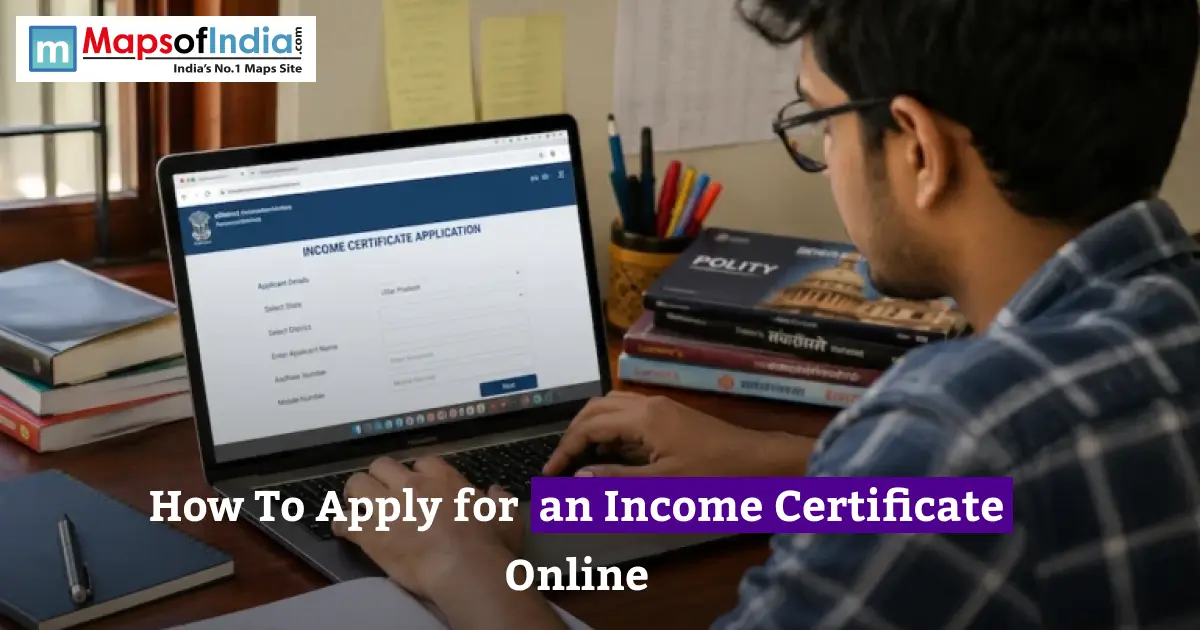
- Visit your state's e-District portal. Every state has its own. UP uses e-Sathi. Delhi uses edistrict.delhigovt.nic.in. Kerala uses edistrict.kerala.gov.in. Not sure of yours? Just search "[your state] e-District income certificate."
- Register or create an account. A mobile number and email usually get you started.
- Log in and select "Income Certificate." Look under Revenue Department services.
- Fill the application form. Personal details, income sources, address. The usual.
- Upload the required documents. Keep scans clear. Stay within the file size limit.
- Pay the fee, if there is one. Some states charge nothing online. Others ask for a small stationery fee, usually ₹15 to ₹30.
- Submit, and note your reference number. You'll need it to track things later.
Income Certificate Application Fees
Here's where it genuinely varies. Roughly 18 states offer this completely free online. Around 14 charge a small stationery-style fee, usually ₹25 to ₹30. Kerala charges ₹15 as the government fee, plus another ₹30 to ₹50 if you go through an Akshaya Centre instead of doing it yourself. Delhi's online submission is free, though CSC-assisted applications might carry a small service charge. Bottom line? Check your own state portal for the exact number. These figures shift.
How to Check Income Certificate Application Status Online
Head back to your state's e-District portal. Look for "Track Application" or "Check Status." Enter your reference number. Your current stage shows right there on screen.
How to Download Income Certificate Online
Once approved, log back in and find "Download Certificate." Most states now issue a digitally signed e-certificate. Legally valid on its own too; no physical stamp needed for most purposes- scholarships, banking, government recruitment, all of it.
Validity of Income Certificate
Most states set this at 6 months. A few, UP and Delhi included, stretch it to a full financial year, valid through 31st March. A handful go even further, up to 3 years. Whatever your state says, double-check the scheme you're actually applying to as well. A lot of them want a certificate no older than 6 to 12 months, regardless of what your state technically allows.
Common Reasons for Application Rejection (and How to Avoid Them)
Missing salary slips trip up plenty of salaried applicants. Left that job? Request one retroactively from HR. Still no response? File an RTI. Income mismatches are another common snag, where the verifying officer records a different number than what you declared. You can challenge this through an SDM appeal, backed by your IT returns or bank statements. Incomplete or unsigned self-declaration affidavits cause rejections too, so get that notary or gazetted officer signature sorted before you hit submit.
How Long Does It Take to Get an Income Certificate?
Most states promise 7 to 15 working days, on paper. Real life often runs a bit longer, anywhere from 7 to 30 days, depending on how fast the local verifying officer, often called a Patwari or Lekhpal, gets around to your check. Stuck well past your state's own timeline? Filing an RTI genuinely tends to get things moving.
Conclusion
Getting an income certificate online is mostly painless these days. Register, fill the form, upload your documents, wait for verification. The real trick is knowing your own state's specific portal, fee, and validity rules, since none of it is standardised nationally. Start with your state's e-District website. Keep your income proof ready. Apply a few weeks before you actually need it in hand, not the day before.
FAQs
Can I apply for an income certificate without visiting a government office?
Yes, in most states. You can register, fill the form, upload documents, and pay any fee entirely online; no office visit needed at all.
Is an income certificate the same as a caste-income certificate?
No. An income certificate covers just your family's income. A caste-cum-income certificate combines income and caste category verification, usually required specifically for reservation-linked benefits.
What is the validity period of an income certificate?
Usually 6 months. Some states, like UP and Delhi, stretch that to a full financial year. A few allow up to 3 years. Always check what the specific scheme wants too.
Can I apply for an income certificate through CSC centres?
Yes. Common Service Centres, and similar local setups like Kerala's Akshaya Centres, offer assisted applications for a small service fee. Handy if you'd rather not navigate the portal yourself.
What documents are needed if I'm self-employed vs salaried?
Salaried applicants usually submit salary slips or an employer certificate. Self-employed or informal-sector applicants typically submit a notarised self-declaration affidavit stating their annual family income instead.
Which government officer issues the income certificate?
Depends on your state. Common ones include the Tehsildar, Sub-Divisional Magistrate, District Magistrate, Deputy Commissioner, or Revenue Circle Officer.
Why does my state's portal look different from another state's income certificate process?
Because it's handled at the state level, not centrally. Each state built its own e-District system, so portal names, exact steps, fees, and validity all differ, even though the core purpose stays the same everywhere.
What should I do if my income certificate application is delayed?
Check your state's stated timeline first, usually 7 to 15 working days. Well past that? Filing an RTI is a genuinely solid way to get a status update, or just get things moving again.