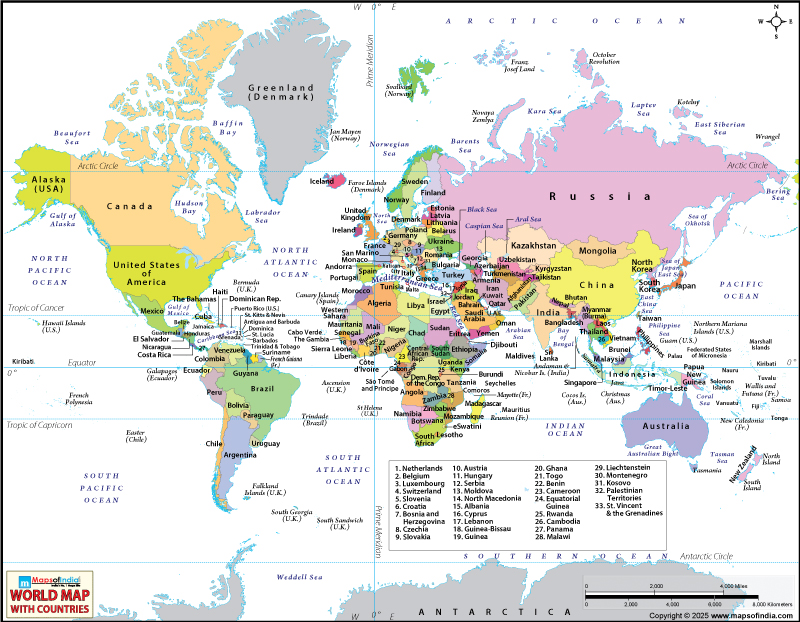



Alphabetical List of Countries in the World
The world comprises a variety of countries and territories of varying geographies, cultures, histories, governance and identities. An alphabetical list of countries enables users to easily find and explore information about other countries around the world. From large countries like India, China and the United States of America to smaller countries like the Islands, each country adds to the diversity of the planet.
Students, travellers, researchers, and geography lovers will find an alphabetical country list helpful for knowing where each country is located. Countries are typically listed alphabetically for ease of navigation and for easy access to geographical info.
How Many Countries Are There in the World?
The number of countries in the world is actually subject to change based on the definition of a country. The most widely accepted international definition is that there are 195 countries in the world. This number refers to the total of 193 United Nations (UN) member states and 2 observers (Vatican City and Palestine).
These countries have very diverse populations,, economic systems, and political and social structures, as well as geographic size. Russia is the largest country in terms of area, and some countries are made up of a small number of islands, occupying a few square kilometres. Likewise, the number of people in the population of countries is either billions of people in India and China or just a few thousand in small countries or islands.
In addition to independent countries, there are also a number of territories and regions in the world with special political status. Some are dependent territories, others are limitedly recognized as sovereign states.
Types of Countries and Territories
Countries and territories around the world can be classified into different categories based on their political status and level of independence.
- Independent Countries:
Independent countries are sovereign nations with their own governments, borders, and authority to manage internal and international affairs. Examples include Japan, Brazil, and Canada. - UN Member Countries:
Most recognized countries are members of the United Nations. These nations participate in international discussions and cooperate on global issues such as peace, climate change, and development. - Observer States:
Some territories have observer status at the United Nations instead of full membership. They participate in international activities but do not have the same voting rights as member countries. - Dependent Territories:
Some regions are not fully independent and are governed or associated with another country. These territories may have their own local governments but depend on another nation for certain matters such as defence or foreign relations. - Special Administrative Regions and Disputed Areas:
Certain regions have special political arrangements or are involved in territorial disputes. Their status may differ depending on international recognition and agreements.
Distribution by Continent
The countries of the world are spread across seven continents, with each continent having a different number of nations and territories.
Africa:
Africa is home to around 54 countries, making it the continent with the highest number of recognized countries. It is known for its diverse landscapes, including deserts, forests, mountains, and grasslands.
Asia:
Asia has approximately 49 countries and is the largest continent by population and land area. It includes some of the world’s most populated nations and plays a major role in global culture, economy, and history.
Europe:
Europe consists of around 44 countries and is known for its historic cities, cultural heritage, and strong economic connections among nations.
North America:
North America includes about 23 countries, including major nations such as the United States, Canada, and Mexico. The continent contains diverse landscapes ranging from Arctic regions to tropical areas.
South America:
South America has 12 countries and is famous for natural wonders such as the Amazon rainforest, the Andes Mountains, and rich biodiversity.
Oceania:
Oceania includes around 14 countries, many of which are island nations located in the Pacific Ocean. Australia and New Zealand are among the most well-known countries in this region.
Antarctica:
Antarctica does not have any independent countries. It is governed under international agreements and is mainly used for scientific research.
An alphabetical country list provides a simple way to explore the world's nations and understand their geographic distribution. Whether used for learning, travel planning, or research, this list helps users discover the diversity and uniqueness of every region on Earth.
List of Countries in the World in Alphabetical Order
FAQs
Q1: How many countries are there in the world?
There are generally considered to be 195 countries in the world, including 193 United Nations member countries and 2 observer states.
Q2: Which is the largest country in the world by area?
Russia is the largest country in the world by land area, covering a vast region across Europe and Asia.
Q3: Which continent has the most countries?
Africa has the highest number of countries, with around 54 recognized nations.
Q4: How are countries different from territories?
Countries are usually independent nations with their own governments and sovereignty, while territories may be governed by or associated with another country.
Q5: Which is the smallest country in the world?
Vatican City is the smallest country in the world by both area and population.
Q6: Which continent has the largest population?
Asia has the largest population among all continents, with billions of people living across its many countries.
Q7: What is an alphabetical list of countries?
An alphabetical list of countries organizes nations from A to Z, making it easier to find and explore information about different countries.
Last Updated on: September 08, 2026

