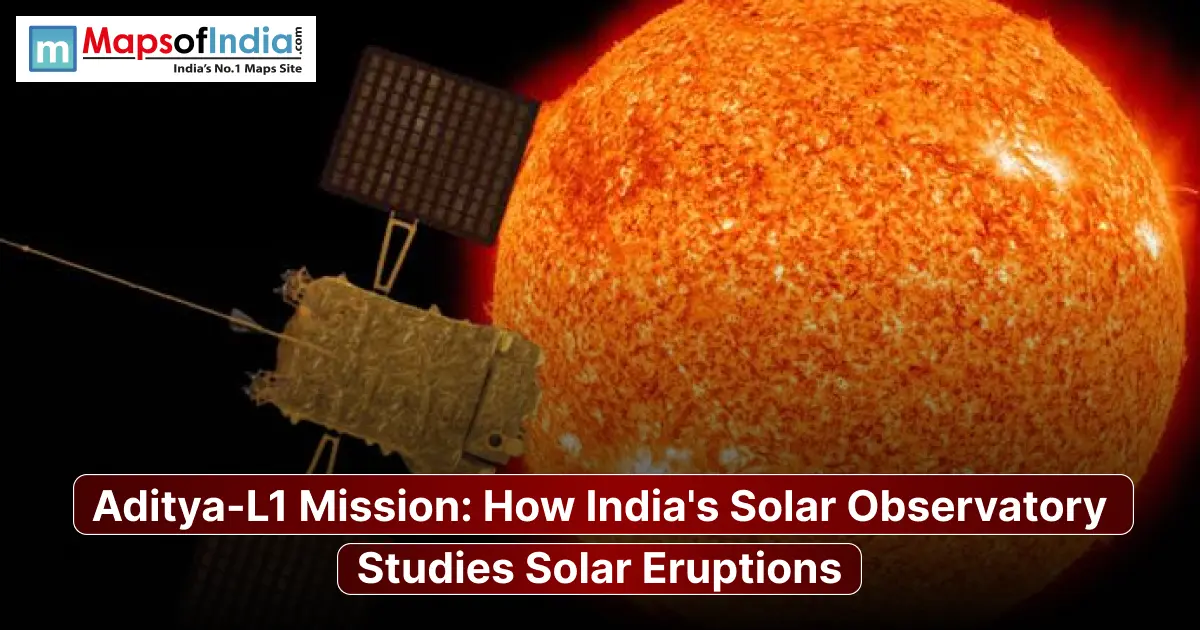
Aditya-L1 is ISRO's solar observatory. It sits near the Sun‑Earth L1 point, so it can watch the Sun all the time, looking at flares and coronal mass ejections. From that spot, Aditya-L1 studies the Sun’s layers and the particles and magnetic fields that flow past Earth. This gives India a view of space weather that now affects satellites, power grids and communications. This article explains what Aditya-L1 is, why it is placed at L1, what its seven instruments do, and what it has discovered since reaching orbit.
What Is the Aditya-L1 Mission?
Aditya-L1 is India’s solar observatory in space. ISRO built Aditya-L1 to study the Sun’s layers, solar flares and coronal mass ejections from about 1.5 million kilometres away from Earth.
The spacecraft was launched on a rocket on 2 September 2023. After 126 days, Aditya-L1 entered a halo orbit around the L1 point on 6 January 2024. ISRO built the spacecraft, and several Indian research groups, including the Indian Institute of Astrophysics (IIA), made the instruments. Aditya-L1’s main science aims are to learn how the Sun heats its atmosphere, how the solar wind speeds up where flares and CMEs begin, and how space weather moves toward Earth.
Why Was Aditya-L1 Placed at the L1 Lagrange Point?
Aditya-L1 was placed at the L1 Lagrange point because a Lagrange point is a spot in space where the pull from the Sun and Earth balances the motion of an object. This lets a spacecraft stay still relative to both bodies. The L1 point is directly between the Sun and Earth, giving Aditya-L1 an uninterrupted view of the Sun with no eclipses or the Earth or Moon blocking the view.
The main reason for this position is that Aditya-L1 can look at the Sun all the time. A spacecraft near Earth would lose sight of the Sun when it goes behind the planet. L1 is 1.5 million kilometres from Earth, so Aditya-L1 can observe the Sun almost continuously.
What Are Solar Eruptions?
Solar flares
Solar flares are bright bursts of radiation that come out when magnetic energy in the Sun’s atmosphere is released quickly. They usually happen near sunspot groups. Solar flares are ranked by strength, and the X‑class flares are the strongest.
Coronal mass ejections (CMEs)
Coronal mass ejections, or CMEs, are clouds of plasma and magnetic fields that leave the Sun’s corona. They often come with a flare, but not always. Unlike flares, which are mainly bursts of light, a CME is a real cloud of solar material that moves outward through space.
Solar wind and geomagnetic storms
Beyond eruptions, the Sun always sends out solar wind – a steady flow of charged particles. When a CME or a change in the wind reaches Earth, it can cause a geomagnetic storm, shaking Earth’s magnetic field and, in severe cases, damaging satellites and power grids.
Simply put, flares are bursts of radiation that reach Earth in minutes. CMEs are clouds of solar material that can take a day or more to arrive, but they often cause stronger space weather.
How Does Aditya-L1 Study Solar Eruptions?
Aditya-L1 uses more than one instrument. It combines images of the Sun’s layers with measurements of particles and magnetic fields that reach L1. Four of Aditya-L1’s remote‑sensing instruments look at the photosphere, chromosphere and corona in colours of light, and they can see an eruption as it starts and grows. Three of Aditya-L1’s in‑situ instruments measure the wind, particles and magnetic field once the activity has reached the spacecraft. Together, these tools let scientists follow an eruption from the Sun’s surface all the way to its impact in space.
Aditya-L1 Payloads and What Each One Does
Aditya-L1 carries seven instruments in total. Four are for sensing, and three are for in‑situ measurement.
VELC (Visible Emission Line Coronagraph).
VELC is an instrument on Aditya‑L1. It is an occulted coronagraph that takes images and spectra of the Sun’s corona, helping scientists see where and how CMEs start.
SUIT (Solar Ultraviolet Imaging Telescope).
SUIT takes pictures of the Sun’s surface and lower atmosphere in light, showing details that are hard to see from Earth.
SoLEXS (Solar Low Energy X‑ray Spectrometer).
SoLEXS watches X‑ray light from solar flares, noting how strong they are and when they happen.
HEL1OS (High Energy L1 Orbiting X‑ray Spectrometer).
HEL1OS records harder X‑ray bursts from flares, adding to SoLEXS’s X‑ray view.
ASPEX (Aditya Solar Wind Particle Experiment).
ASPEX measures particles that flow from the Sun, like protons and heavier ions, and tells their direction.
PAPA (Plasma Analyser Package for Aditya).
PAPA studies the makeup of wind plasma, especially electrons and heavy ions that reach L1.
Magnetometer (MAG).
The magnetometer measures the field in space at L1, tracking changes when CMEs and other solar events pass the spacecraft.
Scientific Findings So Far
Aditya‑L1 has been giving data steadily since it entered orbit. A big first was VELC’s spectroscopic view of a CME. IIA scientists and NASA worked together. They could estimate the CME mass at about 270 million tonnes. That is 180 times the mass of the Titanic iceberg. SUIT has taken near‑ and mid‑ultraviolet pictures of big X‑class flares such as the X‑6.3 flare in February 2024 and an X‑class flare on New Year’s Eve 2023. The magnetometer on the mission also saw changes in the space field during major solar events in 2024, including the May 2024 “Gannon” superstorm, which is one of the strongest geomagnetic storms in twenty years.
In October 2026, ISRO announced that scientists had data from Aditya‑L1’s VELC and ESA’s Proba‑3 mission. Proba‑3’s ASPIICS coronagraph had captured two CMEs in September 2025 from an angle. By mixing VELC’s measurements, which show the CME gas temperature and density, with ASPIICS’s sharp images of the CME shape and motion, researchers tightened the estimates of CME mass, density, and energy near the Sun. This shows how international teamwork can improve science.
Why Does Studying Solar Eruptions Matter?
Solar flares and CMEs are not just interesting to scientists; they affect life on Earth. Big geomagnetic storms can damage satellite electronics, make GPS inaccurate, disturb radio and communication and even stress power grids. Astronauts in space are at risk of radiation during big solar events. India uses satellites for navigation, communication and defence. Therefore, better space‑weather forecasts, which Aditya‑L1 helps provide, are vital to protect this infrastructure before a big eruption happens.
Aditya‑L1 Compared With Other Solar Missions
is one of a few missions designed only to look at the Sun. NASA’s Parker Solar Probe goes closer to the Sun to sample its outer atmosphere. The long‑running SOHO mission, made by NASA and ESA, also sits at L1. ESA’s Solar Orbiter takes an orbit to see the Sun’s poles. Aditya‑L1 is special not because of one tool. Because it combines many tools, it watches the Sun without interruption from L1. Carries instruments that see the Sun’s surface, its corona, and the particles and fields that reach that point. This lets it track one eruption from start to finish in one data set.
Conclusion
- Aditya‑L1 is India’s dedicated solar observatory. It was launched in September 2023. Has been working from a halo orbit around the Sun‑Earth L1 point since January 2024.
- The seven instruments on Aditya‑L1 work together. They look at the Sun’s atmosphere from afar and also measure the solar wind and magnetic fields that reach L1.
- The mission has already made scientific firsts. It gave the visible‑light spectroscopic view of a CME, and in October 2026 it produced the first combined CME data set with ESA’s Proba‑3.
- As India builds more satellites and space facilities, Aditya‑L1’s space‑weather data will become more useful for predicting events and protecting that infrastructure.
FAQs
What is the Aditya-L1 mission?
I find Aditya-L1 is the dedicated solar observatory built by ISRO. Aditya-L1 studies the atmosphere of the Sun, solar flares, and coronal mass ejections. Aditya-L1 is positioned in a halo orbit around the Sun‑Earth L1 Lagrange point.
When was Aditya-L1 launched?
I remember Aditya-L1 was launched on 2 September 2023 aboard a rocket. After 126 days of travel, Aditya-L1 reached its halo orbit around L1 on 6 January 2024.
Why is Aditya-L1 placed at L1 and not closer to the Sun?
I think the L1 point gives Aditya-L1 an unobstructed view of the Sun. At L1, there are no eclipses or occultations from Earth or the Moon. This advantage is more important for Aditya-L1's observation goals than the distance from the Sun.
How many payloads does Aditya-L1 have?
Aditya-L1 carries seven payloads. Four are remote‑sensing instruments: VELC, SUIT, SoLEXS and HEL1OS. Three are in‑situ instruments: ASPEX, PAPA and a magnetometer.
How does Aditya-L1 detect coronal mass ejections?
The VELC payload on Aditya-L1 images the corona and performs spectroscopy to catch coronal mass ejections as they form. The in‑situ instruments on Aditya-L1 measure particles and magnetic field disturbances once a CME’s effects reach the spacecraft at L1.
Can solar eruptions affect life on Earth?
Yes. I think strong solar eruptions can disrupt satellites, reduce GPS accuracy, interfere with radio communications, and strain power grids. Tracking these eruptions is important for space weather forecasting.
Is Aditya-L1 going to land on the Sun?
No. Aditya-L1 observes the Sun from about 1.5 million km away at the L1 Lagrange point. Aditya-L1 is not designed to approach or land on the Sun.