

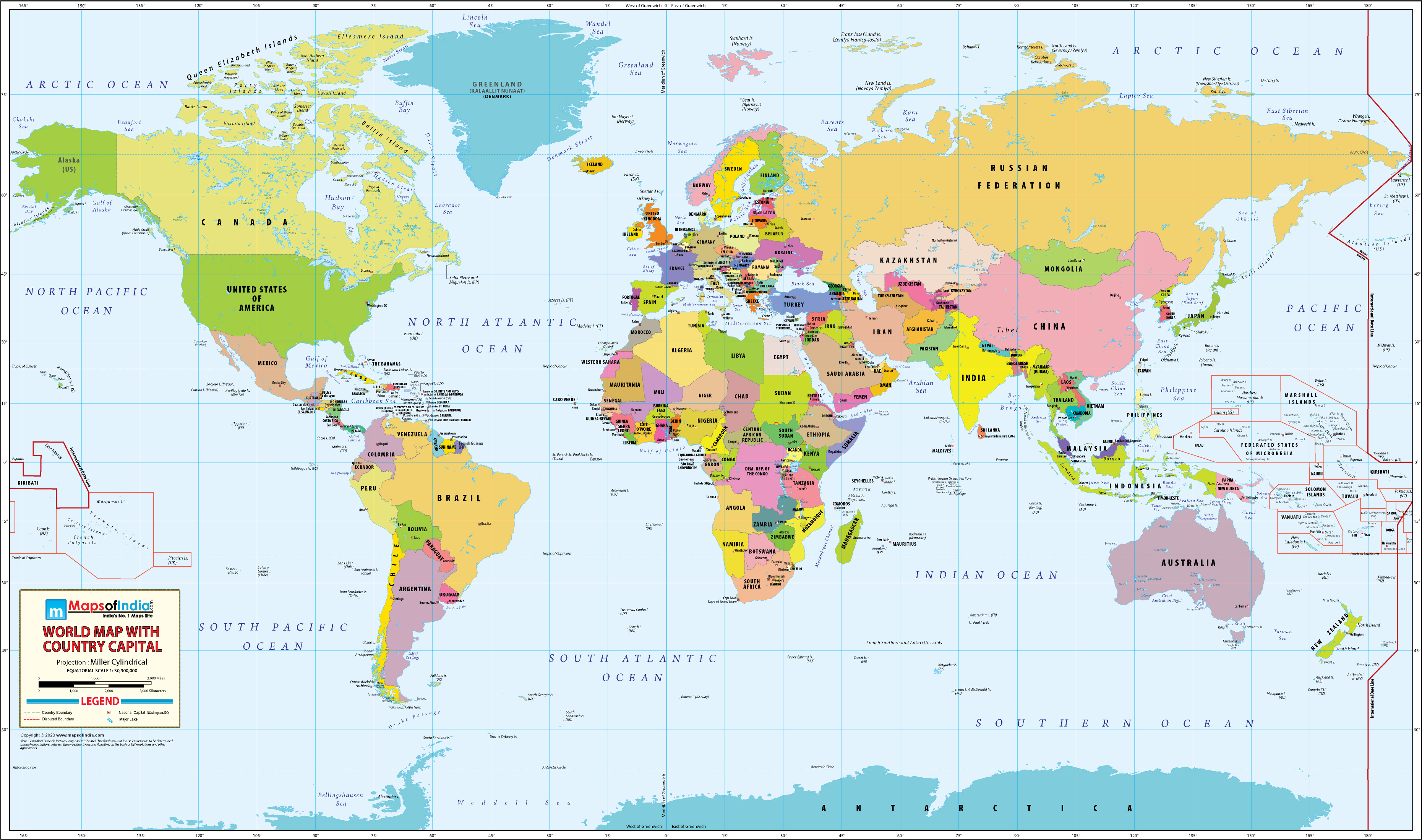



Countries and their capitals
Countries are well-defined territories that share a feeling of belongingness even in the midst of having a variety of cultures. These regions are recognized by international organizations, and they have well defined boundaries. Although they might be similar in principle, they vary in size, population, economy, culture, and political philosophies.
Most countries have one capital. Only a small number have multiple capitals (e.g., South Africa, Bolivia, Eswatini), which are primarily cities or towns that are designed to accommodate within themselves the seats of government.They are, in most cases larger than other cities, the most economically prosperous or the most well connected part of the country. Such regions are typically centers of politics, administration, culture, and history, which in itself portrays the unique identity of the nation. They often stand as symbols of national identity and unity.
When viewed on a world map, the relationship between countries and their capitals becomes easier to understand from a geographical perspective.
Capitals are mainly chosen for many reasons including historical, political, strategic, economic, geographic, or administrative considerations. and are easily accessible to the masses, and along with this, they have access to resources, transportation, or borders. The region might also be representative of the freedom struggle movements, or in the case of countries that were always independent, it might have cultural significance. This aspect also provides a symbolic meaning to the capitals, as they are seen as the centers of the country.
However, another aspect remains to be explored. In the case of several countries, it has been witnessed that there has been a change in the capitals. There can be some notable reasons that account for this change: as a factor of political changes that are set into motion due to independence, mergers, or regime shifts; as a result of economic changes; or due to the large-scale migration of people to another part of the country. In addition to this, it can also be caused by the catastrophic forces of nature or by environmental factors.
Historical Aspect
Empires had often witnessed developments in several regions, and each ruler favored a different view of development. Due to this, such rulers often shifted their capitals from one region to another for ease of administration. However, after the countries gained independence, there was a tendency to shift capitals. In addition to this, the processes of modernization and urbanization have transformed capitals into localities that bring together the best of politics, economy, and culture. For example, Cairo, the capital of Egypt, is an ancient city that is famous for the tombs and mummies that are significant for its history. The city occupies a strategic location near the junction of Africa and Asia and serves as an important gateway to the Mediterranean region.
Geographical Prominence
Capitals can also be situated at strategic points that are in close proximity, such as rivers, coastlines, or borders. The availability of natural resources also gives an edge to the region and influences the setup of major industrial and manufacturing- based factories, which can indulge in large-scale production. The urban planning of the city influences the drainage as well as the architecture of the region, and it is also greatly reflected in the local culture and the history of the region. For example, the capital of Brazil, Brasilia, is a planned capital that showcases modernist architecture and urban design. Another example can be the case of Tokyo, the capital of Japan, whose location within Japan's island geography and surrounding mountainous terrain has influenced its urban development and relationship with nature.
Political Presence
The nation’s sovereignty is reflective of the belief systems and ideologies of its population which embrace free will and the final choice rests with the active citizens, mostly. It also hosts several diplomatic missions and serves as the meeting point for various delegates. They are also the center of contestations, power struggles, protests, and social movements.
Cultural Importance
Capitals also act as a safehouse to preserve national heritage, history, and cultural institutions. They also display an inventory of local arts, architecture, cuisine, and traditions. They are also the base of educational research and innovation, shaping national intellectual life. Further, the major institutions of governance, learning, and other suitable activities also find a home in the capital. For example, the capital city of Paris in France is known as the City of Light and is famous for its art, fashion, cuisine, and architecture.
Economic Hub
Typically serving as economic hubs, the regions are laced with industries, setups of the service sector, and infrastructure. Being such centers, they also attract investment from foreign ventures, bring in tourism from various other territories, and are the major drivers of national growth and development. They often face challenges like congestion, inequality, and environmental degradation. This can also be because of large-scale deforestation activities and population explosions.
Significance of boundaries
Boundaries are significant not just for the demarcation of the exclusive area of the country within which it has full authority in conducting its affairs but also serves for distinctions in terms of the administration and its physicalities. The boundaries can also be of various kinds, such as physical, administrative, and cultural. Physical boundaries are concerned with geographical features such as rivers, mountains, and coastlines. For example, the Potomac River acts as a boundary for the city of Washington, D.C., USA. In addition to this, it is also marked by state lines and the Beltway Highway.
For administrative purposes, the country can be divided into states, and the states into city and municipal corporations. It was also segregated into different districts, wards, and neighborhoods, which can serve the purpose of building better connections between the political representatives of the region and the population. The capital of Beijing is distinguished and serves as a boundary differentiated by the Great Wall, mountains, and administrative districts.
Cultural boundaries are also present and mark the distinct identity of the region enclosed. The architectural styles and landmarks give the capital an edge in terms of its tourism.
Boundaries can shape a capital’s mark and heavily influence its development, as well as impact the daily lives of its citizens. These boundaries are usually fluid and are subject to change if found to be viable by the governing authorities. These changes can also occur due to urbanization and growth. Such divisions can also cause divisions and conflicts among people who strive to advance their conditions by occupying significant territorial locations.
Alphabetical list of all countries and capitals of the world
| Country | Capital city | |
|---|---|---|
| A | ||
| Afghanistan | Kabul | |
| Albania | Tirana | |
| Algeria | Algiers | |
| Andorra | Andorra la Vella | |
| Angola | Luanda | |
| Antigua and Barbuda | Saint John's | |
| Argentina | Buenos Aires | |
| Armenia | Yerevan | |
| Australia | Canberra | |
| Austria | Vienna | |
| Azerbaijan | Baku | |
| B | ||
| Bahamas | Nassau | |
| Bahrain | Manama | |
| Bangladesh | Dhaka | |
| Barbados | Bridgetown | |
| Belarus | Minsk | |
| Belgium | Brussels | |
| Belize | Belmopan | |
| Benin | Porto-Novo | |
| Bhutan | Thimphu | |
| Bolivia | Sucre(de jure),La Paz(seat of government) | |
| Bosnia and Herzegovina | Sarajevo | |
| Botswana | Gaborone | |
| Brazil | Brasilia | |
| Brunei | Bandar Seri Begawan | |
| Bulgaria | Sofia | |
| Burkina Faso | Ouagadougou | |
| Burundi | Gitega | |
| C | ||
| Cabo Verde | Praia | |
| Cambodia | Phnom Penh | |
| Cameroon | Yaounde | |
| Canada | Ottawa | |
| Central African Republic | Bangui | |
| Chad | N'Djamena | |
| Chile | Santiago | |
| China | Beijing | |
| Colombia | Bogota | |
| Comoros | Moroni | |
| Congo, Democratic Republic of the | Kinshasa | |
| Congo, Republic of the | Brazzaville | |
| Costa Rica | San Jose | |
| Cote d'Ivoire | Yamoussoukro | |
| Croatia | Zagreb | |
| Cuba | Havana | |
| Cyprus | Nicosia | |
| Czechia | Prague | |
| D | ||
| Denmark | Copenhagen | |
| Djibouti | Djibouti (city) | |
| Dominica | Roseau | |
| Dominican Republic | Santo Domingo | |
| E | ||
| Ecuador | Quito | |
| Egypt | Cairo | |
| El Salvador | San Salvador | |
| Equatorial Guinea | Malabo(de jure),Oyala(seat of government) | |
| Eritrea | Asmara | |
| Estonia | Tallinn | |
| Eswatini(formerly Swaziland) | Mbabane(administrative),Lobamba(legislative, royal) | |
| Ethiopia | Addis Ababa | |
| F | ||
| Fiji | Suva | |
| Finland | Helsinki | |
| France | Paris | |
| G | ||
| Gabon | Libreville | |
| Gambia | Banjul | |
| Georgia | Tbilisi | |
| Germany | Berlin | |
| Ghana | Accra | |
| Greece | Athens | |
| Grenada | Saint George's | |
| Guatemala | Guatemala City | |
| Guinea | Conakry | |
| Guinea-Bissau | Bissau | |
| Guyana | Georgetown | |
| H | ||
| Haiti | Port-au-Prince | |
| Honduras | Tegucigalpa | |
| Hungary | Budapest | |
| I | ||
| Iceland | Reykjavik | |
| India | New Delhi | |
| Indonesia | Jakarta | |
| Iran | Tehran | |
| Iraq | Baghdad | |
| Ireland | Dublin | |
| Israel | Jerusalem | |
| Italy | Rome | |
| J | ||
| Jamaica | Kingston | |
| Japan | Tokyo | |
| Jordan | Amman | |
| K | ||
| Kazakhstan | Astana | |
| Kenya | Nairobi | |
| Kiribati | Tarawa | |
| Kosovo | Pristina | |
| Kuwait | Kuwait City | |
| Kyrgyzstan | Bishkek | |
| L | ||
| Laos | Vientiane | |
| Latvia | Riga | |
| Lebanon | Beirut | |
| Lesotho | Maseru | |
| Liberia | Monrovia | |
| Libya | Tripoli | |
| Liechtenstein | Vaduz | |
| Lithuania | Vilnius | |
| Luxembourg | Luxembourg (city) | |
| M | ||
| Madagascar | Antananarivo | |
| Malawi | Lilongwe | |
| Malaysia | Kuala Lumpur(official capital), Putrajaya (administrative capital) | |
| Maldives | Male | |
| Mali | Bamako | |
| Malta | Valletta | |
| Marshall Islands | Majuro | |
| Mauritania | Nouakchott | |
| Mauritius | Port Louis | |
| Mexico | Mexico City | |
| Micronesia | Palikir | |
| Moldova | Chisinau | |
| Monaco | Monaco | |
| Mongolia | Ulaanbaatar | |
| Montenegro | Podgorica | |
| Morocco | Rabat | |
| Mozambique | Maputo | |
| Myanmar(formerly Burma) | Naypyidaw | |
| N | ||
| Namibia | Windhoek | |
| Nauru | Yaren District(de facto) | |
| Nepal | Kathmandu | |
| Netherlands | Amsterdam (constitutional capital), The Hague (seat of government) | |
| New Zealand | Wellington | |
| Nicaragua | Managua | |
| Niger | Niamey | |
| Nigeria | Abuja | |
| North Korea | Pyongyang | |
| North Macedonia(formerly Macedonia) | Skopje | |
| Norway | Oslo | |
| O | ||
| Oman | Muscat | |
| P | ||
| Pakistan | Islamabad | |
| Palau | Ngerulmud | |
| Palestine | Jerusalem (East) | |
| Panama | Panama City | |
| Papua New Guinea | Port Moresby | |
| Paraguay | Asuncion | |
| Peru | Lima | |
| Philippines | Manila | |
| Poland | Warsaw | |
| Portugal | Lisbon | |
| Q | ||
| Qatar | Doha | |
| R | ||
| Romania | Bucharest | |
| Russia | Moscow | |
| Rwanda | Kigali | |
| S | ||
| Saint Kitts and Nevis | Basseterre | |
| Saint Lucia | Castries | |
| Saint Vincent and the Grenadines | Kingstown | |
| Samoa | Apia | |
| San Marino | San Marino | |
| Sao Tome and Principe | Sao Tome | |
| Saudi Arabia | Riyadh | |
| Senegal | Dakar | |
| Serbia | Belgrade | |
| Seychelles | Victoria | |
| Sierra Leone | Freetown | |
| Singapore | Singapore | |
| Slovakia | Bratislava | |
| Slovenia | Ljubljana | |
| Solomon Islands | Honiara | |
| Somalia | Mogadishu | |
| South Africa | Pretoria(administrative),Cape Town(legislative),Bloemfontein(judicial) | |
| South Korea | Seoul | |
| South Sudan | Juba | |
| Spain | Madrid | |
| Sri Lanka | Sri Jayawardenepura Kotte (legislative capital), Colombo (executive and commercial capital) | |
| Sudan | Khartoum | |
| Suriname | Paramaribo | |
| Sweden | Stockholm | |
| Switzerland | Bern | |
| Syria | Damascus | |
| T | ||
| Taiwan | Taipei | |
| Tajikistan | Dushanbe | |
| Tanzania | Dodoma | |
| Thailand | Bangkok | |
| Timor-Leste | Dili | |
| Togo | Lome | |
| Tonga | Nuku'alofa | |
| Trinidad and Tobago | Port of Spain | |
| Tunisia | Tunis | |
| Turkey | Ankara | |
| Turkmenistan | Ashgabat | |
| Tuvalu | Funafuti | |
| U | ||
| Uganda | Kampala | |
| Ukraine | Kyiv(also known as Kiev) | |
| United Arab Emirates | Abu Dhabi | |
| United Kingdom | London | |
| United States of America | Washington, D.C. | |
| Uruguay | Montevideo | |
| Uzbekistan | Tashkent | |
| V | ||
| Vanuatu | Port Vila | |
| Vatican City (Holy See) | Vatican City | |
| Venezuela | Caracas | |
| Vietnam | Hanoi | |
| Y | ||
| Yemen | Sana'a | |
| Z | ||
| Zambia | Lusaka | |
| Zimbabwe | Harare | |
FAQs
Q1: What is a world map with countries and capitals?
A world map with countries and capitals shows the political boundaries of countries and the location of their capital cities.
Q2: How many countries are there in the world?
There are 195 widely recognized sovereign countries in the world, including 193 UN member states and 2 observer states
Q3: Can a country have more than one capital?
Yes. Some countries have multiple capitals that serve different administrative or governmental functions.
Q4: Why do countries have capital cities?
Capital cities serve as the main centers for government, administration, and national decision-making.
Q5: What is the difference between a country and its capital?
A country is a sovereign nation, while its capital is the city where the central government is located.
Q6: Which continent has the most countries?
Africa has the most countries, with 54 sovereign nations.
Q7: What can you learn from a world map with countries and capitals?
A world map helps you identify countries, their capitals, neighboring nations, and their location on different continents.
Last Updated on: July 06, 2026

