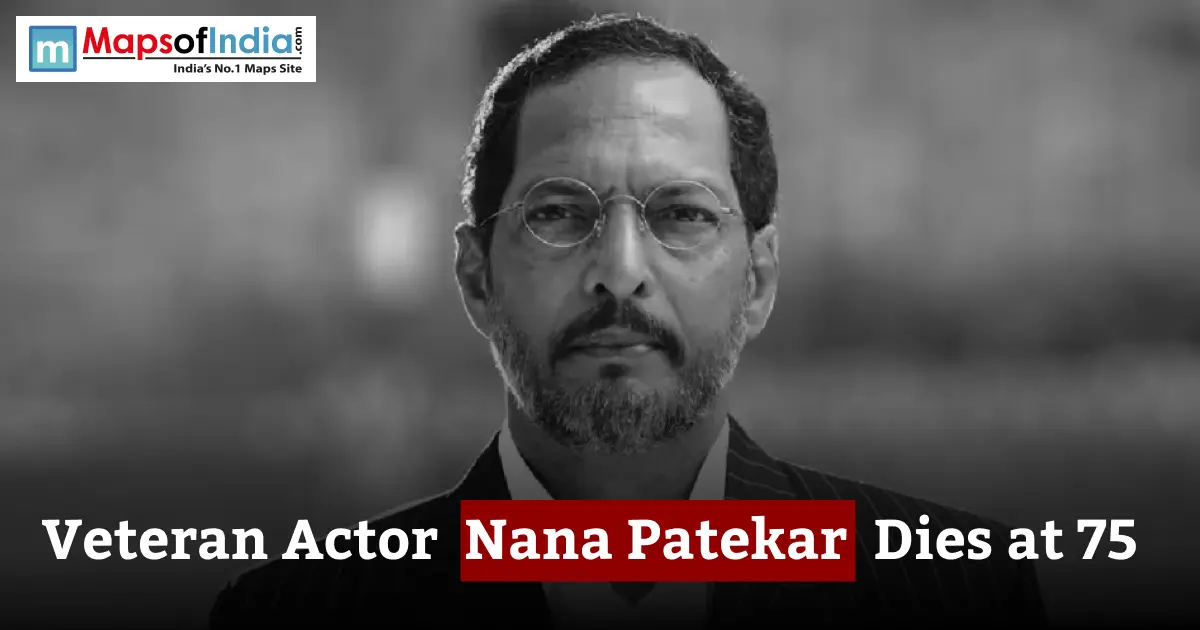
Veteran Indian actor Nana Patekar has died at the age of 75 after suffering a severe cardiac arrest at his residence in Dona Paula, Goa, on Thursday, October 8, 2026. Patekar was a unique personality in the Hindi and Marathi film industry for his portrayal of intense acting, strong delivery of dialogues, and fantastic performances that he did over the several decades of his film career.
The actor was reportedly found unconscious in his home in Goa at about 4 a.m. on Thursday and was rushed to Manipal Hospital. He was not resuscitable despite continuous cardiopulmonary resuscitation (CPR) by doctors. A medico-legal case has been opened, and a post-mortem examination is expected to give more details.
Nana Patekar Dies After Cardiac Arrest
Nana Patekar reportedly suffered a cardiac arrest at his residence in Dona Paula, Goa. Doctors tried to revive the actor for about 45 minutes but failed. According to doctors at Manipal Hospital reports he was declared dead at around 5:20am.
As per reports, Patekar had complained of discomfort and pain on the left side of his chest in the early morning hours of his death. A friend was contacted and subsequently approached his home, at which point medical assistance was sought. He was then rushed to hospital.
The cause of his death is likely to be known as a result of the post-mortem procedure. Several reports have said that the incident involved a heart attack or cardiac arrest, but the final official medical report has yet to come through.
Nana Patekar's Early Life and Acting Career
Born Vishwanath Patekar on January 1, 1951, Nana Patekar began his artistic journey through Marathi theatre before establishing himself as an actor in Indian cinema. His first compositions were inspired by his intensity and realism, which were later closely linked to his performances.
Patekar started his career in the film industry with Gaman in 1978, and slowly emerged into fame through Marathi and Hindi films. He was able to play complex, serious and deeply emotional roles, setting him apart from many of his peers.
He grew to be a well-known figure in both Bollywood as well as the parallel Indian film industry in the years that followed. His acting was often intense and featured a screen presence that was unique to him, and his delivery of his dialogue evolved into a strength.
Nana Patekar's Most Notable Films
In his prolific career, Nana Patekar featured in several critically acclaimed as well as commercially successful movies. He has made some of his iconic films like Parinda, Krantiveer, Prahaar, Agni Sakshi, Khamoshi: The Musical, Salaam Bombay! and Welcome.
His work in the movie Parinda garnered him a lot of praise and proved his aptitude for the character of a complex nature. He is also an award-winning actor, having also received the National Film Award for Best Actor for Krantiveer.
Patekar was also very versatile in his comic roles. He was brought to a younger generation in the 2007 comedy Welcome, where he played Uday Shetty.
He didn't work only in Hindi films. He remained closely involved with Marathi film and theatre and has starred in several films and dramas such as Natsamrat, the character of an old-age theatre actor, which received special acclaim.
Awards and Recognition
During his career, Nana Patekar has won several big awards. His performances won him three National Film Awards, including the Best Actor award for Krantiveer. He also won Filmfare Awards for Hindi movies.
Government of India awarded him the Padma Shri in 2013 for his work in the field of arts. His career was one of unprecedented commercial and critical acclaim and socially relevant cinema.
In addition to acting, Patekar was also a writer and director. His acting career is not the only aspect of filmmaking that he was involved in; he also directed the 1991 film Prahaar: The Final Attack.
Nana Patekar and Social Work
Away from cinema, Nana Patekar was also involved with social causes, having connections with farmers and the rural population. He got involved with the Naam Foundation, a body that works on issues concerning the farmers and rural areas in Maharashtra.
His social work was another facet of his public career. Much of this work has been done in the background of mainstream entertainment, but his film career was not so noticeable at all.
Patekar also had a connection with the Indian Army and was reportedly a visitor and supporter of the military during the 1999 Kargil War. His relationship with the military also attracted his attention in the public sphere.
Nana Patekar's Legacy in Indian Cinema
Nana Patekar has left behind a special legacy in Indian cinema. He took a realistic approach to his acting, was often highly emotional, and could project a strong emotional response without overusing traditional dramatic methods.
He was a great star in films like Parinda and Krantiveer, but also in comic roles like Welcome. His films in Marathi, Hindi, and theatre enabled him to connect with people from different groups and generations.
His character was admired as well for his commanding delivery of dialogue. Some of his dialogues and performances are still remembered even after years have passed since the films they were used in.
Nana Patekar's Contribution to Marathi and Hindi Cinema
Patekar's career is a testament to the close ties between Marathi theatre, regional films, and mainstream Hindi films. He had an eclectic background in theatre, and this influenced his style of acting; some of his performances were natural and intense.
Though Bollywood gave him national fame, Bollywood didn't stop him from working in Marathi movies, and he was also involved in the cultural and theatrical activities of the State. The role of Natsamrat was of great value to him and cemented his place as a big name in Marathi cinema.
He also showed that an actor could thrive in the art-house, commercial, theatre, and socially conscious film and television sectors and could also switch easily between the various sectors.
Tributes to Nana Patekar
The reaction to Nana Patekar's death has been heard from all quarters of the Indian film industry and his fans. He has been remembered by the film industry and the audience for his exceptional acting skills, unique personality, and his impact on Indian cinema.
His death at 75 marks the end of a remarkable career that extended for nearly five decades. From his early theatre work and films in the late 1970s to his later appearances in major Hindi and Marathi productions, Patekar remained an influential figure in Indian entertainment.
Nana Patekar's performances will continue to be remembered for their emotional depth, powerful screen presence and versatility. His contribution to Indian cinema extends beyond individual films, making him one of the most recognisable and respected actors of his generation.
FAQs
1. When did Nana Patekar die?
Nana Patekar died on October 8, 2026, at the age of 75. The veteran actor passed away in Goa after suffering a cardiac arrest at his residence.
2. What was the cause of Nana Patekar's death?
Nana Patekar died after suffering a severe cardiac arrest. Doctors attempted to revive him with CPR for around 45 minutes, but he could not be revived.
3. How old was Nana Patekar when he died?
Nana Patekar was 75 years old when he died. He was born on January 1, 1951, and passed away on October 8, 2026.
4. Where did Nana Patekar die?
Nana Patekar suffered cardiac arrest at his residence in Dona Paula, Goa. He was subsequently taken to Manipal Hospital, where doctors attempted to revive him.
5. What are Nana Patekar's most famous movies?
Some of Nana Patekar's most famous films include Parinda, Krantiveer, Agni Sakshi, Prahaar, Ab Tak Chhappan, Khamoshi: The Musical and Welcome. He was known for both intense dramatic performances and comic roles.
6. How many National Awards did Nana Patekar win?
Nana Patekar won three National Film Awards during his career. He received awards for his performances in Parinda, Krantiveer and Agni Sakshi.
7. What was Nana Patekar's last film?
Nana Patekar continued working in films in the years before his death. His recent screen appearances included projects such as Housefull 5, Subedaar, and O'Romeo.