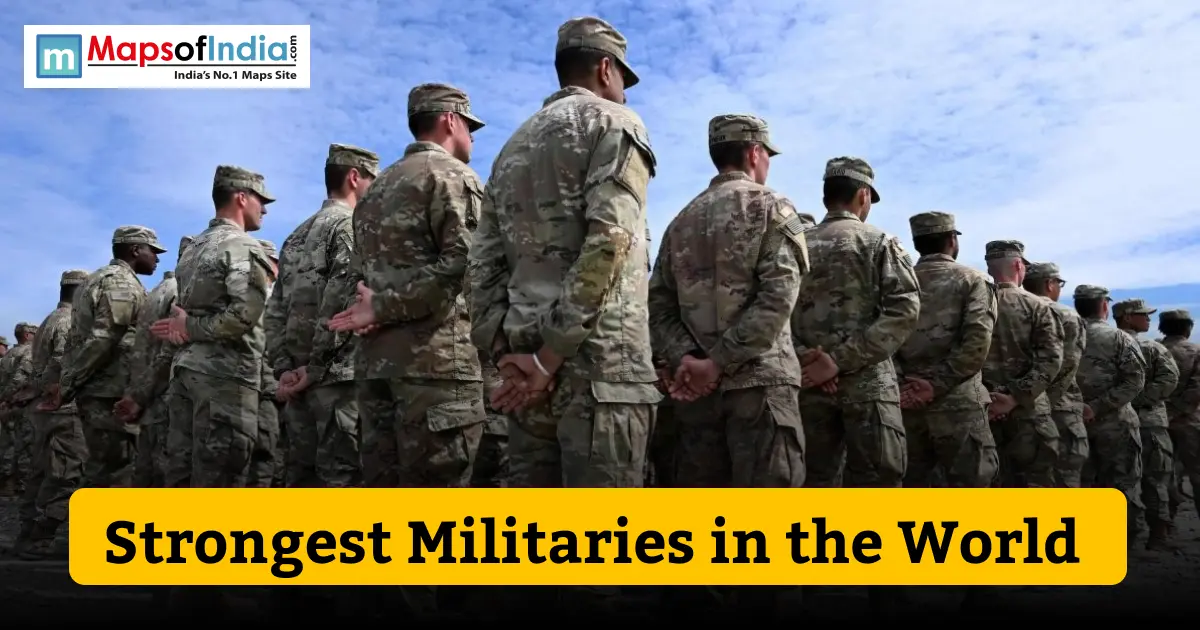
Nine nuclear-armed nations around the world, in 2026, have a total combined arsenal of roughly 12,300 warheads. Global defence spending has reached its high, crossing an estimated $2.9 trillion. But these numbers are not the only factor that decides the strongest military power. Military strength is achieved by many things combined, like manpower, budget, technology, nuclear capability, and the ability to send forces far from home. In this article, I will be using the 2026 military strength index methodology (primarily the Global Firepower model, cross-checked against SIPRI and FAS data). That will help to identify the strongest militaries in the world. Also, to study what factors are taken into consideration in the global military ranking, and to compare the top 10 armies in the world.
What Makes a Military "Strong"?
Active & Reserve Personnel
While raw numbers of troops are still relevant for ongoing ground operations, occupation, and disaster response, contemporary indices will evaluate available and fit-for-service manpower rather than simply numbers.
Defense Budget & Spending
The data on the Defence budget by country gathered from SIPRI, IISS, or national announcements shows what a country can actually buy, train, and maintain. This is done by varying purchasing power between economies.
Nuclear Capabilities
The size of a conventional force is a separate strategic deterrent layer from warheads and delivery systems (ICBMs, submarines, bombers).
Air, Naval & Land Power
Weighing in on fighter jets, planes, submarines, tanks, and artillery is by the numbers, more and more, by quality, readiness, and the ability to work with allies.
Technology & Domestic Defence Industry
Long-term strategic independence is an increasing factor in the rankings, with the ability to design and manufacture advanced weapons domestically being a growing part of this.
Top 10 Strongest Militaries in the World
1. United States
The US remains the world's most powerful army. It has 1.33 million active troops and 2.13 million reserves. In 2025-26, its defence spending is estimated to be close to $954 billion (SIPRI), and with supplemental spending, it will soon exceed $1 trillion, more than all the next several countries put together. Unique advantage: unparalleled carrier fleet and worldwide basing network, in all oceans.
2. Russia
Russia has the world's largest nuclear stockpile. which is about to have 5,459 total warheads. Russia spend 7% of its GDP on defence expenses, which has reached approximately $190–212 billion. The Russian military has the biggest tank and artillery force of any country.
3. China
China has the world's largest standing force of 2,000,000 active military personnel, and the speed with which the Chinese navy has grown in size has outstripped that of the US Navy, with China now having more hulls than the US Navy. Of the defence spending, $277 to $336 billion is estimated (official vs. SIPRI adjusted). Distinguished strengths: the fastest-growing nuclear arsenal, with estimated nuclear stockpiles of up to 600 warheads in 2026.
4. India
India is 4th in the ranking with about 1.45M military active and defence spending $92-109B. Prominent feature: two-front deterrence capability with an estimated 180-190 nuclear warheads and a rapidly growing domestic arms industry.
5. South Korea
With an active military force of approximately 500,000 and a defence budget of nearly $50 billion, South Korea has been constructed almost solely around the threat of North Korea. Notable strength: one of the highest ratios of troops to population among the big powers and an advanced missile defence and artillery counter system.
6. France
France has ~200,000 active soldiers supported by an estimated 290 nuclear warheads and a budget of ~$68 billion. Notable strength: full independent nuclear triad and strong power projection in Africa/Indo-Pacific.
7. Japan
Japan's active force of 247,000 and budget of ~$62 billion represent a historically low and rapidly modernizing force. Distinguished strength: One of the world's most modern navies, growing due to new defence spending pledges.
8. United Kingdom
The UK maintains approximately 150,000 active military service members, some 225 nuclear warheads, and a defence spending budget of approximately $89 billion. Notable achievements: the world's leading nuclear-powered submarine force and NATO's second-largest defence contribution.
9. Turkiye
Turkiye's military strength is about 355,000 personnel (plus ~379,000 reserve personnel) backed by a rapidly growing national defence industry. Distinctive strength: ability to manufacture its own fighter planes, drones, and main battle tanks at a large volume. The Bayraktar drones are heavily exported.
10. Italy
Italy rounds out the top 10 with some 165,500 active personnel and a defence expenditure of $41–48 billion, which is markedly higher in real terms as it strives to meet the NATO 5%-of-GDP spending target. Notable strength: leading role in EU shipbuilding and in NATO Mediterranean operations.
Military Strength Comparison Table
Country | Active Personnel | Defence Budget (approx.) | Nuclear Warheads | Global Ranking |
| United States | 1,328,000 | $954B–$1T | ~5,177 | 1 |
| Russia | ~1,330,000 | $190–212B | ~5,459 | 2 |
| China | ~2,035,000 | $277–336B | ~600 | 3 |
| India | ~1,450,000 | $92–109B | ~180 | 4 |
| South Korea | ~500,000 | ~$50B | 0 | 5 |
| France | ~200,000 | ~$68B | ~290 | 6 |
| Japan | ~247,000 | ~$62B | 0 | 7 |
| United Kingdom | ~150,000 | ~$89B | ~225 | 8 |
| Turkiye | ~355,000 | ~$40B | 0 (hosts NATO warheads) | 9 |
| Italy | ~165,500 | ~$41–48B | 0 (hosts NATO warheads) | 10 |
Countries with the Largest Nuclear Arsenals
Of the nine nuclear powers listed, two dominate: Russia and the United States. Both control roughly 87% of the world's total nuclear inventory. Russia holds an estimated 5,459 total warheads, the US around 5,177. China trails well behind at roughly 600, but is expanding faster than any other nuclear state. Its stockpile has grown by an estimated 20 warheads in the past year alone. France (~290) and the UK (~225) round out the recognized Western nuclear powers, while India (~180), Pakistan (~170), Israel (~90, undeclared), and North Korea (~50–60) make up the remaining arsenal.
Defence Spending vs. Military Strength: Is Bigger Budget Always Better?
Not always. A dollar spent on American F-35 maintenance buys something very different from a dollar spent on Russian conscript wages or Chinese state-subsidized shipbuilding. Purchasing-power gaps mean raw defence budget by country figures can overstate or understate real capability. Russia's Ukraine campaign has shown that mass and industrial-base depth can offset a smaller nominal budget, while high-spending countries with ageing procurement pipelines (or heavy personnel-cost burdens) don't always convert dollars into readiness efficiently. Budget size predicts capacity, not automatically effectiveness; training quality, logistics, and combat experience matter just as much.
Regional Military Powers to Watch
Emerging Powers: Turkiye, Indonesia, Iran
Outside of the top 10, regional influence is being rapidly created by many countries. Turkey has already secured its name in the top 10 countries thanks to its domestic drone and armour industry. Indonesia has the biggest military in Southeast Asia in terms of manpower. It is also spending a lot on naval modernization to protect its archipelagic waters. Iran's military budget is relatively small, but it has adopted a strategy of missile and asymmetric power rather than parity, and is a major regional player.
Conclusion
- In 2026, the United States, Russia and China will continue to be the world's three largest militaries, a fact that remains consistent with previous years.
- India is a formidable Number 4, and the rest of the top five completes with the strength of focused regional deterrence from South Korea.
- With its domestic defence industry, Turkiye has surpassed traditional European powers to enter the top 10.
- Nuclear Arsenal remains concentrated; The USA and Russia possess about 87% of the world's warheads.
- Methodology reminder: these rankings are based on a combination of manpower, budget, nuclear power, conventional military forces and technology; none of this is a one-size-fits-all affair with a single determinant of “strongest.”
FAQs
Which nation in the world is the most powerful militarily?
The United States, according to the 2026 Global Firepower Index. The ranking is based on the nations as a function of their budget, technology and global reach.
What is the Global Firepower Index?
An annual rating system ranking more than 145 countries based on over 60 factors such as manpower, equipment, budget and geography, to arrive at a composite score that represents military strength
Does nuclear power automatically mean a stronger military?
No, there is strategic deterrence with nuclear weapons, but manpower, equipment and money are much more important in conventional rankings, and several nuclear powers do not appear in the top 10.
How is military strength different from military size?
Size is numbers or equipment; strength factors are in training, technology, budget, logistics and readiness. A smaller force that is better equipped can outrank a larger force.
Which countries are increasing defence spending fastest?
In 2026, the largest increase in military spending is seen in European NATO members (particularly Germany and Poland). In the Asia-Pacific countries, Japan and South Korea are leading the charge.
Why are some countries with nuclear weapons not included in the top 10 countries?
The primary input is one of many, and nuclear warheads are a strategic factor. It is not only about nuclear weapons, but there are also countries that have nuclear weapons but are not in the top 10 because their conventional manpower and budgets are smaller when compared with the leading conventional powers, and also their technological base is smaller.
Is it possible for a country to have a rapid change in rank in the military?
Yes. The position a country holds on the list of defence spending can change in a span of 1-2 years due to various factors such as sudden hikes in defence spending, new arms deals, advances in technology or war. The latest example of such a turnaround is the domestically made drones that have made Turkiye the top 10.
Do alliances like NATO affect individual country rankings?
Individual rankings usually relate to a country's own forces, but in practice, alliances such as NATO have nuclear forces deployed in nations that do not have them, which provide enhanced military power through the force being collectively deployed.