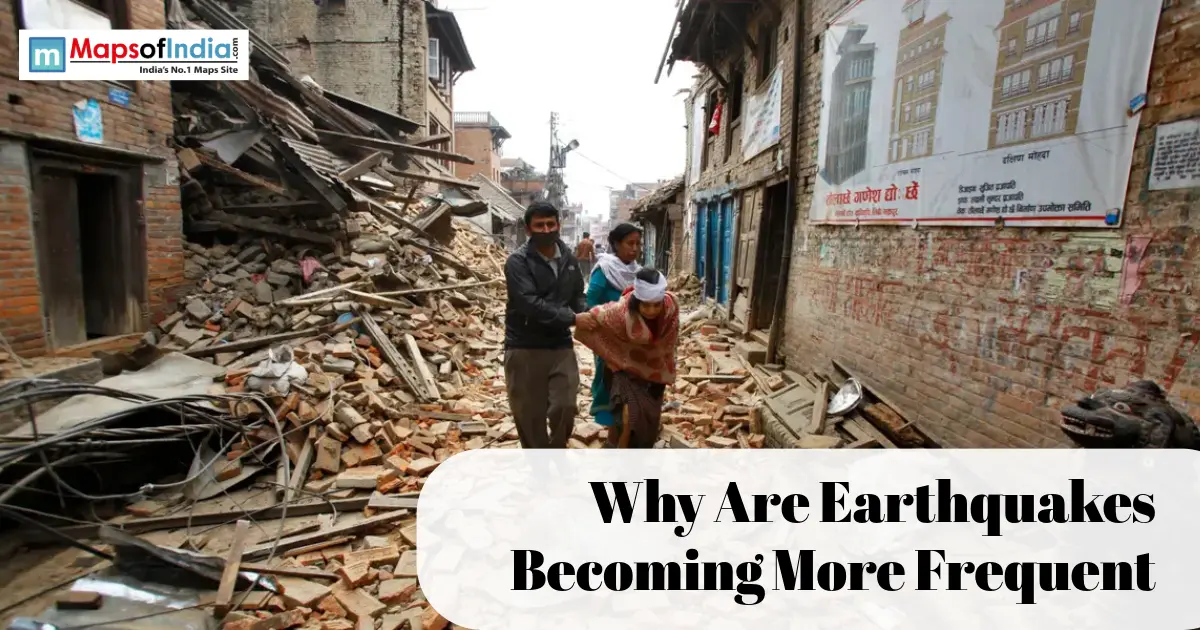
The blocks of the Earth's crust slide, or fault, past each other along a fault plane to cause earthquakes. These movements create energy, which is then released in the form of seismic waves. It can happen anywhere, but is most commonly seen at the boundaries of huge tectonic plates. New Zealand, Japan, Alaska, California, Mexico and Chile are areas where earthquakes tend to occur the most, known as the Pacific Ring of Fire. Other important earthquake belts include regions such as Turkey, Iran, the Mediterranean and the Himalayas. While earthquakes have occurred throughout the history of the Earth, their occurrence rate could be affected in addition by the total population increase and the capacity of the media to identify and report earthquakes. The knowledge of the causes and locations of earthquakes is crucial for proper preparation.
Are Earthquakes Actually Becoming More Frequent?
This has been confirmed by the data from the USGA, USGS and BGS of big earthquake events. The studies made on such data, which have changed only slightly over 100 years, with an average of 15-16 per year, have hardly increased the number of such magnitude earthquakes. The development of technology has enabled us to detect and find smaller events that may not have been detected before. However, there is no firm or substantial evidence that there is an increase in the number of big earthquakes. Seismographic activity is now being paid more attention to, and this is due to the instant information that is provided by news programmes and social media about it. In addition, the overall public is more engaged/interest in life's affairs.
Why It Seems Like Earthquakes Are Increasing?
Although it may seem like earthquakes occur more often than ever before, the reality is that many modern things make it seem that way.
More Seismograph Stations = More Detected Events
The number of seismic stations has increased tremendously in recent decades, around the world. With the growing use of new technology, smaller events have been able to be recorded, which would have otherwise gone undetected. Hence, it is possible to conclude that there are more minor earthquakes that have always occurred throughout the Earth’s history. Overall, there are no more or fewer bigger earthquakes.
24/7 Global News & Social Media
The news is global and instant: everybody can know what happens anywhere at any time. The instant press coverage and continuous information flow promote the illusion that some events are occurring more frequently than ever.
Population Growth in Earthquake-Prone Areas
The overall world population has greatly increased throughout the last century. In addition, there are numerous residents in metropolitan areas now. The vicinity of major urban centres automatically means there will be a high number of affected individuals and high economic losses. These events become known to everyone and result in a perception of seismic risk on a global scale.
Recency Bias & Clustering
Some time after a big earthquake, people start to think that the Earth is more unstable, so there are more large-scale earthquakes. The main reason is that we suspect that there are more earthquakes because the earthquakes we have seen recently are all very large and very close together. All of the above are indeed within the range of large earthquakes, but the nearness of the events makes them look abnormal.
What Actually Influences Earthquake Activity?
Human-Induced Seismicity
Human activities like underground injection of wastewater and other fluids, building large water dams and fracking may weaken the rocks below ground, allowing them to move more easily. Due to this, this area may see an earthquake, but these are typically of low intensity.
Climate Change and Seismic Risk
The potential for earthquakes to be affected by climate change is being discussed. It is difficult to draw a specific link, but an increase in sea level, glacial melting, and other stresses on the Earth's crust may affect seismic activity. Such phenomena should be studied with caution as they cause serious threats to a community.
Glacial Rebound
The weight of large glaciers bends the Earth's crust, thus adding weight to it. The gradual melting of such formations results in the release of this pressure and causes earthquakes in certain areas. One specific area of interest involves isostatic adjustments in Alaska, Greenland, and elsewhere that are resulting from the warming temperatures.
How Scientists Measure and Track Earthquake Frequency?
The Moment Magnitude Scale (Mw) is used by scientists to determine the amount of seismic disturbance. While the Richter scale is only a good measure for earthquakes up to magnitude 8, the Mw takes into account the energy of large and small earthquakes. The earthquake database maintained by USGS (United States Geological Survey) is called the Comprehensive Earthquake Catalogue (ComCat). The National Earthquake Information Centre (NEIC) maintains this resource and is a source for the latest earthquake reports from seismograph stations around the world. USGS experts are constantly watching earthquakes around the world, analysing and screening all earthquakes to create a large catalogue of global seismicity.
The most significant earthquakes on the Moment Magnitude Scale are those with magnitudes of 7+. While minor earthquakes are more common, they make up background noise when it comes to large-scale seismic events.
What This Means for Earthquake Preparedness?
Despite the fact that there is no increase in the frequency of large earthquakes, there has been an increase in the number of people being exposed to earthquakes of this size. The population of the world has been increasing by a factor of two with every generation, so that the number of people now living in natural hazard-prone regions has increased. Moreover, many of these people live in highly developed urban centres that typically possess poor infrastructure in terms of earthquake safety. Mass casualties are likely to occur if there is a disturbance in such conditions. Also, there is a potential for a major disaster in an area with limited emergency infrastructure. These factors should be considered by communities, and they should prepare their disaster preparedness plan accordingly so that all people are aware of what to do in case of an earthquake. Although the number of big earthquakes has not increased, it is important to plan for those that are coming because they are unavoidable.
FAQs
1. Are earthquakes becoming more frequent worldwide?
No. According to data from the USGS and other geological agencies, the number of major earthquakes has remained relatively stable over the past century. Improved monitoring technology simply detects more smaller earthquakes.
2. Why does it seem like earthquakes are happening more often?
Earthquakes appear more frequent because of better seismic detection, 24/7 global news coverage, social media updates, and growing populations in earthquake-prone regions.
3. What causes earthquakes?
Earthquakes occur when tectonic plates move along faults in the Earth's crust, releasing stored energy as seismic waves that shake the ground.
4. Which countries experience the most earthquakes?
Countries along the Pacific Ring of Fire, including Japan, Indonesia, Chile, Mexico, New Zealand, and the United States (Alaska and California), experience the highest earthquake activity.
5. Can human activities trigger earthquakes?
Yes. Activities such as wastewater injection, hydraulic fracturing (fracking), mining, and large reservoirs behind dams can induce small earthquakes in some regions.
6. Can climate change increase earthquake activity?
There is no conclusive evidence that climate change directly causes more earthquakes. However, glacial melting and changes in Earth's crust may influence seismic activity in certain areas.
7. How can people prepare for an earthquake?
Prepare an emergency kit, secure heavy furniture, identify safe spots indoors, create a family emergency plan, and follow official earthquake safety guidelines before, during, and after a quake.