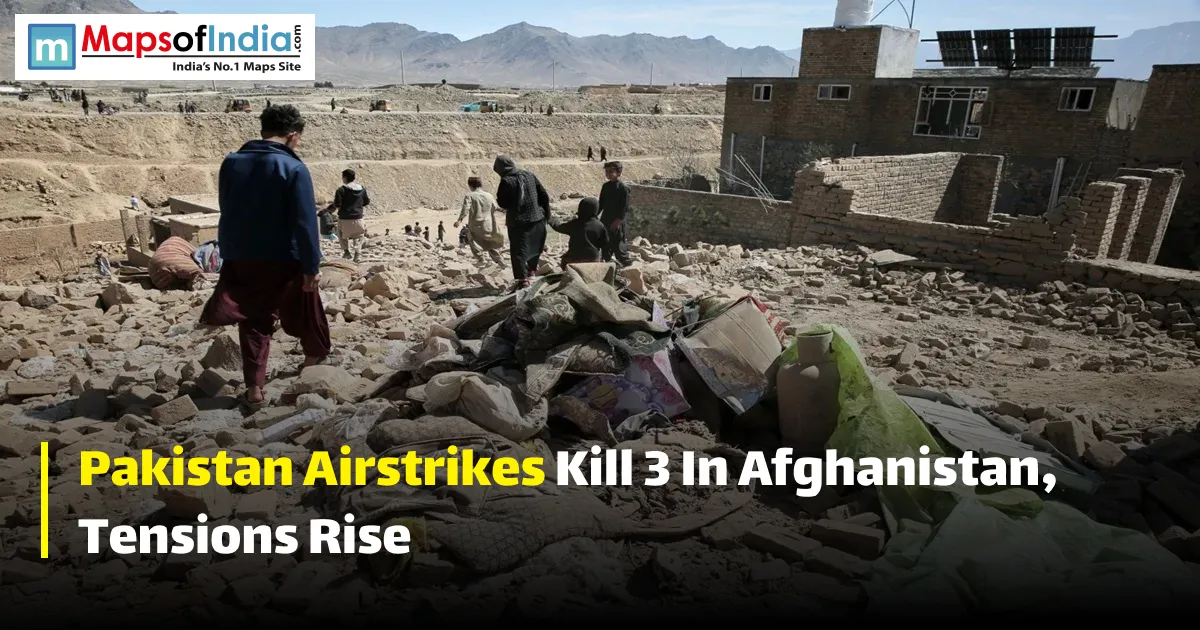
Pakistan carried out airstrikes in Afghanistan on September 21, 2026, killing at least three people and injuring several others, according to Afghan officials. The strikes reportedly targeted areas in Afghanistan’s eastern provinces of Kunar and Paktika, close to the Pakistan-Afghanistan border.
The latest military action has increased tensions between the two neighbouring countries, which have faced growing disagreements over cross-border militancy and security. The strikes have also raised concerns about the possibility of further military confrontation between Islamabad and Kabul.
Pakistan Airstrikes Target Eastern Afghanistan
The airstrikes were reportedly carried out by the military in the Kunar and Paktika provinces, which are close to the Afghanistan-Pakistan border. In Kunar, the attack reportedly occurred in Nurgal district, killing three family members and injuring four others.
Strikes were reported in Barmal district of Paktika. There was damage to buildings, with a shop and an empty house reported. There were no immediate reports of anyone being killed at those places.
The affected areas fall within the mountainous eastern border region of Afghanistan, where security factors have been difficult over the years. The area has also seen militant activity and a series of violent skirmishes between the Afghan and Pakistani forces.
Pakistan and Afghanistan Give Different Accounts
The two sides have offered different explanations for the latest attacks.
Pakistani authorities have described the strikes as operations against militant targets inside Afghanistan. Pakistan has accused militant groups based in Afghanistan of planning and carrying out attacks on Pakistani territory.
Afghan authorities, however, have condemned the strikes as violations of Afghan territory and said civilians were among those affected. Afghan officials have disputed Pakistan’s description of the targets and warned that the attacks could have serious consequences for bilateral relations.
The contrasting claims make it difficult to establish the full circumstances and casualty figures immediately after the strikes.
Why Are Pakistan and Afghanistan in Conflict?
Security concerns surrounding militant groups have become one of the biggest sources of tension between Pakistan and Afghanistan.
Pakistan has repeatedly accused the Tehrik-e-Taliban Pakistan, commonly known as the TTP, of using bases and safe locations inside Afghanistan. Islamabad has demanded that the Afghan authorities prevent militant groups from operating against Pakistan from Afghan territory.
The Taliban government in Afghanistan has rejected accusations that it deliberately provides shelter to militants targeting Pakistan. Afghan officials have also objected to Pakistan carrying out military operations inside Afghanistan, arguing that such actions violate Afghan sovereignty.
These opposing positions have contributed to a prolonged deterioration in relations.
Border Security Remains a Major Issue
The Pakistan-Afghanistan border has long been a source of disputes. The mountainous terrain and movement of people across the frontier make border security particularly difficult.
Pakistan has strengthened security measures along the border and constructed sections of fencing to restrict unauthorized crossings. Afghanistan’s Taliban authorities have objected to parts of the border arrangements and have also disputed aspects of Pakistan’s approach to managing the frontier.
Cross-border attacks and military operations have periodically intensified these disagreements.
Civilian Casualties Raise Concerns
The reported deaths in Kunar have added to concerns about the impact of military operations on civilians living in border communities.
Eastern Afghanistan contains numerous villages and settlements located close to areas where security operations take place. Any airstrike in populated areas can therefore create risks for civilians as well as suspected militant targets.
Afghan officials have repeatedly called for an end to attacks that they say harm civilians. Pakistan, meanwhile, has maintained that its military operations are directed at militants responsible for attacks against Pakistan.
The competing narratives have made civilian casualty figures and the identification of targets an important part of the dispute.
Previous Military Escalations
The latest strikes come after repeated periods of heightened tensions between Pakistan and Afghanistan.
Both countries have experienced border clashes and accusations of cross-border attacks. Pakistan has previously conducted strikes against suspected militant positions in Afghanistan, while Afghan forces have responded with their own military actions along the border.
These incidents have raised concerns that individual attacks could trigger a wider cycle of retaliation.
The continuing disputes also complicate diplomatic efforts between the two sides. Although Pakistan and Afghanistan share historical, cultural and economic links, their relationship has become increasingly dominated by security concerns.
Taliban Government Warns of Response
Afghan authorities have strongly condemned the latest Pakistani airstrikes. Taliban officials have described the attacks as an infringement of Afghanistan’s territorial sovereignty and indicated that Afghanistan reserves the right to respond.
Any military response could further increase tensions along the border. A prolonged confrontation could also affect civilians living in border areas and disrupt trade and cross-border movement.
The situation therefore remains closely linked to how both governments manage their military and diplomatic responses in the coming days.
Regional Implications
The Pakistan-Afghanistan relationship has wider implications for South Asia. Both countries occupy strategically important positions, and instability along their shared border can affect regional security, trade routes and humanitarian conditions.
A sustained escalation could also complicate diplomatic initiatives aimed at reducing tensions. Neighbouring countries have an interest in preventing the dispute from developing into a prolonged military confrontation.
For Afghanistan, continued airstrikes and border tensions could place additional pressure on communities already facing significant economic and humanitarian challenges. For Pakistan, militant attacks originating from across the border remain a major security concern.
What Happens Next?
The immediate concern is whether the latest airstrikes will remain a limited military operation or lead to further confrontation.
The reported deaths and injuries have added another serious incident to the already strained relationship between Pakistan and Afghanistan. Both governments face pressure to address their respective security concerns while avoiding actions that could trigger broader escalation.
The situation will largely depend on whether Pakistan conducts additional operations, how Afghanistan responds, and whether diplomatic channels can be used to address disagreements over militant groups and border security.
The latest airstrikes once again highlight the fragile nature of Pakistan-Afghanistan relations. With both sides maintaining sharply different positions on security and sovereignty, tensions along the border remain a major regional concern.
FAQs
1. Why did Pakistan carry out airstrikes in Afghanistan?
Pakistan said the airstrikes targeted militant positions in Afghanistan. The operation came amid continuing tensions over allegations that militant groups operating from Afghan territory have carried out attacks inside Pakistan.
2. How many people were killed in the Pakistan airstrikes on Afghanistan?
At least three people were reported killed in the Pakistan airstrikes on Afghanistan. Several others were also reported injured, with the casualties reported in Kunar province.
3. Where did Pakistan carry out airstrikes in Afghanistan?
The reported Pakistani airstrikes took place in Kunar and Paktika provinces in eastern Afghanistan. Both provinces are located near Afghanistan’s border with Pakistan.
4. What caused the latest Pakistan-Afghanistan tensions?
The latest tensions are linked mainly to disputes over cross-border militancy and security. Pakistan has accused militant groups based in Afghanistan of conducting attacks inside Pakistan, while Afghan authorities have opposed Pakistani military operations on Afghan territory.
5. Which militant group is at the centre of Pakistan-Afghanistan tensions?
The Tehrik-e-Taliban Pakistan (TTP) is a major focus of the dispute. Pakistan has accused the group of operating from Afghan territory and carrying out attacks in Pakistan, while the Taliban government has rejected accusations that it deliberately supports such activities.
6. How has Afghanistan responded to Pakistan's airstrikes?
Afghan Taliban authorities have condemned the airstrikes as attacks on Afghan territory and warned that Afghanistan could respond. The strikes have further increased concerns about military escalation along the Pakistan-Afghanistan border.
7. Could the Pakistan-Afghanistan conflict escalate further?
Further escalation remains a concern because the two countries continue to disagree over militant activity, border security and military operations. Additional strikes or retaliatory actions could increase tensions along their shared border.