Thailand Airstrikes Hit Cambodia as Border Conflict Flares
Abhishree Sharma December 8, 2025
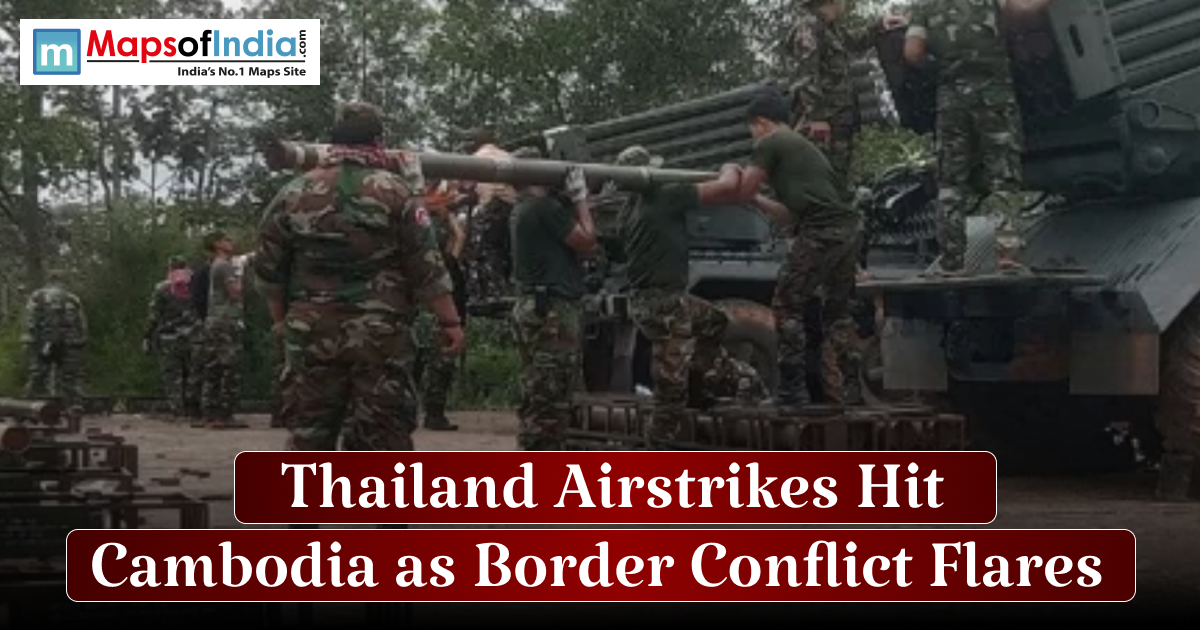
The old territorial conflict between Thailand and Cambodia has broken out into violence again, and this issue has been highlighted on the international screen and questions about the stability of the region. On December 8, 2025, the Royal Thai Army announced that it had sent airstrikes on Cambodian military targets in response to what it claimed was unprovoked fire from the Cambodian forces. Cambodia, however, turned down this by arguing that Thailand was the one who launched the attack. Since the two countries offer contradictory accounts, the situation on the border is only getting worse, and the civilian population finds itself in the middle.
What Triggered the Latest Clash?
Thailand’s Account
Thai military officials claimed that Cambodian soldiers opened fire on the other side of the border early in the morning, killing one of the Thai soldiers and injuring several other soldiers. As such, Thailand responded by using air power against what they say are Cambodian military bases that caused the attack.
Cambodia’s Counterclaim
Cambodia rejects the initiation of the first fire. Phnom Penh officials accuse Thai troops of entering Cambodian land and launching aggression at dawn, which made Cambodian troops take retaliatory measures. This argument on who to blame initially reflects past conflicts, proving the fact that relations have become very weak.
A Border Marked by History and Dispute
The 817-Kilometre Contested Line
The border between Thailand and Cambodia is approximately 817 kilometres in length, but there are large portions where it is not delimited. It is this ambiguity that lies behind recurring outbursts.
Colonial-Era Roots
To a large extent, the conflict is based on maps prepared by French colonial rulers at the beginning of the 20th century. Thailand has always opposed such maps, claiming that they had not been true to natural boundaries. Instead, Cambodia insists that the maps were internationally established and legally binding.
Preah Vihear Temple: The Emotional Flashpoint
The area near the ancient Hindu temple of Preah Vihear is one of the most controversial areas. In 1962, the International Court of Justice (ICJ) awarded Cambodia the temple, though some of the surrounding areas are still disputed. The two countries consider the territory as a culturally and strategically significant front, and it is a battlefield every time tensions escalate.
A Timeline of Escalation in 2025
July 2025: First Major Clashes of the Year
One of the deadliest incidents on the disputed border happened in mid-2025 in years. A blaze of fire erupted in July, leading to dozens of military and civilian fatalities and tens of thousands of refugees on each side. The fire of artillery, mortar shells, and infantry confrontations destroyed the villages of the border, which caused great concern in the world community.
October 2025: A Fragile Ceasefire
Months of violence led to a ceasefire being negotiated in October 2025. The deal is said to have entailed the mediation of former U.S. President Donald Trump. Even though the truce decreased actual fighting, specialists claimed that it had no clear monitoring procedures, which created space for mistrust.
November 2025: Tensions Resurface
Thailand gunned down Cambodia just less than a month after the ceasefire, claiming that Cambodia had planted landmines that wounded Thai soldiers. Cambodia regarded the allegations as unfounded and hostile, and a failure in communication erupted once again.
December 2025: Airstrikes Break the Ceasefire
The assassination in early December actually tore the October ceasefire. The airstrikes by Thailand were a big climax because air power is hardly applied during border skirmishes. Cambodia condemned the strikes as an aggressive manifestation, whereas Thailand insisted that it was a form of defence.
Humanitarian Impact on Civilians
Evacuations and Casualties
It was reported that there have been airstrikes on the Cambodian border, which have evicted several villages near the border. Some of the injured victims have been women, children and elderly residents. Shelters are being crowded with families going further into Cambodia.The Thai side has also recommended that the border communities stay indoors, and some schools have closed down temporarily due to safety concerns.
Disruption of Daily Life
There has been an instant blow to border markets, transportation routes and local businesses. Most inhabitants depend on trading across borders to earn their living, and the closure of major checkpoints is likely to bring economic pressures.
Psychological Toll
To people who have already experienced past violence, the fresh violence reminds them of the painful times. The region has reverted to anxiety, fear and uncertainty.
Regional and International Concerns
ASEAN’s Limited Role
The Association of Southeast Asian Nations (ASEAN) has always promoted amicable resolution of conflicts but seldom acts directly. As a member state of both Thailand and Cambodia, the rise puts ASEAN put itself in a very awkward diplomatic situation. Analysts claim that border violence can be sustained unless there is more regional participation.
The Question of External Mediation
The disintegration of the Trump-mediated ceasefire makes one wonder whether external mediation is effective or not. According to experts, future agreements might also not work in case there is no neutral monitoring body or verification system.
Impact on Trade and Tourism
The war poses a risk to the economic stability in the region. There is a reason why thousands of Cambodians are crossing into Thailand to work, and Thai manufacturers depend on Cambodian labour and markets. The long-term conflict may interfere with the supply chains and also tourism, which is a major tourist source in both nations.
Why the Dispute Keeps Reigniting
Nationalism and Sovereignty
Both countries are filled with nationalistic feelings over the territorial issues. It is a challenge that politicians are usually under domestic pressure not to look weak; hence, compromise is hard.
Lack of Demarcation
There is likely to be clashes until the border delimitation plan is finalized through a mutually agreed arrangement. Earlier efforts to form a common demarcation have been brought to a halt because of political differences.
Military Posturing
The two parties frequently escalate the number of troops in disputed regions. Although the intention is to discourage aggression, it results in misunderstandings of movements and causes skirmishes.
What Lies Ahead?
It is unclear what the next steps involve. There are also reported diplomatic back channels; however, there is still weak trust between the two governments. The fear of escalation is that the further the two parties do not restrain themselves, the higher the level of escalation that may happen. Analysts highlight the importance of open communication, external control and a fresh effort to settle the border on a long-term basis.What the civilians along the border need is very simple: the guns go silent. The future of the two countries is not just about the decisions made in the military, but also the decisions made by the leaders of both nations to use negotiation instead of war. The question of whether the tranquillity ever comes back and will remain will decide the destiny of thousands who have lost in this long conflict.