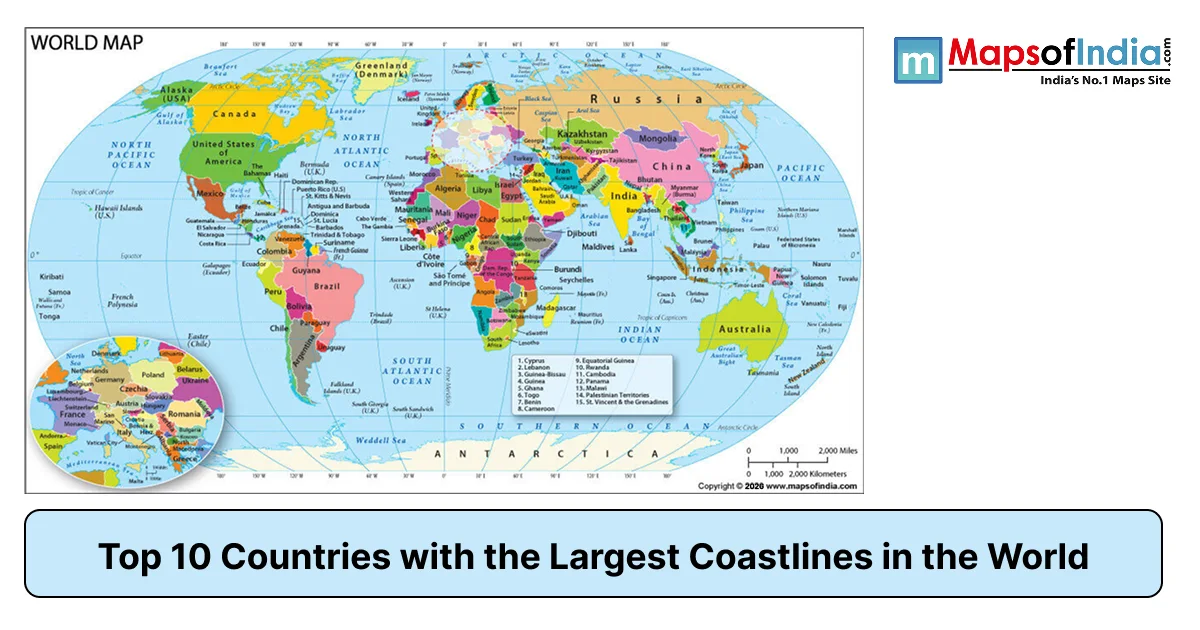
Canada has the world's longest coastline at approximately 202,080 km, more than the next several countries with the longest coastlines combined. Norway ranks second at roughly 58,133 km, and Indonesia third at 54,716 km. These countries with the largest coastlines dominate the rankings for very different reasons: Canada's vast Arctic archipelago, Norway's fjords, and Indonesia's 17,000-plus islands.
How Coastline Length Is Measured?
The Coastline Paradox Explained
The coastline paradox describes a strange mathematical reality: the more precisely you measure a jagged coast, the longer it gets. Tracing every inlet, bay, and rock formation at fine resolution can push a country's measured length dramatically higher than a coarser survey would show, which is exactly why coastline length by country figures vary so widely between sources.
Straight-Line vs. Fractal Measurement Methods
A straight-line method connects major points along a coast with simple segments, producing shorter, more conservative totals. Fractal-based measurement instead follows every curve at a fine scale, which is closer to how the CIA World Factbook, the most widely cited source for the world's longest coastlines, compiles its figures.
Top 10 Countries with the Largest Coastlines
1. Canada
Coastline: 202,080 km (125,567 miles)
Canada's coastline touches the Pacific, Atlantic, and Arctic oceans, and it's longer than the next four countries on this list combined. Its Arctic Archipelago alone contains over 36,000 islands, creating an almost impossibly intricate coastal edge. Canada's coastline is a total of 15 % of the world's coastline length.
2. Norway
Coastline: 58,133 km (36,122 miles)
Norway has Europe's longest coastline. This coastline is shaped almost entirely by deep glacial fjords and thousands of small islands along its western edge. The mainland of this island is just 2,650 km. The fjords and islands add the rest. Norway's fjords are so deeply carved that some extend over 200 km inland from the open sea.
3. Indonesia
Coastline: 54,716 km (33,998 miles)
Indonesia is the biggest archipelagic country in the world. It has a coastline of over 17,000 islands in the Indian and Pacific Oceans. It has the longest coastline in Asia. In the world, it ranked in third place.
4. Russia
Coastline: 37,653 km (23,396 miles)
Russia's coast is on the Pacific, Atlantic and Arctic oceans, as well as the Baltic, Black and Caspian Seas. Much of this is in the far north and is frozen for much of the year. The most important cities of Russia are located on this coastline.
5. Philippines
Coastline: 36,289 km (22,548 miles)
The Philippines is an archipelago composed of more than seven thousand (7,000) islands with one of the highest coastline-to-land ratios in the large island countries in the world. The coastline is an important region as it accounts for 40-60% of the total fish production in the country and thus contributes significantly to the national economy.
6. Japan
Coastline: 29,751 km (18,486 miles)
With its long coastline, Japan is not only the No. 62 largest island in the world, but also the longest in the world, with a chain of islands. Japan's islands on the coast are numerous, over 6800, most of which are uninhabited.
7. Australia
Coastline: 25,760 km (16,006 miles)
Australia is the biggest island and smallest continent, being the largest country in the world with no land borders. It has a coastline that includes the Great Barrier Reef coast, the biggest coral reef system in the world.
8. United States
Coastline: 19,924 km (12,383 miles)
Twenty-three states have a coastline along the Atlantic Ocean, Pacific Ocean, the Arctic Ocean, the Gulf of Mexico, and along the vast northern coastline in Alaska. Alaska has more shoreline than all of the other 22 coastal states combined.
9. New Zealand
Coastline: 15,134 km (9,404 miles)
Made up of two main islands and hundreds of smaller ones, New Zealand's coastline is long relative to its modest land area of just 268,021 km². Interesting fact: no point in New Zealand is more than 130 km from the sea.
10. Greece
Coastline: 13,676 km (8,498 miles)
Greece's roughly 2,000–3,000 islands, combined with a deeply indented mainland peninsula, give it one of the highest coastline-to-area ratios in Europe. Interesting fact: nearly one-fifth of Greece's total territory consists of islands.
Comparison Table - Coastline Length by Country
Rank | Country | Coastline (km) | Coastline (miles) | Coastline-to-Area Ratio (km per 1,000 km²) |
| 1 | Canada | 202,080 | 125,567 | ~20.2 |
| 2 | Norway | 58,133 | 36,122 | ~151.0 |
| 3 | Indonesia | 54,716 | 33,998 | ~28.7 |
| 4 | Russia | 37,653 | 23,396 | ~2.2 |
| 5 | Philippines | 36,289 | 22,548 | ~121.0 |
| 6 | Japan | 29,751 | 18,486 | ~78.7 |
| 7 | Australia | 25,760 | 16,006 | ~3.4 |
| 8 | United States | 19,924 | 12,383 | ~2.0 |
| 9 | New Zealand | 15,134 | 9,404 | ~56.5 |
| 10 | Greece | 13,676 | 8,498 | ~103.6 |
Countries with the Largest Coastline Relative to Land Area
Raw length tells only part of the story. Among this top 10 countries by coastline list, Norway has by far the highest coastline-to-area ratio; its deeply fjorded terrain packs roughly 151 km of coast into every 1,000 km² of land, over seven times Canada's ratio, despite Canada's far longer absolute coastline. The Philippines and Greece follow closely, both archipelagic or heavily indented nations where island geography inflates coastline length far beyond what land area alone would suggest. At the opposite extreme, Russia and the United States rank near the bottom of this ratio despite appearing high on the absolute largest coastline country list; their coastlines are long only because their landmasses are enormous. Smaller island nations outside the top 10, like the Bahamas or Palau, post even higher ratios than Norway, underscoring that raw ranking and relative "coastal density" measure genuinely different things.
Conclusion
- Canada holds the longest coastline in the world by an enormous margin, over three times Norway's total.
- Norway and Indonesia round out the top three, driven by fjords and island archipelagos, respectively, rather than sheer landmass.
- Norway has the highest coastline-to-land-area ratio of any country in this top 10, making it the most "coastal" nation on the list relative to its size.
- Coastline figures will always vary somewhat between sources because of the coastline paradox; there's no single, universally "correct" measurement.
Countries with the largest coastlines tend to combine one of two traits: sheer landmass touching multiple oceans (Canada, Russia, Australia), or a fragmented, island-heavy geography (Indonesia, Philippines, Japan, Greece) and the two paths produce very different-looking coastlines despite similar final rankings.
FAQs
1. Which country has the longest coastline in the world?
Canada has approximately 202,080 km (125,567 miles) of coastline.
2. Does Canada or Norway have a longer coastline?
Canada's coastline is more than three times longer than Norway's, 202,080 km versus roughly 58,133 km.
3. What is the coastline paradox?
A geographic effect that occurs when the length of a coastline measured by a ruler becomes longer the more closely one follows its contours; therefore, there is no fixed length for any coastline.
4. Which country has the shortest coastline?
Tiny countries such as Monaco (total length just over 4 km) have some of the shortest totals in the world.
5. How is coastline length measured?
The land-sea boundary, usually measured by satellite images and standardized survey methods such as those of the CIA World Factbook.
6. Why do coastline figures differ between sources?
Due to the coastline paradox and measurement scale variations, some sources approximate the length using straight lines, and others follow every fjord, bay and inlet in detail.
7. Which country has the longest coastline relative to its size?
With its long fjord coastline, Norway is the highest-ranking of the large countries in the world, with around 151 km of coastline per 1,000 km² of land surface area.
8. Are island nations always near the top of coastline rankings?
By coastline-to-area ratio, they don't dominate, but they are certainly not the least! Thousands of islands, not large land masses, make Indonesia, the Philippines and Japan high.