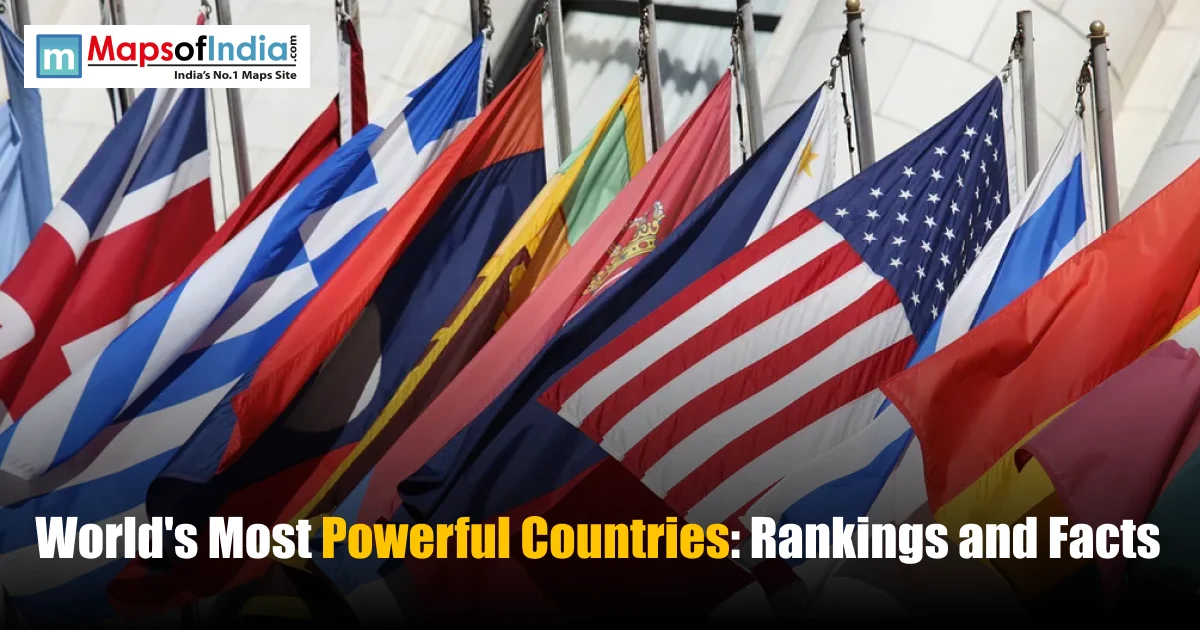
Economic strength, diplomatic power, and cultural impact are all part of a country's strength and are the factors that make the world's most powerful countries. This article has been updated in 2026 to show the most powerful countries in the world. This is based on the Global Power Index, military strength, GDP, political influence and soft power, as reflected by data from Global Firepower, the IMF, and the Wharton/US News Best Countries. If you look at the map of the most powerful countries in the world, then the bulk of power is concentrated in three regions of the world: North America, East Asia and Western Europe, with South Asia and the Gulf region showing rapid growth.
What Makes a Country "Powerful"?
Military Strength
For getting top in economic and military power ranking, troop numbers, defence budgets, nuclear capability, and equipment quality are considered. These are benchmarked and used in the Global Firepower Index.
Economic Power (GDP, Trade, Currency Influence)
Economy size, global trade share, and reserve-currency status. The US dollar's dominance is a major, often-overlooked lever in any assessment of the strongest countries in the world.
Political & Diplomatic Influence
Full membership of the UN Security Council, leadership of alliances (NATO, G7, G20) and influence over international agreements.
Soft Power (Culture, Innovation, Alliances)
Cultural exports, education, innovation, and reputation are key differentiators in the global influence ranking by country in the world. This can be very different from military influence.
Top 10 Most Powerful Countries in the World
1. United States
The world's No. 1 GDP, No. 1 military and the dominant reserve currency. The United States is the top among the true superpowers of the world, combining strength in military, economic, and cultural aspects.
2. China
The world's second-largest economy at $20.85 trillion (and No. 1 on a PPP basis), with the No. 3 military globally. Standout fact: China now fields more naval vessels than the US Navy, a key marker in this top 10 most powerful countries list.
3. Russia
A $2.66 trillion economy, small next to several countries ranked below it, but Russia holds the world's largest nuclear arsenal and the No. 2 military by Global Firepower, proving that a military strength index score doesn't always track GDP.
4. Germany
Europe's largest economy is at $5.45 trillion and the EU's political anchor. Standout fact: despite ranking only 12th militarily, Germany's export-driven economy secures its place among the strongest countries in the world.
5. United Kingdom
A $4.26 trillion economy, a permanent UN Security Council seat, an independent nuclear deterrent, and the No. 8 military globally. Standout fact: London remains one of the world's top financial centres.
6. France
A $3.36 trillion economy, a UNSC seat, an independent nuclear triad, and the No. 6 military by Global Firepower. Standout fact: France holds the world's second-largest exclusive economic zone via its overseas territories.
7. Japan
A $4.38 trillion economy, the world's 4th largest, with the No. 7 military despite a constitutionally restrained defence posture. Standout fact: Japan ranks among the global top three in soft power, reinforcing its place among the most powerful nations.
8. South Korea
A smaller economy of $1.9 trillion, ahead of several larger ones, in the top-5 military powers in the world. The highlight: K-pop, film, and tech exports give Seoul soft power clout beyond its size.
9. India
A $4.15 trillion economy, a nuclear arsenal and No. 4 military strength (Global Firepower). Rising to a major swing factor in the future global power index, the standout fact of India is that it is the fastest-growing major economy in the world in 2026.
10. Saudi Arabia
An oil-anchored $1.1–1.4 trillion economy with the No. 25 military but outsized influence through OPEC+ and Vision 2030. Standout fact: Riyadh can move global energy markets with a single production decision.
Power Ranking Comparison Table
Country | GDP (2026) | Military Rank (GFP) | Nuclear Status | UNSC Seat |
| United States | $32.38T | 1 | Yes | Permanent |
| China | $20.85T | 3 | Yes | Permanent |
| Russia | $2.66T | 2 | Yes | Permanent |
| Germany | $5.45T | 12 | No | No |
| United Kingdom | $4.26T | 8 | Yes | Permanent |
| France | $3.36T | 6 | Yes | Permanent |
| Japan | $4.38T | 7 | No | No |
| South Korea | $1.9T | 5 | No | No |
| India | $4.15T | 4 | Yes | No |
| Saudi Arabia | ~$1.1–1.4T | 25 | No | No |
Economic Power vs. Military Power - Which Matters More?
Neither wins outright in any honest economic and military power ranking; they solve different problems. Military strength buys deterrence in a crisis; economic power buys leverage in the calmer 99% of the time, trade terms, currency influence, and the capacity to fund a military in the first place. Germany and Japan prove the point: both sit outside the Global Firepower top 10, yet remain unquestioned members of the global power tier through economic and industrial scale. Saudi Arabia flips the pattern, a modest No. 25 military strength index rank offset by outsized economic leverage through oil. The most durable superpowers of the world are the ones that don't have to choose the US, and China combine both dimensions, which is exactly why they anchor almost every global power index, regardless of methodology.
Soft Power Leaders - Countries That Influence Without Force
Soft power is where the most powerful nations' ranking changes the most from hard-power lists. Topping the 2026 Brand Finance Global Soft Power Index is the U.S. at 74.9, followed by China at 73.5, but the UK (69.2) and Germany (67.7) also have strong soft power scores due to their education and governance reputation. Of course, South Korea and Japan are the two countries that stand out the most: They have no seats on the UN Security Council but are among the world's most popular countries thanks to their technology exports, entertainment and design reputation, which affects customers around the world.
Rising Powers to Watch
It is not complete without these names: India, Indonesia, Brazil and Turkey, which are the strongest countries in the world. India is already among the top 5 world economies and is becoming one of them at a very fast rate. The biggest economy in Southeast Asia, Indonesia, is becoming a regional anchor. Brazil continues to be South America's leading nation in the BRICS and G20 fora. Turkey has been more focused on strengthening its own defence industry than on its economy, making it the most powerful force in the region.
Conclusion
- In most of the power indexes, the United States, China, and Russia hold the top three spots.
- Germany and the UK round out the top five, mainly on economic and diplomatic weight, not military rank.
- France, Japan, South Korea, and India form a tightly contested next tier, with exact order shifting by index.
- Saudi Arabia rounds out the top 10 largely on energy leverage rather than conventional military strength.
- Methodology note: rankings blend military, economic, political, and soft-power factors, so results shift year to year.
FAQs
1. What is the strongest country in the world?
The United States is No. 1 for nearly every 2026 index because of its military, economic and diplomatic superiority.
2. What are the factors used to determine the power of countries?
Military power, economy, political/diplomatic influence, soft power, culture and innovation.
3. Is economic power greater than military power?
They are not mutually exclusive; economic power enables sustained influence, and military power enables deterrence.
4. What countries have nuclear weapons and good economies?
The US, China, Russia, the UK, and France are all nuclear-powered countries with great economies.
5. In what way is soft power a factor in a country's rank in the world?
It can raise a country's influence much more strongly than its military or GDP ranking. The best examples are South Korea and Japan.
6. What is a global power index?
A multifaceted ranking of countries with respect to overall influence based on a combination of cultural, political, economic and military indicators.
7. Why is there a difference in power rankings among sources?
The top-10 lists are different for each index, with military, economic and perception-based elements given different weights.
8. What countries would be included on the list of Rise Up countries?
The top four emerging markets that have the eyes of others on them in the coming years are India, Indonesia, Turkey and Brazil.