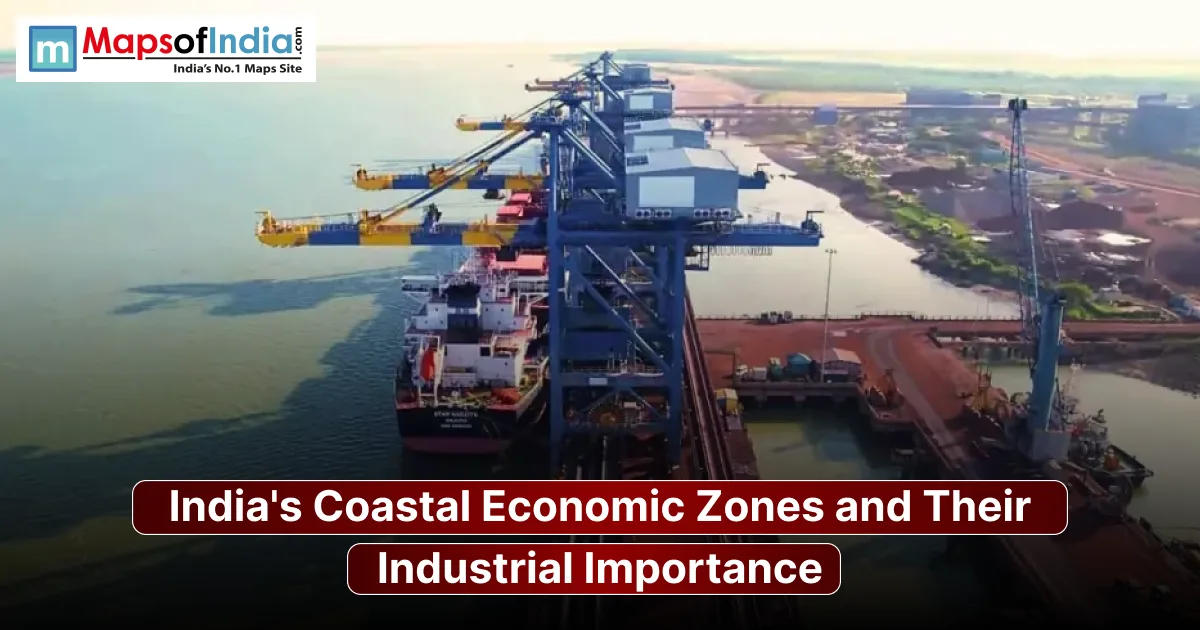
Coastal Economic Zones in India are planned economic regions that link manufacturing, logistics, and trade with ports and the coastline. Identified under the Sagarmala Programme, Coastal Economic Zones aim to lower cargo movement costs, attract investment, boost exports, and create jobs by bringing industries near gateways. India’s coastline was revised to 11,098.81 km in 2025, showing the potential for coastal development. But Coastal Economic Zones are not the same as operational industrial estates; their success depends on infrastructure, investment and coordination between central and state authorities. This article explains what Coastal Economic Zones are, how they differ from Special Economic Zones, where the 14 proposed zones are located, which industries they could support and how government policies, infrastructure and environmental matters will shape their future.
What Are Coastal Economic Zones in India?
Coastal Economic Zones are port‑linked economic regions designed to encourage industrial growth near coastal districts and maritime transport networks. A Coastal Economic Zone can contain industrial clusters, logistics facilities and supporting infrastructure, helping businesses move raw materials and finished products between factories, ports and domestic markets more efficiently. Under Sagarmala, 14 Coastal Economic Zones were identified in the National Perspective Plan to promote port‑led industrialisation.
How CEZs Differ from Special Economic Zones (SEZs)
| Feature | Coastal Economic Zones (CEZs) | Special Economic Zones (SEZs) |
| Main purpose | Encourage port-led industrialisation and coastal economic development | Promote exports and investment through a legally designated zone |
| Geographic scope | Can cover several districts linked to one or more ports | A specifically notified area under the SEZ framework |
| Core focus | Industrial clusters, logistics, ports and coastal trade | Export-oriented production, services and trade |
| Governance | Developed through infrastructure planning and coordination among relevant authorities | Governed by the SEZ Act, 2005, and associated rules |
| Tax and customs treatment | A CEZ designation does not automatically grant special tax benefits | Eligible units and activities may receive benefits under applicable SEZ provisions |
A Coastal Economic Zone is mainly a regional planning and industrial‑development idea. A Special Economic Zone is a designated zone with its own regulatory framework. An industrial unit located within a proposed Coastal Economic Zone does not automatically receive Special Economic Zone tax or customs benefits.
The Role of the Sagarmala Programme
Launched in 2015, the Sagarmala Programme aims to improve port infrastructure, strengthen connectivity, support port‑led industrialisation, develop communities and encourage coastal shipping and inland water transport. Its National Perspective Plan identified 14 proposed Coastal Economic Zones with plans prepared in consultation with states and central ministries.
The broader idea is to link ports with clusters and their hinterlands instead of treating ports as isolated cargo‑handling facilities. Better road and rail links, warehouses, industrial land and reliable utilities can make coastal locations more appealing to manufacturers.
Why India’s Coastline Is Ideal for Industrial Clusters
Coastline Length and Port Network
India’s coastline was reassessed to 11,098.81 km in 2025, replacing the widely cited figure of 7,516.6 km. The revised measurement reflects updated mapping methods. Does not, by itself, change the boundaries of Coastal Regulation Zone rules. India’s maritime network includes 12 ports and more than 200 non‑major ports, which handle a range of cargo including crude oil, coal, containers, fertilisers and agricultural commodities.
Ports support industries that rely on imported materials or export finished goods. Refineries, petrochemical complexes, steel producers and container‑based manufacturers can benefit when factories, storage facilities and transport networks are planned around port access.
Access to Global Shipping Routes
India’s position along Indian Ocean shipping routes connects its ports with markets in Asia, the Middle East, Africa and Europe. Coastal industrial clusters can use these connections to import inputs and export finished products. Integrate into international supply chains.
Access to shipping routes is not enough, however. Competitive port charges, reliable schedules, efficient customs processes and strong road and rail connections are also needed to attract investment.
Logistics Advantage
Transporting cargo by sea can be more economical than moving the same goods over long distances by road. When ports are linked to clusters by rail, highways, freight corridors and inland waterways, businesses can reduce handling time and transport costs. This advantage is especially useful for high‑volume industries such as cement, steel, petroleum refining, fertilisers and power generation. For cargo, like electronics and processed food, reliable container handling and logistics services are equally important.
Major Coastal Economic Zones and Industrial Clusters in India
The government has identified fourteen proposed Coastal Economic Zones under Sagarmala. These Coastal Economic Zones are only planning regions, not a list of fourteen operational zones. The locations and industrial opportunities shown below come from the National Perspective Plan; actual projects and investment can change over time.
Western Coast: Gujarat and Maharashtra
The coast is home to major ports, petroleum facilities, chemical industries and manufacturing centres. Gujarat’s proposed Coastal Economic Zones include:
- Kachchh Coastal Economic Zone: linked to the Kandla and Mundra port region with potential for petrochemicals, cement and furniture manufacturing.
- Saurashtra Coastal Economic Zone: identified for apparel and automotive industries.
- Suryapur Coastal Economic Zone: covering parts of southern Gujarat with potential for marine‑related industrial clusters.
In Maharashtra, the North Konkan Coastal Economic Zone was proposed around districts including Thane, Mumbai, Pune and Raigad, with potential for power, electronics and apparel. South Konkan Coastal Economic Zone, covering parts of Maharashtra and Goa, was associated with refining, steel and food processing.
Industrial activity around Mundra, Kandla, Dahej, Hazira, Jawaharlal Nehru Port (JNPA/JNPT) and the Mumbai–Pune belt illustrates the region’s port‑linked manufacturing and logistics potential.
Southern Coast: Kerala, Karnataka and Tamil Nadu
The southern coast features major ports, manufacturing centres, fisheries, shipbuilding facilities and petroleum-related industries. Proposed Coastal Economic Zones include:
- Dakshin Kanara, Karnataka Coastal Economic Zone: linked to the New Mangalore port region with petrochemicals identified as an industry.
- Malabar, Kerala Coastal Economic Zone: covering coastal districts with furniture manufacturing identified as a potential opportunity.
- Mannar, Tamil Nadu Coastal Economic Zone: covering Kanyakumari, Tirunelveli and Thoothukudi with apparel and refining listed as potential industries.
- Poompuhar, Tamil Nadu Coastal Economic Zone: a proposed region associated with leather processing and power.
- VCIC South, Tamil Nadu Coastal Economic Zone: the southern section of the Visakhapatnam–Chennai Industrial Corridor with potential for steel, petrochemicals, electronics and shipbuilding.
Key port and industrial centres include Kochi, Mangaluru, Chennai, Kamarajar (Ennore), Kattupalli and V.O. Chidambaranar Port at Thoothukudi. Vizhinjam is also relevant to India’s expanding deep‑water port capacity, although its presence does not mean that it was separately named as one of the fourteen Coastal Economic Zones.
Eastern Coast: Andhra Pradesh, Odisha and West Bengal
The eastern coast has several major ports along the Bay of Bengal, connecting inland regions with maritime trade routes. Three proposed Coastal Economic Zones in the plan were:
- VCIC Central, Andhra Pradesh Coastal Economic Zone: covering Chittoor and Nellore with electronics identified as a potential industry.
- VCIC North, Andhra Pradesh Coastal Economic Zone: covering districts from the central to northern coast with potential for food processing, petrochemicals, cement and apparel.
- Kalinga, Odisha Coastal Economic Zone: covering coastal districts including Puri, Jagatsinghpur and Bhadrak with potential for petrochemicals and marine processing.
- Gaud, West Bengal Coastal Economic Zone: covering Purba Medinipur and South 24 Parganas with leather processing identified as a potential industry.
Important port and industrial centres include Visakhapatnam, Krishnapatnam, Paradip, Dhamra, Kolkata and Haldia. Their role extends beyond shipping: ports support steel, mineral processing, petroleum products, food exports and other industries across their hinterlands.
Industries Driving Coastal Economic Zones
Petrochemicals, Refining and Chemicals
Petroleum refineries and chemical plants often rely on large volumes of imported crude oil, natural gas and other industrial feedstocks. Locating them near ports can reduce transport requirements. Gujarat and other coastal industrial regions already host petroleum and chemical activities, which can support connected manufacturing businesses.
Shipbuilding, Ship Repair and Maritime Services
Ports generate demand for ship repair, vessel maintenance, marine equipment, port services and maritime training. Shipbuilding clusters can benefit from access to suppliers, skilled workers and shipping customers, although their competitiveness also depends on technology, finance and orders.
Automobile, Engineering and Electronics Manufacturing
Automotive and engineering industries rely on a steady supply of components and access to domestic and international markets. Electronics manufacturers can benefit from container logistics, reliable electricity and nearby supplier networks. Port proximity is useful. It must be matched by skilled labour and competitive production costs.
Steel, Power and Heavy Industry
Steel plants, power facilities and other heavy industries require efficient handling and transportation of raw materials and finished goods. Ports can simplify the movement of coal ores, machinery and industrial products. These industries also require planning for energy use, emissions, water supply and waste management.
Textiles, Seafood and Agro-Processing
Textile and apparel clusters can use ports to send garments and fabrics
Seafood processors benefit from storage and reliable refrigerated transport. Agro‑processing businesses need facilities and dependable links between farms, factories and export markets.
Logistics, Warehousing and Free Trade Zones
Warehouses, container freight stations, distribution centres and logistics parks link factories to ports. Free‑trade and customs facilities can also aid cargo operations when they are authorised separately. These facilities cut delays only if digital systems, customs procedures and road and rail links operate smoothly.
Industrial Importance of Coastal Economic Zones
Boosting Exports and Trade Competitiveness
Coastal economic zones in India help manufacturers reach markets by linking production to shipping services. Faster cargo movement and lower transport costs can make Indian goods more competitive in industries that rely on imported inputs or export large volumes.
Job Creation and Regional Development
Industrial clusters create jobs in manufacturing, transport, warehousing, maintenance, hospitality and port services. They also produce jobs among suppliers and small businesses. The benefits depend on hiring, training, fair working conditions and whether smaller firms can join the supply chain.
Attracting Foreign and Domestic Investment
Ports, land and reliable infrastructure attract investors who want access to markets and transport networks. Investment decisions also rely on policy stability, land availability, energy costs, environmental approvals and the presence of skilled workers.
Supporting Supply Chain Resilience and "Make in India”
Locating suppliers, manufacturers and logistics services in clusters reduces delays and improves coordination. It also helps domestic manufacturing grow. Still, concentrated supply chains can suffer from cyclones, port closures or international shipping problems, so resilience planning is essential.
Strengthening the Blue Economy
The blue economy includes activities linked to oceans and coastal resources such as shipping, fisheries, ports, marine services and coastal tourism. Well‑planned coastal economic zones support these activities while improving infrastructure and jobs. Long‑term success needs protection of ecosystems and benefits for local communities.
Government Policies and Infrastructure Supporting Coastal Economic Zones
Sagarmala Projects: Port Modernisation, Connectivity and Industrialisation
Sagarmala is the government’s main programme for development led by ports. It covers port modernisation, connectivity, port‑led industrialisation, community development along coasts and coastal shipping and inland water transport.
In an April 2026 backgrounder, the government reported 845 Sagarmala projects worth ₹6.06 lakh crore, with 315 finished, 210 underway and 320 planned as of 24 March 2026. These figures cover the programme, not just coastal economic zones. A separate August 2026 government reply said no project had received help under Sagarmala’s port‑led industrialisation pillar at that time. This is important: progress in port infrastructure does not automatically mean every proposed coastal economic zone has begun full‑scale development.
PM Gati Shakti and Multimodal Connectivity
PM Gati Shakti offers a platform for integrated infrastructure planning across ministries and states. It helps find gaps in road, rail and other links between ports, industrial areas and markets. Better coordination can cut investment and improve last‑mile connectivity, which is often a major factor in logistics performance.
Dedicated Freight Corridors and Industrial Corridors
Dedicated freight corridors enable rail freight movement while industrial corridors link manufacturing centres with transport and logistics infrastructure. Their benefits for economic zones depend on how well ports, inland terminals, industrial parks and distribution networks are connected.
State‑Level Maritime and Industrial Policies
Coastal states use their industrial policies, maritime boards and port‑development plans to attract investment and regulate development. Gujarat, Maharashtra, Tamil Nadu, Andhra Pradesh and Odisha, among others, have port‑linked activity. Investors still must follow the land, environmental, coastal‑zone and industrial rules.
Challenges Facing Coastal Economic Zones
Land Acquisition and Environmental Clearances
Large industrial projects need land, water, power and transport infrastructure. Acquiring land can spark disputes if communities are not consulted or compensation is too low. Projects must also win coastal clearances, especially when development could affect wetlands, mangroves, fisheries or other sensitive habitats.
Climate Risk, Cyclones and Coastal Regulation
Coastal industrial assets face risks from cyclones, storm surges, flooding, erosion and sea‑level rise. Ports and industrial facilities need designs that can withstand climate emergencies and have reliable drainage. Development must also follow Coastal Regulation Zone rules; a coastal economic zone designation does not override law.
Last‑Mile Connectivity and Port Congestion
A modern port cannot give its economic benefit if trucks wait in long lines, rail links are not enough, or nearby roads are congested. Warehousing, digital cargo management and coordinated scheduling are needed to cut back bottlenecks. Smaller ports may also need links to inland markets.
Competition from Other Regional Hubs
Coastal industrial clusters compete with manufacturing and logistics hubs in other countries. Port efficiency, shipping frequency, electricity costs, labour skills, policy predictability and customs processes all influence investment. Building infrastructure is one part of creating a competitive industrial location.
Future Outlook for India’s Coastal Economic Zones
Port Expansion, Green Hydrogen and New Industrial Opportunities
India’s coastal industrial future will depend on whether port capacity is matched by efficient inland links and commercially viable industrial projects. The government’s April 2026 review reported that major ports handled a record 915.17 million tonnes of cargo in FY 2025–26 while the wider Sagarmala programme kept developing port and connectivity infrastructure. These are programme figures, not CEZ-specific outcomes.
Green hydrogen is another growth area. In October 2025, Deendayal Port in Gujarat, V.O. Chidambaranar Port in Tamil Nadu and Paradip Port in Odisha were recognised as hydrogen hubs under the National Green Hydrogen Mission. Their development could support production, use and export of low‑emission fuels provided renewable power, infrastructure and buyers are available.
The next phase should focus on industrial investment, better road and rail links, efficient logistics, skilled workers and environmental safeguards. Future claims about capacity investment and export targets should be tied to a dated government announcement rather than treated as guaranteed outcomes.
Conclusion
Coastal economic zones in India are intended to connect ports, industrial clusters and inland transport networks to improve manufacturing competitiveness, exports and employment. The 14 CEZs identified under Sagarmala provide a planning framework. Their success depends on implementation, infrastructure, investment and coordination between governments and industry. Sustainable development must also protect ecosystems and local livelihoods.
FAQs
1. What are coastal economic zones in India?
Coastal economic zones in India are proposed port‑linked regions intended to encourage manufacturing, logistics and trade near coastal districts. Identified under the Sagarmala Programme, they aim to reduce cargo movement costs and support clusters. The designation is a planning concept and does not automatically provide tax benefits or mean the zone is fully operational.
2. How are coastal economic zones different from SEZs?
Coastal Economic Zones are regional development areas planned around ports and connected industrial clusters. Special Economic Zones are designated areas governed by the SEZ Act, 2005 and associated rules. Eligible SEZ units may receive regulatory, customs or tax treatment under applicable provisions, while CEZ status alone does not grant those benefits.
3. How many coastal economic regions are proposed under Sagarmala?
The National Perspective Plan, under Sagarmala, identified 14 Coastal Economic Zones across India’s regions. Their proposed locations include Kachchh, Saurashtra, Suryapur, North Konkan, South Konkan, Dakshin Kanara, Malabar, Mannar, Poompuhar, VCIC South, VCIC Central, VCIC North, Kalinga and Gaud. These are proposed planning regions, not 14 operational zones.
4. Which Indian states have the important coastal industrial clusters?
Gujarat and Maharashtra have port-linked petroleum, chemical, engineering and manufacturing activity. Tamil Nadu, Karnataka and Kerala support ports, manufacturing and maritime services while Andhra Pradesh, Odisha and West Bengal have ports and industrial centres on the eastern coast. The importance of a cluster depends on its industries, port access and inland connectivity.
5. Which industries benefit most from economic zones?
Industries that move volumes of raw materials or finished goods can benefit significantly. These include petroleum refining, petrochemicals, steel, cement, power, shipbuilding, engineering, textiles, seafood processing and logistics. Electronics and other container-based industries may also gain from shipping, although they require reliable utilities, skilled workers and well-developed supplier networks.
6. Why are coastal economic zones important for India's exports?
Coastal economic zones can bring manufacturers closer to ports, shipping services and logistics facilities. This can reduce cargo movement, shorten delivery times and improve access to overseas markets. Their contribution to exports depends on customs procedures, competitive production costs, reliable infrastructure and the ability of Indian businesses to meet international quality standards.
7. What challenges do coastal economic owners face?
Major challenges include land acquisition, environmental clearances, coastal ecosystem protection, climate risks, port congestion and inadequate last-mile road or rail connectivity. Zones also compete with industrial hubs for investment and skilled workers. Effective planning, community consultation, resilient infrastructure and predictable policies are essential to turn proposed development regions into industrial clusters.