When I drive up into the Nilgiris, a distinct smell greets me. The scent is a mix of eucalyptus and wet earth. Drying tea leaves. It is carried by the thin air that rises from the mountains. The Nilgiris, called the Blue Mountains by the Tamil people, have attracted visitors since the British first climbed the plateau in the 1800s. However, this Nilgiris tourism guide goes beyond the photo‑stops of Ooty’s toy train and boat house. It explores what truly makes the Nilgiris worth the climb: the long‑standing communities, the oldest tea estates in India, and a biosphere reserve that remains one of the country’s most ecologically important areas.
Where Are the Nilgiris?
The Nilgiris derive their name from the Tamil word for Blue Mountains. They form part of the Western Ghats where the states of Tamil Nadu, Kerala and Karnataka meet. In 1986, the hills around the Nilgiris were declared the Nilgiri Biosphere Reserve, India's biosphere reserve. The reserve covers 5,520 square kilometres across all three states. Later, UNESCO added the reserve to its World Network of Biosphere Reserves to honour its value. It is the protected forest area in India linking the parks of Mudumalai, Bandipur, Nagarhole, Wayanad, Mukurthi and Silent Valley into a single network.
The Nilgiri Biosphere Reserve
The Nilgiri Biosphere Reserve is a protected area that covers the hills around the Nilgiris. It is known for its variety of plants and animals.
Key towns — Ooty, Coonoor, Kotagiri
Udhagamandalam, which most people call Ooty, has been the district headquarters since 1882. Remains the main town of the Nilgiris. Coonoor, 20 kilometres away, is quieter and less commercialised. Kotagiri, the oldest of the three hill towns, is famous for its tea farms. Usually has fewer crowds even during busy seasons.
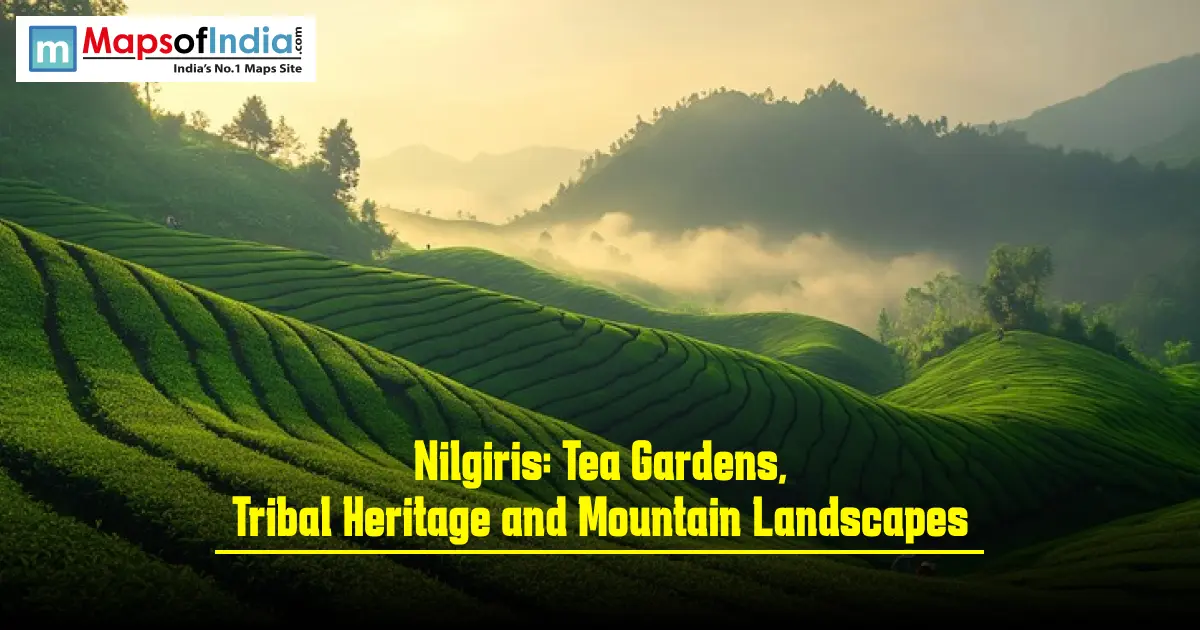
The Tea Gardens of the Nilgiris
History of Tea Cultivation in the Region
Tea farming began in the Nilgiris in the mid‑1800s after the British discovered the plateau. John Sullivan, the Collector of Coimbatore, reached the hills in 1819. Built the first European house in Ooty in 1822. What started as an experiment by the British grew into a major part of the landscape. Today tea plantations cover slopes across the Nilgiris.
Best Tea Estates to Visit (Ooty, Coonoor)
Today the Nilgiris are the largest tea region in India after Assam and West Bengal. About 62,000 hectares of land produce 180 million kilograms of tea each year. The estates near Ooty and Coonoor are the most visited, and many of them offer guided walks through the gardens and their processing facilities.
Tea Tasting and Factory Tour Experiences
At estates and at Ooty’s Tea Museum, visitors see the whole process from leaf to cup. They learn about the history of tea, how it arrived in India, and how it changed in the Nilgiris. The visit usually ends with a tasting session where the difference between orthodox and CTC processing can be felt.
Tribal Heritage
The Toda Tribe: Culture and Traditions
Before the British came, the Nilgiri plateau was home to the Toda people. The Toda are a community that depends on a special breed of long‑horned buffalo. They live in villages called munds, each with six or seven barrel‑vaulted huts. The Toda keep conical milk‑storage structures that only priests may enter. Today women are famous for a free‑hand embroidery style without using traced patterns. Today about 2,000 Toda people live, most inside the Nilgiri Biosphere Reserve.
Other Indigenous Communities (Kota, Badaga, Kurumba)
The Toda share the hills with native groups. The Kota were artisans and musicians, making tools and playing at Toda and Badaga festivals. The Badaga are now a tribal community in the Nilgiris and are the main farmers. The Kurumba, who live more in the forest, are known for gathering honey. Have deep knowledge of the shola forests.
Sustainable and Respectful Tribal Tourism
Because there are few Toda people, visits to Mund villages should be respectful and low‑impact. It is best to arrange visits with local guides who know which communities welcome visitors instead of dropping by unannounced. Buying Toda embroidery directly from the women who make it is a way to help the community.
Mountain Landscapes and Natural Attractions
Doddabetta Peak
At 2,637 metres, Doddabetta stands as the highest point in the Nilgiris and the third‑highest peak in South India. A telescope house close to the summit provides views across the district on clear days, making Doddabetta one of the most‑visited natural landmarks near Ooty.
Nilgiri Mountain Railway (UNESCO Heritage)
Completed in 1908 as an extension of the 1899 Mettupalayam‑Coonoor line, Nilgiri Mountain Railway is India's only rack railway. It was built to haul trains up gradients too steep for conventional tracks. The Mettupalayam‑Coonoor stretch still runs on steam locomotives while the Coonoor‑Ooty section switched to diesel—a shift that local campaigns sometimes aim to reverse by bringing steam. In 2005, UNESCO added Nilgiri Mountain Railway to the Mountain Railways of India World Heritage Site with the Darjeeling Himalayan Railway.
Wildlife and biodiversity
Mudumalai Tiger Reserve, covering 321 square kilometres in the northern Nilgiris, protects tigers, leopards, Indian gaur and elephants, as well as the endemic Nilgiri tahr, which is Tamil Nadu's state animal. Nilgiri tahr lives in the high‑altitude shola‑grassland mosaics of the region. Over 350 bird species have been recorded in the biosphere reserve. Some of these birds are found elsewhere, such as the Nilgiri pipit and the Nilgiri wood pigeon.
Best Time to Visit the Nilgiris
March to May brings days and blooming flowers, and Ooty hosts its annual Flower Show each May. This period is the popular window for families. September and October come after the monsoon. It shows especially vivid greenery across the tea estates and shola forests. December and January bring dry winter weather, which attracts visitors who like the hills at their coldest and clearest.
How to Reach the Nilgiris
By Air
Coimbatore International Airport is the nearest airport. It is 90 kilometres from Ooty via Mettupalayam, and it offers regular domestic flights and some international connections.
By Train
Mettupalayam serves as the broad‑gauge railhead. It connects to cities, and from there the historic Nilgiri Mountain Railway continues up to Coonoor and Ooty.
By Road
The Nilgiris are well connected by road from Coimbatore, Mysore and Bengaluru. The Nilgiri Ghat road offers one of South India's dramatic mountain drives with hairpin bends that climb through forest and tea estate alike.
Conclusion
The Nilgiris reward visitors who go beyond Ooty's lake and boat rides. The region's real character shows up in its century‑old tea estates, in the Toda communities who called these hills home before any colonial planter arrived, and in a biosphere reserve that still holds some of South India's richest biodiversity. Whether the draw is the toy train, the tea or the tahr, timing a visit around the March‑May or September‑October windows makes the most of what the Blue Mountains have to offer.
FAQs
1. What makes the Nilgiris famous?
The Nilgiris are best known for their tea gardens, the UNESCO‑listed Nilgiri Mountain Railway, the indigenous Toda community and India's first biosphere reserve. These attractions spread across the hill towns of Ooty, Coonoor and Kotagiri.
2. Which is the best month to visit Nilgiri tea gardens?
March to May is generally considered ideal. It combines weather with peak flowering season. September to October offers vivid greenery right after the monsoon.
3. Are Toda tribal villages open to tourists?
Some Toda mounds do welcome visitors. Ideally, visits are arranged through guides. With a population of around 2,000, sustainable low‑impact visits are strongly preferred over unannounced drop‑ins.
4. Is Ooty part of the Nilgiris
Yes. Ooty, which is formally called Udhagamandalam, serves as the headquarters of the Nilgiris district. Ooty is also a well‑known town in the Nilgiris, together with Coonoor and Kotagiri.
5. How far is Ooty from Coimbatore?
Ooty is 90 km from Coimbatore, a drive of about 3 to 4 hours via Mettupalayam, climbing steadily through the Nilgiri Ghat roads' forested hairpin bends.
6. Is the Nilgiri Mountain Railway still operational?
Yes, the toy train still runs daily between Mettupalayam and Ooty, with steam locomotives operating the Mettupalayam-Coonoor stretch and diesel engines covering the Coonoor-Ooty section.
7. What is the Nilgiri Biosphere Reserve known for?
It is known for being India's biosphere reserve, established in 1986, and for its exceptional biodiversity, including the endemic Nilgiri tahr, lion-tailed macaque, and over 350 recorded bird species across its shola forests and grasslands.