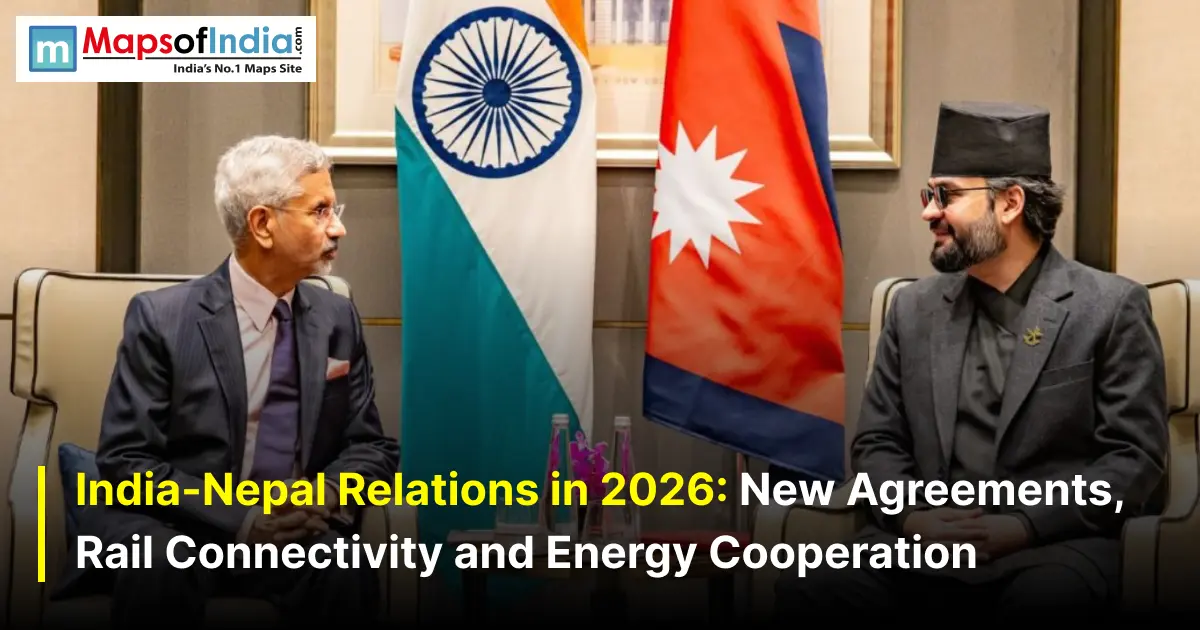
India and Nepal share a unique relationship shaped by geography, history, culture, trade and longstanding people-to-people connections. In 2026, bilateral relations are gaining fresh momentum, with infrastructure development, cross-border railway connectivity, hydropower cooperation and economic partnerships emerging as important areas of engagement. The visit of Nepal Prime Minister Balendra Shah to India on November 22–23, 2026, has further highlighted the importance of strengthening cooperation between the two neighbouring countries.
The talks between the Prime Ministers should give direction to the next phase of bilateral engagement. In the practical dimension, the two sides are seeking to deepen cooperation, and in the bilateral dimension, they aim to resolve their differences by means of diplomatic discussions.
A New Phase in India-Nepal Diplomatic Relations
The visit of Prime Minister Balendra Shah is important because it is his first bilateral visit to India since his leadership in March. The two governments are working on deepening bilateral cooperation in various areas of economic development, infrastructure, technology, education, energy and regional connectivity.
There are some bilateral documents and agreements that will be exchanged during the visit. Topics also addressed include development assistance, investment opportunities, disaster management and climate resilience. One of the significant proposals being looked at is an economic vision document, which will give a more comprehensive plan for future cooperation.
India is also the largest trading partner, a source of investments, and a significant development partner of Nepal. In the case of Nepal, due to its geographical isolation from the rest of the world, it heavily relies on the Indian transport networks for its international trade. It is, therefore, important for both countries to strengthen this economic relationship.
New Agreements and Development Cooperation
Development cooperation continues to play a significant role in India-Nepal relations. Projects with Indian support include education, health care, roads, electric power, agriculture, cultural heritage and community infrastructure.
The two sides are expected to make progress in the area of cooperation in November 2026 through agreements and project-related announcements. In addition, several projects in Nepal are set to be inaugurated virtually by the two prime ministers.
The other important issue to be discussed is financial support for reconstruction in Nepal after the floods. The country has faced heavy floods and related calamities and has had increased infrastructure and rehabilitation needs. India and Nepal are looking at ways to enhance the disaster response, bolster disaster resilience, and support reconstruction.
Other subjects that are under focus are digital technology, innovation, start-ups, sports and higher education. In these sectors, there may be scope for further opportunities for youth participation and for more robust economic partnerships other than those based on trade and infrastructure.
Railway Connectivity Between India and Nepal
One of the key components of the emerging bilateral relationship is railway connectivity. Better rail infrastructure can lower transportation costs, facilitate trade, facilitate tourism, and ease movement between communities along the international border.
There are already two significant railway cross-border links. Jaynagar-Bijalpura railway is the link line between Bihar and the Madhesh region in Nepal, and Jogbani-Nepal Customs Yard railway is the link line between the Indian railway and Biratnagar in Nepal. These projects have contributed to enhancing the movement of passengers and goods between the two countries.
A proposed passenger train service between Ayodhya and Janakpur Dham is another significant development discussed in 2026. Both destinations hold considerable religious and cultural importance because of their association with the Ramayana tradition. It is expected that the proposed service will promote pilgrimage tourism and cultural linkages.
The proposed Raxaul-Kathmandu railway project is also important for the future of regional transportation. The railway would, if developed, offer a direct link between the capital city and the rail network of India, for both passengers and goods. Additional discussions are needed on its implementation and development.
Energy Cooperation and Hydropower Trade
Energy cooperation is a key area of bilateral ties between India and Nepal. Nepal has a significant potential base of hydropower, and India's rising demand for electricity opens the door to possible trade opportunities.
The long-term power trade pact allows India to import up to 10,000MW of power from Nepal over a 10-year period. This would provide Nepal with export revenues and would help India diversify its power supply.
Today, electricity exports are an important source of income for Nepal. In FY 25/26, the country received approximately Rs.1,800 crore per year from net electricity exports to India.
The two nations are also trying to enhance the transmission lines between the countries. One of the important projects under consideration is the 400 kV Gorakhpur-New Butwal transmission line. Improved transmission will enable electricity flows and promote growth in hydropower generation.
In July 2026, the coordinated energy grid operations, solar energy, green hydrogen and technical capacity building were also discussed bilaterally. In these areas, energy cooperation is slowly moving beyond the traditional business of hydropower development.
Trade, Investment and Economic Opportunities
India has a long-standing trade history with Nepal, and this is being strengthened by geographical proximity and good transport infrastructure. India is the top market for Nepal's exports and also a source of foreign investment. Developing customs facilities, roads, railway connections, and logistics infrastructure could be another boost for bilateral trade.
The two governments are also looking into areas of start-up development, financial connectivity and technology. Collaborative initiatives have been in place, supporting training and mentorship for entrepreneurs from Nepal by Indian institutions.
Challenges and the Road Ahead
Though cooperation is high, India and Nepal have some diplomatic challenges to deal with. Kalapani, Lipulekh and Limpiyadhura issues continue to be sensitive ones and require ongoing dialogue. Bilateral relations can also be affected by political differences and concerns related to regional strategic interests.
Both countries, however, have many opportunities to further develop their cooperation at the action level. Progress in railway infrastructure, electricity trade, investment and development assistance can generate lasting economic benefits.
In 2026, India-Nepal relations are increasingly focused on connectivity, energy security and shared development. Sustained diplomatic engagement and effective implementation of proposed initiatives will determine how successfully both neighbours translate their longstanding friendship into a stronger and more productive partnership.
FAQs
1. What is the relationship between India and Nepal?
India and Nepal share close historical, cultural, religious, economic and geographical ties. They maintain diplomatic relations and cooperate in trade, infrastructure, hydropower, security, education and cross-border connectivity.
2. What are the major developments in India-Nepal relations in 2026?
Major developments include high-level diplomatic engagements, new cooperation initiatives, railway connectivity, hydropower development, cross-border electricity trade, digital payment facilities and improved trade infrastructure.
3. What are the new agreements between India and Nepal in 2026?
Cooperation in 2026 has included an agreement on mutual legal assistance in criminal matters, alongside initiatives concerning digital payments, language technology, infrastructure, energy and economic development.
4. Which railway projects connect India and Nepal?
Important railway connections include the Jaynagar-Bijalpura railway line and the Jogbani-Nepal Customs Yard connection. These links support passenger movement and freight transportation between the two countries.
5. How does India help Nepal in hydropower development?
India supports Nepal's hydropower sector through investment, technical cooperation, transmission infrastructure and electricity purchase agreements. Indian participation in projects such as Arun III also contributes to Nepal's electricity generation capacity.
6. What is the importance of India-Nepal trade relations?
India is Nepal's largest trading partner and a major source of investment. Bilateral trade includes petroleum products, medicines, agricultural goods, machinery and manufactured products. India's transport networks also provide Nepal with access to international markets.
7. Why is Nepal strategically important to India?
Nepal is strategically important because of its geographical position between India and China, its shared Himalayan border, cultural connections and economic links. Cooperation with Nepal supports regional security, border management, trade, energy development and stability in South Asia.