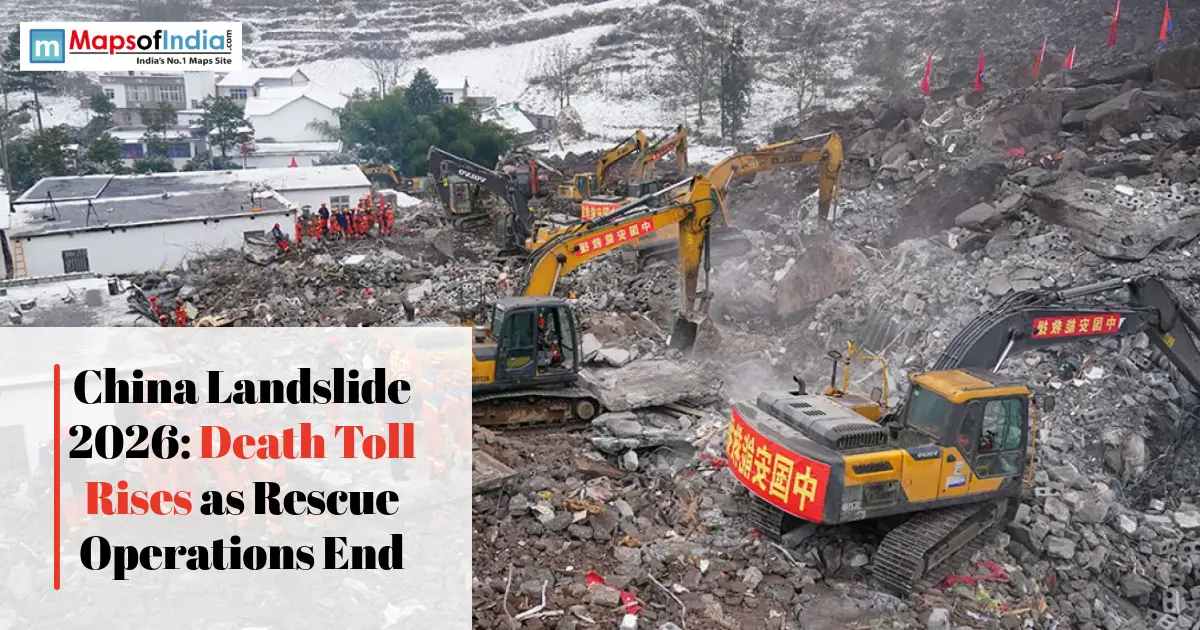
A devastating landslide in Gansu Province, northwestern China, has claimed 21 lives, prompting authorities to conclude rescue operations after an intensive two-day search. The disaster struck Nanhe Township in Longnan City on July 7, 2026, burying homes and trapping dozens of residents beneath mud and rocks. Rescue work was carried out around the clock in harsh weather conditions to find survivors and recover victims. The accident has also caught the attention of the public on the threat of heavy rains and unstable mountain terrain and the increasing incidence of natural disasters caused by the weather in China.
What Happened in the China Landslide?
The landslide was triggered by heavy rainfall in the mountainous region of Nanhe Township in Gansu Province, which persisted through several days. A large portion of a hillside collapsed, with mud, rocks and debris cascading into neighbouring homes as a result of saturated soil and unstable slopes. The landslide engulfed several houses in just a few minutes, and many residents were trapped.
Local officials say 33 people have been caught in the disaster. The affected area was immediately subjected to a process of emergency response including fire fighters, medical staff, police and geological experts. But with continuous rain and unstable ground conditions, the rescue was highly difficult.
Death Toll Rises as Rescue Operations End
After an extensive search operation, officials confirmed that the death toll had risen to 21, with all missing individuals now accounted for. Rescue operations have officially ended after emergency workers recovered the remaining victims from the debris.
Apart from the fatalities, seven people sustained minor injuries and received medical treatment, while five others escaped unharmed. Authorities continue to monitor the area due to the possibility of additional landslides triggered by unstable slopes and ongoing rainfall.
Rescue Teams Worked Around the Clock
Hundreds of emergency workers were deployed, including excavators, drones, sniffer dogs, thermal imaging cameras and traditional digging methods, to sift through the debris. All work had to be done carefully due to the unstable hillside, which was always a risk to rescuers.
Emergency workers fought through the bad weather and the threat of secondary landslides, working day and night until all people trapped by the landslide were found. Rescue efforts were carried out in extremely dangerous circumstances and were commended by officials for their dedication.
What Caused the Landslide?
Preliminary investigations indicate that continuous heavy rainfall was the primary cause of the disaster. Days of rain saturated the soil, significantly reducing the stability of the mountain slope until it eventually collapsed.
Experts say that landslides are caused when water weakens the layers of soil and rock, causing the steep hillsides to lose the ability to hold up their own weight. The massive event was caused by the rugged topography of Gansu Province, coupled with heavy rainfall.
Authorities are continuing geological surveys to determine whether any additional environmental or geological factors contributed to the collapse.
Why Gansu Province Faces Frequent Landslides
Gansu Province is particularly vulnerable to geological disasters because of its mountainous terrain and fragile soil conditions. Many communities are located near steep hillsides where heavy rainfall can quickly destabilize slopes.
In China, rainy seasons are often associated with the risk of landslides and flash floods, as long periods of rain have been observed. Climate change is also driving more extreme weather events, and thus heightening the risk of disasters in several regions of this country, according to scientists.
Impact on Local Communities
For the families of Nanhe Township, the landslide has resulted in great loss of life and livelihood. Multiple residences were destroyed, and many residents were forced to evacuate the area due to falling rubble and debris. Roads were damaged, and rescue efforts were hindered as a result of the road closures; temporary power and communication outages added to the difficulties for local communities.
Provision of temporary shelter, food, medical care and psychological aid for affected people has been made. The reconstruction and recovery process will likely be ongoing for months, with authorities still to determine the extent of damage.
Government Response
The Chinese government responded to the landslide with an emergency response right away. Rescue personnel were immediately deployed, people in areas deemed to be in danger were evacuated, and geologists started studying the slopes around the mountain for other dangers.
The government has also said it will provide support to affected families to find temporary housing and financial aid. Local governments are now urged to increase disaster monitoring and enhance early warning systems in areas prone to disasters in the mountains.
Lessons from the Disaster
The Gansu landslide serves as another reminder of the increasing risks associated with extreme weather. While China has significantly improved its disaster response capabilities through better forecasting systems and emergency planning, sudden landslides remain difficult to predict, particularly in remote mountain regions.
Experts think that ongoing investment in geological monitoring, early warning technology and public awareness will be an important factor in saving lives in future disasters. Community education about evacuation procedures and the identification of high-risk areas will also help save lives.
Conclusion
The China Landslide 2026 has ended in tragedy, with 21 confirmed deaths and rescue operations now officially concluded. Although emergency teams worked tirelessly to search for survivors, the disaster has left lasting scars on the affected communities in Gansu Province.
As authorities shift their focus from rescue to recovery, the incident underscores the urgent need for stronger disaster preparedness, improved monitoring of landslide-prone regions, and effective early warning systems. With extreme weather events becoming more frequent, building resilience against natural disasters will remain a key priority for China in the years ahead.