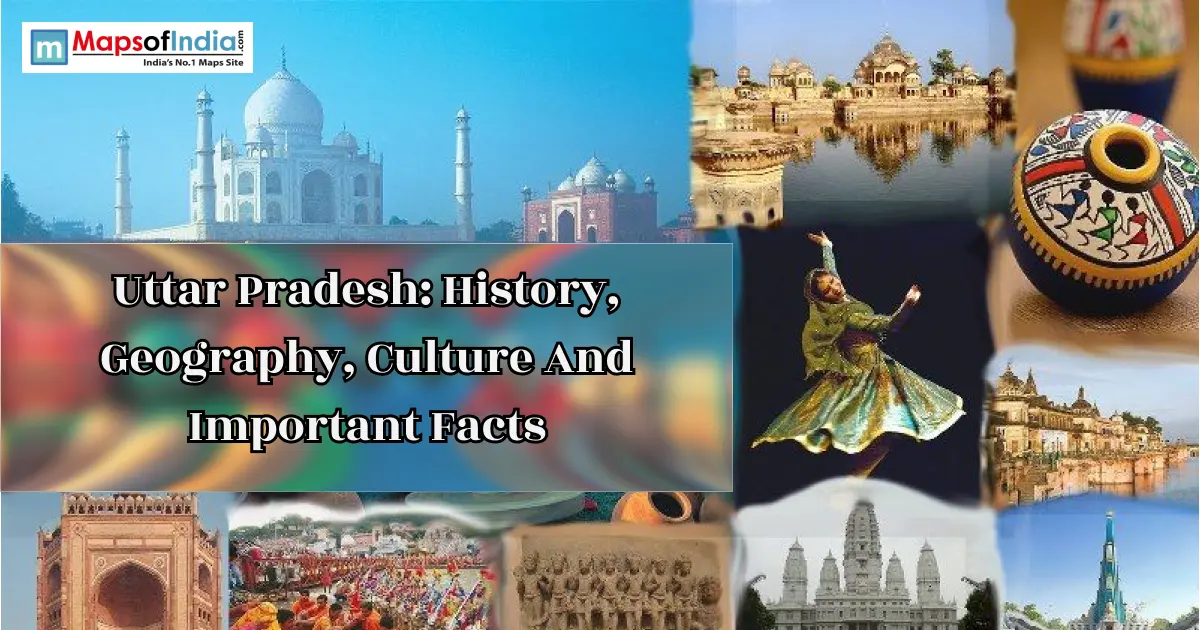
Uttar Pradesh is the heartland of India, which is rich in cultural and historical as well as political significance. It is the most populous state in the nation and has influenced Indian civilisation for thousands of years. Uttar Pradesh is a living museum for the glorious past and dynamic present of India, from the ancient holy cities along the banks of the Ganga to the magnificent Taj Mahal. The state has an important role in the politics, agriculture and culture of the nation. It is an adventure to explore Uttar Pradesh, which is to discover the soul of India.
Geography of Uttar Pradesh
In terms of geographical area, Uttar Pradesh is the fourth largest state of the Indian Union with a geographical area of nearly 243,286 sq.km in the northern part of the country. It is surrounded Uttarakhand and Nepal in the North, and Madhya Pradesh and Chhattisgarh in the South, Bihar in the east, and Rajasthan in the West. The land was crossed by the rivers Ganga and Yamuna, resulting in fertile plains called Doab. The terrain shifts from snow-capped mountains near the Himalayas to the green hills of the Vindhyas. It's like a living heart, fed by ancient waters, on which ancient culture grew long ago.
Ancient and Historical Importance
Rising out of history, Uttar Pradesh was a part of the early story of India. Its reign shifted from the Mauryan to the Gupta period, and thus its legacy developed. From the villages of Ayodhya, where it is said Rama was born, and of Mathura, linked with the visit of Krishna, deep belief prevails. Varanasi is a city that has never ceased to be inhabited. The revolution was quiet when Buddha began giving his first teachings from Sarnath. Armies fought in the fields, including those of the Mughals, in wars that were long remembered across the fields. A land that is older than memory, where the gods walked, faith was planted, and time has formed empires.
Role in India's Freedom Struggle
It was from this land that Mahatma Gandhi started the Non-Cooperation Movement and the Salt Satyagraha. Although Uttar Pradesh's role in the struggle for freedom of India's freedom is not that much emphasised, it was at the core of the struggle. Jawaharlal Nehru was born in Allahabad, which has produced several prominent individuals. The call for Quit India was issued, and people responded without any delay to it in the state. Sorrow left deep impressions out there: the horrifying episode at Jallianwala Bagh and the subsequent events at Chauri Chaura.
Rich Cultural Heritage
On this northern land, voices arose to make centuries. Tulsidas composed epics, and Amir Khusrau composed melodies which are still sung today. In Kathak, a dance that rose from this very soil in the courtyard of the villages and royal courts, rhythm began to take shape to become form. What poetry flows like the air is Urdu poetry raised by generations here. Stitched into fabric are stories too; the delicate trails of Chikankari whisper quiet artistry from Lucknow lanes. Over in Varanasi, breathes life into silk, weaves sarees rich in sheen and history.
Festivals and Traditions
Uttar Pradesh is a state that is extensively enriched by festivals. On Diwali, Holi, Eid or Buddha Purnima, the streets are dyed in colours, lit with lamps, and hearts are filled with prayers. Peace is strongest at Prayagraj, where millions of people gather together every 12 years during the Kumbh Mela without any conflict. The local folks are also celebrating! Navratri dances spin, and Janmashtami chants rise, Ram Navami processions roll through towns. Here, the festivity turns into vibrant expressions of culture, a kind of everyday theatre. Music generatively moves through, and dances tell stories without words. Feasts are not only for food, but also for time.
Famous Cuisine of Uttar Pradesh
Uttar Pradesh is the home of some deep-rooted food customs from the heart of India. Every bite tells royal history flavours, as in slow-cooked kebabs and fragrant rice dishes in Lucknow. Tangy chaat strikes a close resemblance to the street corners of Varanasi, and after it comes the cool thandai. The sweetness of the petha of Agra, which remains a sweet in the mind, is unique and special. In other parts of the region, desserts like golden laddoos, creamy malai ki rabri and syrup-soaked gulab jamun add some flavour. Pictures of street food scenes fill the cities with colour and vibrancy, like Kanpur and Prayagraj. The taste and traditions of the old world, and the patronage of the kings for centuries, produce a myriad of dishes that can be found on every corner.
Important Tourist Attractions
There is a golden aura around Uttar Pradesh, and travellers can experience more than just sightseeing. Agra's Taj Mahal has two crowns: Marble and UNESCO, both of which are among the wonders in stone. In Varanasi, steps plunge into the water, and faith resonates through the carved pillars of Ayodhya, along the Ganges. The monks used to walk in Sarnath amongst the quiet trees, which are still felt today. There are so many more: old walls in Lucknow tell a tale of the past, and grit in Jhansi, river bends in Prayagraj. Dudhwa National Park is a wildlife refuge that lies in the midst of its forests. Just like a place with historic temples and peaceful riverbanks, under the open sky.
Economy and Development
Here, farming permeates the land, with fields as far as the eye can see of sugarcane, wheat and, yes, potatoes. The factories are louder now, as are more and more tech offices and service industries. Of course, Noida is the standout, closely followed by Greater Noida, which is emerging as an industrial hub and hub for digital work. Due to this, roads improve, policies change in a good way, and investments are encouraged and begin to flow. It was once a site that was ignored, but now it's improving, little by little, and becoming something that cannot be ignored, year by year.
Why Uttar Pradesh Stands Out
What makes Uttar Pradesh unique is just the way it resonates within India's narrative. Beginning here were centuries of change, not only in power but in thought, belief, and music. At the beginning of each morning, along the meandering river Ganga, it is not noise but quiet chants. A marble wonder, near Agra, which is not silent but speaks without words. Lives are layered with ancient traditions and new highways, rural beats and urban pace. If you're going to understand India, you need to travel its streets and listen to different dialects at every turn, some say. Not because it’s perfect but because it tries, breathes, stumbles forward. It's like a pulse underneath the skin, but you can't see it; it's there, it's there all the time.