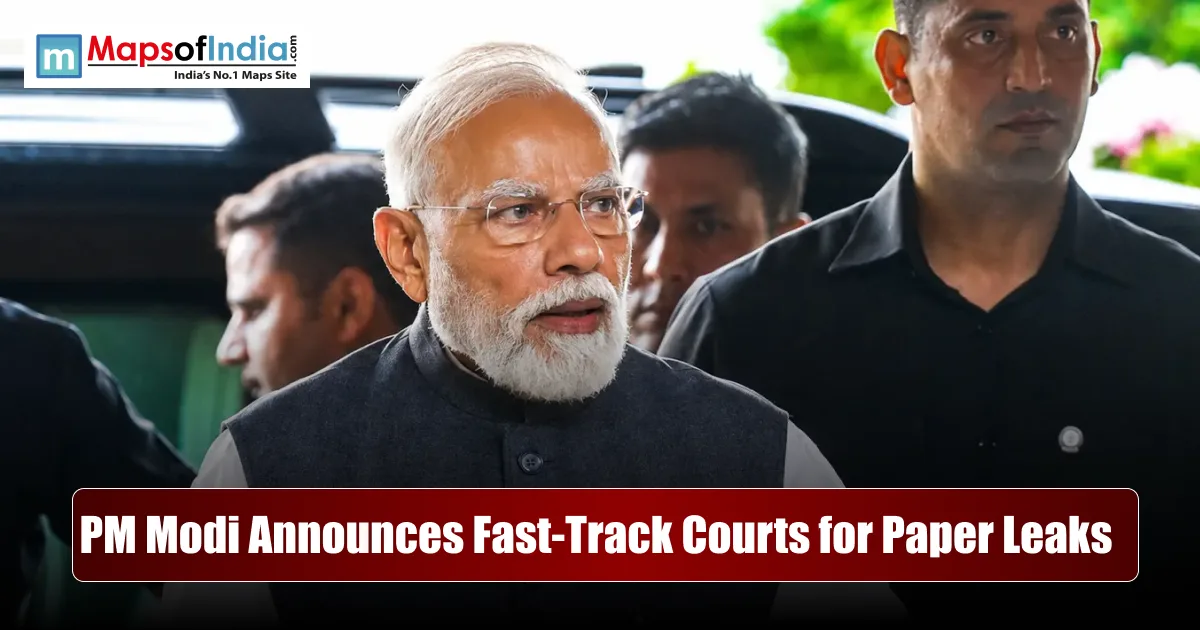
Central Government has launched a huge legal drive to address one of the most significant issues in Indian education: exam paper leakage. The government will set up fast-track courts for paper leak cases, which will be tasked with speeding up trials, ensuring tougher punishment and making people responsible for examination fraud, Prime Minister Narendra Modi announced.
The announcement coincides with paper leak scandals making the news at a national level. Allegations of the leakage of question papers have been made in the recruitment exams as well as entrance tests, leading to protests and litigation and mounting calls for systemic change. Year after year, millions of students who have taken years to prepare for competitive exams have been requesting greater measures to preserve the integrity of the exam process.
The government is trying to tackle both the crime and one of the biggest criticisms of the past investigations, the time-consuming judicial process which often delays justice.
PM Modi's Announcement: A Stronger Legal Response
In his remarks on the matter, Prime Minister Narendra Modi once again stated that it is not possible to compromise the future of young India with organized examination fraud. The Centre will set up fast-track courts to deal with paper-leak cases so that investigations and trials are conducted within a shorter period of time, he said.
The PM says that the aim is simple: People who have leaked examination papers, tampered with the recruitment process, or run a cheating syndicate must be met with a speedy legal response. He said that more speedy trials will not only help punish the offenders but also deter them from committing similar offences in future.
It is being seen as one of the toughest legal moves the government has made against examination-related fraud, which used to be just about ensuring exams were more secure, but now also that there is quicker judicial action against those who commit examination fraud.
Why This Announcement Matters?
India is no stranger to paper leaks. But over the years, the incidence of such incidents has become a serious concern to the credibility of competitive exams. Leaks have been a problem with major entrance exams and recruitment exams, forcing officials to reschedule exams and re-test or launch wide-scale investigations.
The issue has come to the forefront of discussion after various controversies have erupted over national-level examinations recently. Students, parents, the education fraternity and political leaders have all been urging more stringent measures be taken against those who have been responsible for the breach in the examination system.
The latest announcement is noteworthy because it's not just about administrative changes. The government is now pinning its hopes on getting paper leak-related cases through the system much quicker, rather than just relying on better security measures.
This is designed to increase accountability and reduce the risk of accused people mounting a successful defence and avoiding prosecution.
What Are Fast-Track Courts?
Fast-track courts are special courts established for the hearing of certain types of cases in an urgent manner. Fast-track courts, unlike normal courts, do not have a large number of pending cases, but they are concentrated on the fast disposal of certain cases.
The government of India has had fast-track courts in the past for crimes against women, children, and other pressing issues before the court. The government's proposal for examination fraud to be punishable under a similar mechanism in cases concerning paper leak is an indication of its desire to consider examination fraud to be a serious offence against the country's interests.
These courts have the potential of saving considerable time in investigations, hearings and final verdicts when properly utilized.
How Will Fast-Track Courts Work?
The government has not yet provided detailed working procedures, but in the proposed courts, cases that involve paper leaks will be given the first priority, from the investigation stage all the way to delivering judgments.
The collaboration between investigating agencies, state police, cybercrime units, prosecution and judiciary will probably be increased. This would help clear cases quicker, as some have been pending for years in the Indian judiciary, which has been a criticism of the system.
The faster convictions, the better it will be as a deterrent to organized examination fraud that can cross state lines, according to legal experts.
Connection with Recent Exam Controversies
The announcement comes amid heightened public scrutiny over recent paper leak allegations, particularly those linked to competitive entrance examinations and government recruitment tests.
The alleged NEET-UG 2026 paper leak has remained one of the most discussed issues in the education sector, triggering student protests, political debates, and court proceedings. Similar allegations involving recruitment examinations in different states have further intensified demands for stricter legal action.
These incidents have brought to light the existence of organized groups that are obtaining and disseminating private examination papers illegally. Agencies have arrested several individuals in the last several months, and trials in such cases may take years to be completed.
The government's measure to set up fast-track courts seems to have been designed to solve this problem by providing a speedy delivery of justice.
Will Fast-Track Courts Solve the Paper Leak Problem?
The announcement has been met with some relief from students and education experts, but most think the fast-track courts won't be enough to overcome paper leaks.
Other reforms needed for the success of the initiative include: robust examination security measures, enhanced digital systems, secure transmission of question papers, better monitoring of examination centres, and effective coordination between examination authorities.
Technology is expected to play a more and more important role. To curb the chances of examination cheating, experts have suggested using artificial intelligence for surveillance, encrypted digital question papers, biometric verification systems, and real-time monitoring.
While fast-track courts can provide for faster punishment, getting rid of paper leakage in the first place will call for ongoing improvement of examination management.
What This Means for Students?
For millions of students preparing for competitive examinations, the announcement offers hope that examination fraud will be dealt with more seriously than before.
The expedient process of the court can deter criminal networks from trying to influence examinations and put candidates' minds at ease that those who influence them will not go unpunished for delayed trials.
Students have always said that they shouldn't be punished for the mistakes made by their administrators, or for the illegal behaviour of some people. Fast-track courts, if used properly, would bring back confidence in the fairness of competitive examinations, as well as the uncertainty arising from frequent paper leaks.
The transfer is also an indication that the government will also toughen up the legal measures along with administrative changes to safeguard the interests of the real contenders.
Challenges That Still Need Attention
Although the announcement was well-intentioned, there are a number of issues to clear up.
Speedy justice can only be provided by fast-track courts if investigations are conducted in an efficient manner and the evidence produced in the investigations is strong. The overall time frame of cases may still be influenced by delays in evidence collection and/or in the forensic analysis and prosecution.
The government will also have to ensure adequate judicial infrastructure, recruitment of adequate judges and appointing specialized prosecutors to effectively deal with examination fraud cases.
Furthermore, it is important for central and state governments to work together, since many leak cases involve organized crime gangs and multiple states.
If these measures are not put in place, the advantages of fast-track courts could be curtailed.
The Bigger Picture
The country has some of the biggest entrance and recruitment tests held around the world, and hundreds of millions of candidates take them annually in an effort to secure a seat at the institutions, as well as a position in the government sector. Such exams are crucial not only for students but also for educational institutions, employers, and the country's administration, for the credibility they lend.
Setting up fast-track courts is just one step to improve transparency, accountability, and fairness in the examination process. Although examination fraud does not simply go away with legal change, the speed and effectiveness with which action is taken will certainly be enhanced.
With the backing of improved technology, security measures and institutional changes, this could be a watershed moment in India's battle against paper leaks.
Conclusion
Prime Minister Narendra Modi's announcement to establish fast-track courts for paper leak cases marks an important development in India's ongoing efforts to protect the integrity of competitive examinations. By prioritizing quicker trials and stricter legal action, the government aims to ensure that those responsible for compromising examinations are brought to justice without unnecessary delays.
It's not just about a legal change; it's about the students who are working hard and hoping for a better future being protected. It will be the next few months that will show how quickly these courts are set up and how they perform. In the context of improving examination security and administrative processes, fast-track courts can become a significant check and balance to restore the confidence of the public in the education and recruitment system in India and reaffirm the notion of merit over malpractice.
FAQs
1. What are fast-track courts for paper leak cases?
They are special courts that will hear paper leak cases on priority to ensure quicker trials and faster judgments.
2. Why is the government setting up fast-track courts?
To speed up justice, punish offenders swiftly, and curb examination fraud.
3. Which exams will these courts cover?
They are expected to cover paper leak cases related to national and state-level entrance and recruitment exams.
4. How will fast-track courts help students?
They can improve trust in exams by ensuring faster action against those involved in paper leaks.
5. Are these courts linked to the NEET 2026 paper leak?
The announcement follows recent exam controversies, including NEET-UG 2026, but the courts are meant for paper leak cases across all major exams.
6. Will fast-track courts prevent future paper leaks?
They can deter offenders through quicker punishment, though stronger exam security is also essential.
7. When will the fast-track courts start functioning?
The government has announced the proposal, while the implementation timeline is yet to be officially announced.