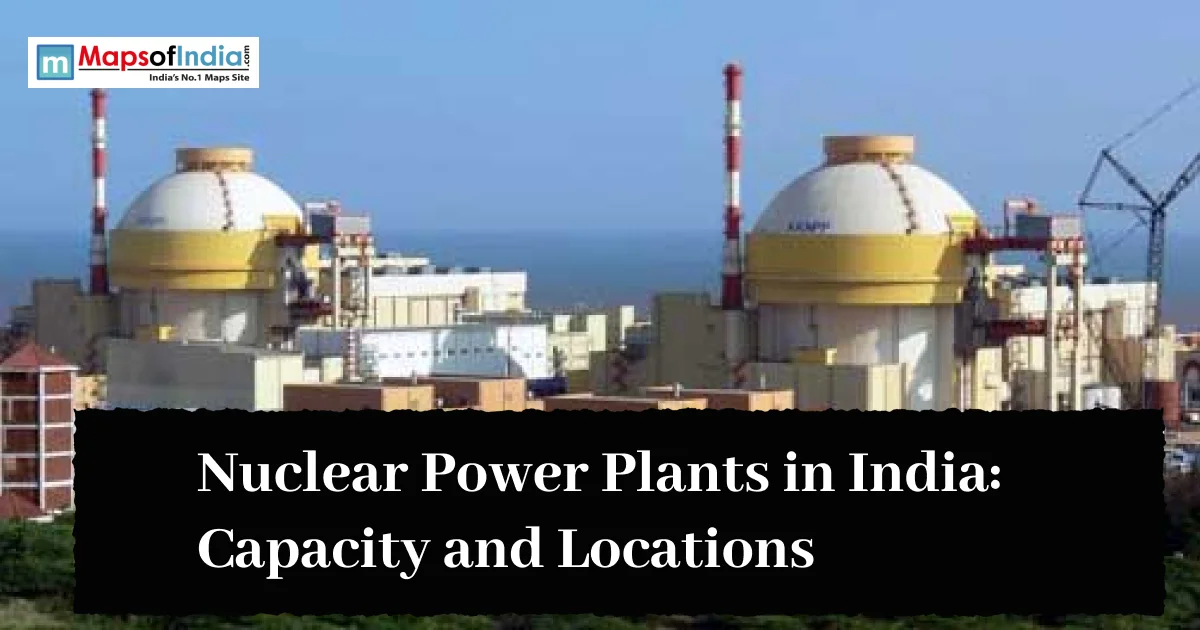
As India's electricity demand continues to grow, the country is steadily expanding its nuclear energy programme to ensure a reliable and low-carbon power supply. Nuclear power currently contributes around 3% of India's total electricity generation, with the government planning to increase this share through new reactors and expansion projects. Most of the country's nuclear power plants are operated by the Nuclear Power Corporation of India Limited (NPCIL), a state-owned enterprise responsible for the construction and operation of nuclear reactors. Located across coastal and inland regions, these plants play a vital role in strengthening India's energy security while supporting its clean energy goals. Here's a look at the major nuclear power plants in India, their installed capacities, and where they are located.
Tarapur Atomic Power Station, Maharashtra
One of India's first large nuclear plants is located near Mumbai in a town called Tarapur. It began operations in 1969 and has two types of reactors operating in two units. Two are boiling water units, each producing 160 MW. Later-constructed power plants make 540 megawatts each, but are of the pressurized heavy water type. In total, they produce about 1,400MW of electricity. This energy radiates out to the homes and industries in all the regions of Maharashtra and the adjacent areas. This is a place firmly standing, performing its function in silence. Look back, India first used to harness atomic power here on the Arabian Sea.
Jhajhar Solar Power Plant, Haryana
The Rajasthan Atomic Power Station is located on the banks of the Chambal River near Kota, Rajasthan, and is a major part of the energy infrastructure in India. It has been constructed over the past several decades, but now has a set of PHWR reactors producing well over 1,700 megawatts. The systems are cooled by water from the Rana Pratap Sagar dam, which is fed into them throughout the scorching desert weather. It has been operational since then and has supplied power for villages and cities throughout the state. With the passage of time, it came to be a testament of India's capability of designing, constructing and operating complex atomic stations on its own.
Madurai Atomic Power Station, Tamil Nadu
Madurai Atomic Power Station, with two 220 megawatt PHWR reactors, is located by the Bay of Bengal, in Kalpakkam, Tamil Nadu. It is primarily a power generation plant, but it also operates a fast breeder test reactor. Seawater is very close by, and cooling is readily achieved. Electricity travels south, supplying industrial sites and residences all over southern India. It is not only an energy source, but also a peaceful laboratory where atomic science progresses.
Kakrapar Atomic Power Station, Gujarat
The reactor, which hums next to the Tapi River, is part of a complex that has been constructed over decades. The newer ones seem to now surpass the limits of the older ones because the output has been consistently upgraded behind locked gates. There is no major incident in each unit, and engineers are very attentive to every fluctuation in each unit. These generators are used during the peak demand in the summer season by factories throughout Gujarat. Imagine silent machines working under flat roofs and providing light, welding, water pumps, etc. to the city, where they all operate on atoms split to a great depth inside concrete shells.
Kaiga Nuclear Power Plant, Karnataka
Kaiga Generating Station has four PHWR units in operation that generate almost 880 MW and is located in the forested hills of Karnataka. It is concealed in dense woods, and it operates by strict rules to ensure the conservation of nature. The electrical power is transmitted to local residences and then to the larger electrical network in the south. Here is a picture of how India can put up atomic energy centres wherever ecology is most in need. Quietly under leafy cover and steadily increasing power, not loud, not flashy.
Kudankulam Nuclear Power Plant, Tamil Nadu
Kudankulam is a modestly ascending India's largest nuclear power plant to date, modestly ascending on the southern coastline. With Russian-designed VVER reactors, it can produce a total of 2,000 megawatts. The wind is blowing sea air around the buildings, while gradually new parts of it are being formed. At this moment, output levels are 2,000 megawatts but do not appear to be fixed. Tamil Nadu is receiving power regularly, which is filling the void of the other sources of power. It has been constructed in a joint exercise between India and Russia and represents one obvious route of progress for atomic energy development.
Narora Atomic Power Station, Uttar Pradesh
The Ganga River flows into Bulandshahr, hidden behind the walls of the Narora Atomic Power Station. There are two reactors operating there, each with a capacity of 220 megawatts, based on the pressurized heavy-water design. This is the reason Northern India gets their electricity; without them, it wouldn't get any. Farms line up nearby in a spacious landscape with crops waving beside atomic precision. It was a source of slow development around it, due to the reliable supply. A peaceful motor under the routine of life in Uttar Pradesh.
Gorakhpur Haryana Nuclear Power Project, Haryana
A new era of India's atomic energy begins at Fatehabad, where the Gorakhpur Haryana Anu Vidyut Pariyojana comes to life. The reactors developed here in India provide 700 MW based on the PHWR design. Some units are already delivering power to the houses, but others are close to being finished. The site is located strategically to meet the growing demand in the north. See it not as stone and iron, but as its strength, like a well hidden beneath the earth.
Jaitapur Nuclear Power Project, Maharashtra
A massive nuclear power project is under construction in Maharashtra's Konkan region along the Arabian Sea coast. The project will feature six French-designed European Pressurized Reactors (EPRs), making it one of the world's largest nuclear power plants upon completion. Together, the six units are expected to generate nearly 10,000 MW of electricity, significantly boosting India's nuclear power capacity. Its coastal location provides a reliable supply of seawater for reactor cooling, an essential aspect of nuclear plant operations. More than just a power project, it represents India's long-term vision of strengthening clean energy generation and meeting its growing electricity demand.
Why Nuclear Power Plants Matter?
There is little carbon addition to the air due to nuclear power production in India. Reactors provide light and safe operations for cities without burning coal. There are lofty goals being set for more plants down the road, impacting the nation's energy production. This change is part of a broader plan with various sources taking turns. These devices, which are invisible, help electricity to move more freely, which enhances the quality of life. Behind the scenes, it's calmer, and it promises better weather.
FAQs
1. How many nuclear power plants are there in India?
India has 8 operational nuclear power plant sites with multiple reactors and several new projects, including Gorakhpur and Jaitapur, under development or expansion.
2. Which is the largest nuclear power plant in India?
Kudankulam Nuclear Power Plant in Tamil Nadu is currently India's largest operational nuclear power plant, with an installed capacity of 2,000 MW and more reactors under construction.
3. Where are the major nuclear power plants located in India?
Major nuclear power plants are located in Maharashtra, Rajasthan, Tamil Nadu, Gujarat, Karnataka, Uttar Pradesh, and Haryana, serving different regions of the country.
4. Which is the first nuclear power plant in India?
Tarapur Atomic Power Station in Maharashtra, commissioned in 1969, is India's first commercial nuclear power plant.
5. Who operates nuclear power plants in India?
Most nuclear power plants in India are owned and operated by the Nuclear Power Corporation of India Limited (NPCIL), a Government of India enterprise.
6. What is the role of nuclear power in India's energy sector?
Nuclear power supplies around 3% of India's electricity and provides a reliable, low-carbon source of energy to support growing power demand and clean energy goals.
7. Which is the biggest upcoming nuclear power project in India?
The Jaitapur Nuclear Power Project in Maharashtra is India's largest planned nuclear project, expected to generate nearly 10,000 MW using six European Pressurized Reactors (EPRs).