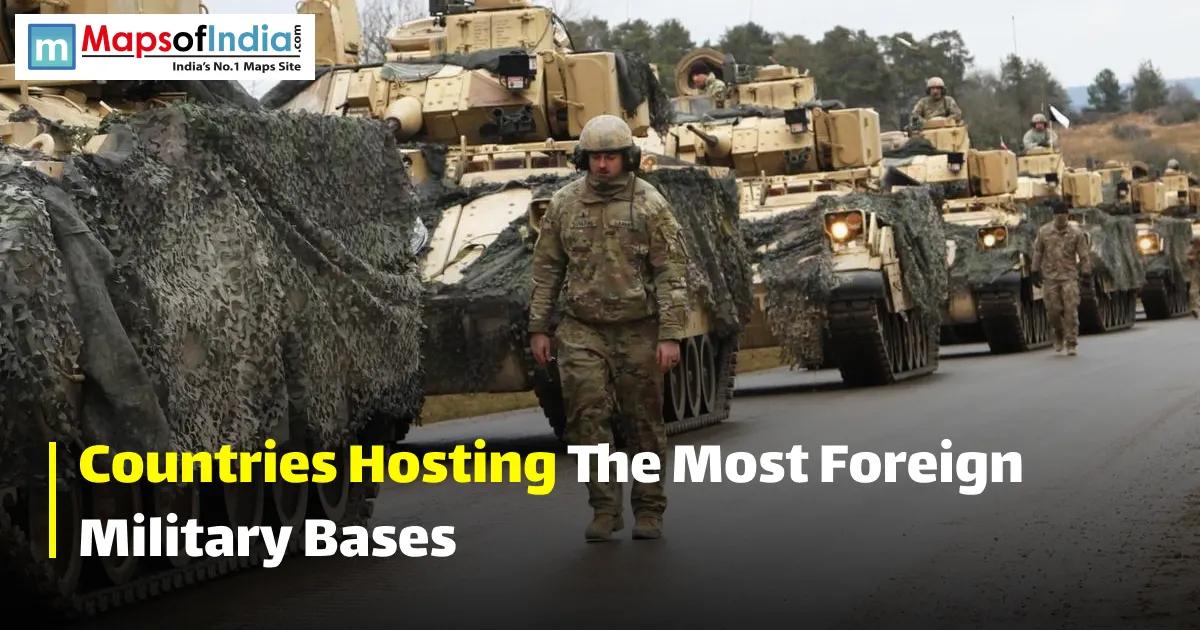
Foreign military bases are concentrated in a small number of countries, particularly Japan, Germany, South Korea, and Italy, where the United States maintains extensive overseas infrastructure. The Pentagon's FY2025 Base Structure Report provides one of the useful datasets, although its definition of a "site" is broader than a traditional military base. Counts therefore vary significantly by source and methodology.
Foreign military-base figures are difficult to compare because some databases count major installations while others include training areas, communications sites, housing, logistics facilities, or access arrangements. This article uses U.S. Congressional Research Service and Department of Defence data where possible while identifying estimates separately.
How Many Foreign Military Bases Exist Worldwide?
What counts as a "foreign military base"?
A foreign military base is generally an installation or facility located in one country but operated, controlled, or used by the armed forces of another country. However, the term can cover different arrangements.
A large permanent installation with thousands of personnel is clearly different from a communications site, logistics facility, or training location. Some countries also receive forces through access agreements without hosting a conventional foreign-owned base. The U.S. Congressional Research Service (CRS), for example, distinguishes bases from other military sites and access arrangements.
Why estimates differ between sources
There is no accepted global database that counts every foreign military base using one definition. The U.S. The Department of Defense's Base Structure Report counts sites within its real-property system, while CRS uses an inventory for its analysis of U.S. Overseas basing.
CRS identified 128 U.S. bases and sites across 49 countries and territories in its 2024 study, while broader Pentagon site counts can produce much larger numbers because they include additional categories of installations. This is why a global ranking should always identify its source and definition rather than presenting one number as definitive.
Which Countries Host the Most Foreign Military Bases?
The countries strongly associated with large foreign military footprints include Germany, Japan, South Korea, and Italy, particularly because of the scale of the U.S. Presence. Pentagon site data summarized from the FY2025 Base Structure Report put the number of U.S. Sites at 122 in Germany, 98 in Japan, 80 in South Korea, and 47 in Italy, although these figures should be understood as "sites," not necessarily conventional bases.
Japan
Japan hosts one of the world's concentrations of U.S. Military infrastructure and personnel. CRS reported 54,774 permanently assigned active-duty U.S. service members in Japan in March 2024, with facilities supporting Army, Navy, Marine Corps, and Air Force operations.
The presence is rooted in the post-World War II U.S.-Japan security relationship and Japan's strategic position in the Indo-Pacific. The U.S.-Japan Status of Forces Agreement provides the framework governing the status of U.S. Forces and their activities in Japan.
Germany
Germany has hosted a U.S. Military presence since the end of World War II and remains one of the most important overseas locations for U.S. Forces in Europe. CRS reported 35,068 permanently assigned U.S. service members in Germany in 2024 alongside major Army and Air Force infrastructure.
Germany's location makes it a major logistics and command hub for NATO operations in Europe. Its facilities also support training, transportation, medical services, and the movement of forces to parts of the continent.
South Korea
South Korea hosts the U.S. Military presence as part of the U.S.-South Korea alliance and the effort to deter potential aggression from North Korea. CRS recorded 24,234 permanently assigned active-duty U.S. service members in South Korea in March 2024.
The two countries also operate a combined command structure, making the U.S. presence more closely integrated with South Korean defence planning than a simple foreign-base arrangement.
Other major hosts
Italy, the United Kingdom, Japan, South Korea and Germany are among the important locations for the U.S. Overseas network, while Djibouti and several Gulf states are strategically significant despite having fewer permanent installations.
Italy hosts U.S. Sites supporting European and Mediterranean operations. The United Kingdom is also important because of its standing defence relationship with the United States and its strategic position between Europe and the Atlantic.
Djibouti is particularly significant because of its location near the Bab el-Mandeb Strait, a maritime chokepoint connecting the Red Sea with the Gulf of Aden.
Which Countries Operate the Most Bases Abroad?
The United States
The United States operates the world's extensive overseas military network. CRS identified 128 U.S. bases and sites in its narrower 2024 inventory, while broader estimates based on Pentagon real-property data count hundreds more sites. The difference illustrates why comparisons must specify whether they are counting bases, sites or facilities.
The U.S. Network developed through World War II, the Cold War, bilateral alliances, and later counterterrorism and regional-security operations. Today major concentrations remain in Europe and the Indo-Pacific with infrastructure in the Middle East and Africa.
Russia
Russia maintains an overseas military footprint than the United States concentrated largely in countries close to its borders and within the former Soviet sphere. Its overseas military presence has historically included arrangements in countries such as Armenia, Belarus, Kazakhstan, Kyrgyzstan and Tajikistan as well as a long-standing presence in Syria.
Because Russian deployments and facilities can change with military circumstances, public estimates vary considerably.
France and the United Kingdom
France and the United Kingdom retain military facilities and access arrangements reflecting their colonial histories, defence alliances and continuing interests in Europe, Africa, the Middle East and the Indo-Pacific.
However, both countries have also reorganized parts of their overseas footprints. Their modern networks are generally smaller than the U.S. Network. Increasingly focused on specific strategic partnerships and regional missions.
China and Turkey
China's overseas military network remains much smaller than that of the United States. Has been expanding its external military relationships. Its established overseas base at Djibouti and the development of the China-Cambodia facility at Ream have attracted attention.
In September 2026, China and Laos opened an operational support and training centre at Ban Keun Airport. China describes the facility as a training arrangement rather than a base directed against another country, while outside analysts have debated whether its capabilities could eventually give China a broader military presence in Southeast Asia.
Turkey also maintains a growing military footprint, particularly through arrangements in regions where it has developed close security relationships.
Why Do Countries Host Foreign Military Bases?
Security alliances and deterrence
One of the reasons countries host foreign military forces is to strengthen an alliance. A permanent or semi-permanent foreign presence can signal that an attack on the host country would involve its security partners.
Japan and South Korea are examples. Their arrangements with the United States developed around regional security concerns and continue to play an important role in deterrence.
Legacy of World War II and the Cold War
Many modern foreign military bases are legacies. The United States established overseas infrastructure during World War II and maintained much of it after the war as Cold War alliances developed.
Germany, Japan, and South Korea are particularly important examples of this post-war pattern. Over time, some installations have closed, changed missions, while others have remained strategically important.
Strategic locations and chokepoints
Geography is another factor. Bases and military facilities can provide access to maritime routes, air corridors, and regions where forces may need to respond quickly.
Djibouti's position near the Bab el-Mandeb is one example. Diego Garcia in the Indian Ocean is another, with the UK government describing the UK-US facility as strategically important for operations across the Indian Ocean, Middle East, Indo-Pacific and Africa.
Economic and political incentives for host nations
Host countries can receive benefits from foreign military infrastructure, including construction spending, employment, infrastructure investment and payments under burden-sharing arrangements.
However, the financial relationship is complicated. CRS notes that debates over whether host nations contribute toward U.S. Basing costs have existed since the early Cold War, with different analysts reaching different conclusions about the appropriate balance.
Which Regions Have the Highest Concentration of Foreign Bases?
East Asia and the Pacific
East Asia is one of the most concentrated regions because of U.S. Alliances with Japan and South Korea and the wider strategic competition involving China. The U.S. Military presence also extends through Australia, the Philippines, and other Pacific locations.
The Philippines, for example, has expanded the number of locations for the U.S. Forces under the Enhanced Defence Cooperation Agreement. In 2023, four additional locations were added to the five existing agreed locations.
Europe
Europe contains a network of foreign and multinational military infrastructure. Germany, Italy, and the United Kingdom are important hosts for U.S. Forces, while NATO's collective defence system adds another layer of multinational military infrastructure.
Following Russia's full-scale invasion of Ukraine in 2022, the United States also expanded its military presence and rotational deployments in several Eastern European countries.
The Middle East
The Middle East remains strategically important because of energy infrastructure, maritime routes, regional conflicts, and the proximity of major security concerns.
Countries including Qatar, Bahrain, Kuwait, and others have U.S. Facilities or allow U.S. Forces to use their territory. Qatar, for example, has spent a lot on building things that help the U.S. Military stay there.
Africa and the Horn of Africa
Africa has more permanent foreign military bases than Europe or East Asia, but the Horn of Africa has a lot of foreign military activity.
Djibouti is very important because many countries have facilities or agreements to use the area. The country's position near the Red Sea and Bab el-Mandeb makes it very useful for protecting the sea and for operations in the region.
How Are Foreign Bases Controlled?
What is a Status of Forces Agreement?
A Status of Forces Agreement (SOFA) creates the rules for foreign soldiers who are in another country. Depending on the agreement, it can handle who is responsible for crimes, taxes, moving in and out, claims, using buildings, and duties between the two governments.
Not every foreign military presence uses the SOFA. Some use defence cooperation agreements, access agreements, memorandums of understanding, or other agreements between countries.
Who pays for the bases?
The cost can be shared between the country sending the military and the country hosting them. Payments can include money, building work, utilities, land, structures, or other support.
For example, CRS said that Japan and South Korea gave a lot to help pay for the U.S. Base costs, while it can be hard to know exactly how much support the host country gives because some help is not clear.
Sovereignty, control and local anger
Foreign military bases do not take away the host country’s right to rule its land. Instead, the host government and military talk about what rights and duties they have.
Control can still be a problem. SOFAs may set up who handles kinds of crimes, causing debate about which country’s courts should deal with a case.
Local anger can also affect decisions about where to place bases, especially when people are worried about land use, the environment, noise, safety, or the political effects of having forces.
Are Foreign Military Bases a Problem?
Reasons to support
People who like bases say they can help keep things safe, make alliances stronger, and allow quick responses. RAND's study of U.S. bases abroad said there are benefits like being ready, keeping things safe, making allies feel secure, and helping with security work.
Host governments may see forces as a way to make their own security better, get help with military work, and bring in building projects.
Reasons against
Critics talk about the money needed, the effects on the environment and people's problems with a country's right to rule and the risk of getting in trouble.
RAND also found that having bases can be more expensive sometimes and that these places can be attacked. Other critics say a foreign military presence can put a host country in conflicts it would otherwise not be involved in.
Because these ideas are debated, claims about whether bases are good or bad should be linked to governments, researchers, or groups, not presented as clear facts.
Are Foreign Bases Increasing or Decreasing?
New bases, closures, and agreements
The world situation is better described as changing than just growing or shrinking.
The U.S. Left Niger in September 2024 after ending Air Base 101 in Niamey and Air Base 201 in Agadez. The move happened after the old security relationship between Washington and Nigeria's military government broke down.
At the time, the U.S. had made more agreements in other places. The Philippines and the U.S. added four places to their EDCA agreement in 2023, and more deals kept investing in those places.
The UK-US military presence on Diego Garcia also got a long-term agreement in the 2025 UK-Mauritius deal. Mauritius got control of the Chagos Archipelago while plans were made to keep the UK-US base on Diego Garcia going.
China opened the China-Laos Joint Support and Training Centre in September 2026. Reuters said satellite pictures showed buildings at the site, while China says it is a place for training together and not a base aimed at another country.
What experts are looking at next
The main thing to watch is whether countries prefer bases or smaller, more spread-out access plans. Competition in the Indo-Pacific, changes in how NATO acts in Europe, problems near the Red Sea, and changes in U.S. Plans could all affect where military bases are.
The difference between an old-style base and a group of temporary or shared places is becoming more important. This makes counting bases less helpful for knowing the military size around the world.
Conclusion
Germany, Japan, and South Korea are still some of the most important places for foreign military bases, while Italy, the UK, Gulf states, and Djibouti also have big roles. The U.S. has the biggest overseas network, but other countries, like Russia, France, the UK, China, and Turkey, have their military bases.
Because definitions change, the best way to compare bases is to look at the data and tell the difference between bases, sites, buildings, and access agreements. Understanding how this works is important when looking at military rankings.
FAQs
Which country has the foreign military bases?
The U.S. has a network of bases outside its own country. The exact number of bases depends on how it's measured. CRS found 128 bases in its 2024 list, while other estimates say there are hundreds more. No single list is accepted as the one.
Which country has the U.S. Soldiers?
Japan has been the place for U.S. Soldiers for a long time. CRS said about 54,774 active U.S. Soldiers were based in Japan in March 2024 compared to 35,068 in Germany and 24,234 in South Korea.
How many countries have the U.S. Bases?
The number depends on what counts as a base. CRS found 128 bases and sites in 49 countries and areas in 2024. Other estimates count more because they include places and buildings that CRS does not see as long-term bases.
Does China have bases outside its country?
Yes. China has a base in Djibouti. Has built more places and partnerships. China and Cambodia opened a training centre in 2025. In September 2026, China and Laos opened another one. China does not call it a base.
Do countries pay to have bases?
The way they pay changes. The host country may give money to build things, provide services, land, or other help. CRS says Japan and South Korea have given a lot to help with U.S. Base costs. Some help is hard to measure because it is not clear.
Can a country ask the military to leave?
Yes, if the agreement allows it. Foreign bases depend on the host country's agreement and the rules that are set. The U.S. Leaving Niger in 2024 shows that a foreign presence can end if the political and legal relationship changes.
What is the difference between a base and a facility?
A base is usually a place that supports long-term military operations, people, or equipment. A facility or place can be smaller, like a place for communication, logistics, training, or support. Datasets count these in different ways, so the number of bases and the number of facilities should not be treated the same.