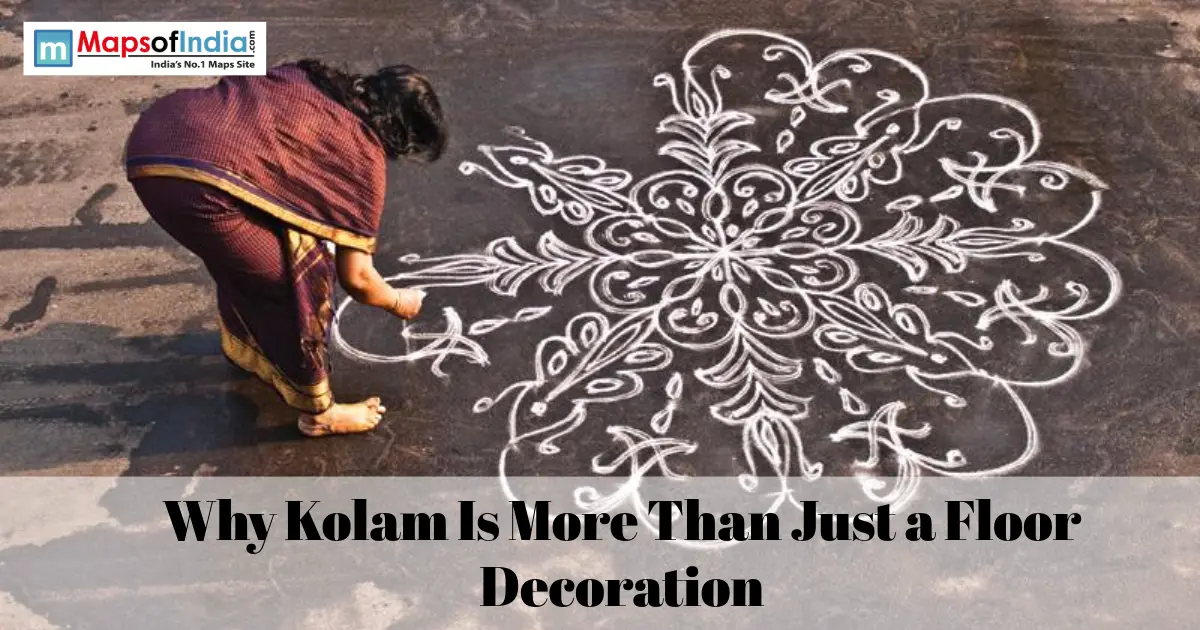
Kolam is a floor art created using rice flour and is a traditional art that is used in South India beyond its decorative aspects. It can be used as a daily mantra, as a way to feed the insects and birds, and as an authentic celebration of mathematical symmetry, handed down by women through the generations. Knowing what kolam means is knowing about a true fusion of art, ecology and devotion, all occurring in a person's home before dawn.
What Is Kolam?
Etymology and Regional Names
Kolam is the Tamil name for this art form. Head north, and the same basic tradition gets called rangoli. In Andhra Pradesh and Telangana, it's muggu. Different names, same core idea: a pattern drawn fresh on the ground, usually right at the entrance to a home.
Materials Used
Traditional kolam uses rice flour, ground fine and let fall through the fingers onto swept earth or stone. Chalk powder and colored powders show up too, especially for festival versions, but plain white rice flour remains the everyday standard.
The Spiritual Significance of Kolam
Kolam as a Daily Offering to Goddess Lakshmi
Many Tamil households draw kolam specifically to welcome Lakshmi, the goddess of prosperity, into the home each morning. It's treated as a small, repeated act of invitation, not a one-time decoration.
Threshold Symbolism
The doorway matters here. A kolam sits right at the threshold, the exact spot where outside meets inside, symbolically inviting good fortune in while pushing negativity back out.
Why It's Drawn Fresh Each Dawn
This is the part that trips a lot of people up. A kolam gets walked over, rained on, and swept away within hours of being drawn, and that's completely intentional. Its impermanence is the actual point. Drawing something beautiful, knowing it won't last the day, is itself treated as an act of devotion and humility, not wasted effort.
The Hidden Mathematics in Kolam Patterns
Dot-Grid (Pulli) Geometry and Symmetry Principles
The majority of kolam design patterns begin with the creation of a grid of dots, which is known as pulli and is arranged with great precision. The artist then draws lines or curves around these dots, based on rules that ensure that the pattern remains symmetrical and, in the case of a pulli kolam, in particular, that it is unbroken and continuous.
Kolam and Graph Theory
This isn't just a poetic comparison. In the 1970s, mathematicians Gift Siromoney and Rani Siromoney, working at Madras Christian College, published a series of academic papers analysing kolam as what they called a "picture language," a formal system with its own syntactic rules, similar to how a computer programming language has grammar. Their work, published in journals including Computer Graphics and Image Processing and Information and Control, treated kolam-making as a real, rigorous mathematical process, not just folk art.
How Kolam Has Influenced Computer Science and Pattern Studies
The Siromoneys' research helped launch an entire academic subfield studying kolam through array grammars, graph theory, and even early computer-generated pattern design. Researchers have continued this line of work for decades since, connecting kolam to fractals, knot theory, and formal language theory, genuinely rare territory for a folk art practised daily by women who never called it mathematics at all.
The Ecological Purpose Behind the Art
Rice Flour as Sustenance for Ants, Birds, and Insects
Here's the ecological layer most outsiders miss entirely. Rice flour, laid out at ground level every morning, becomes food. Ants, birds, and small insects eat directly from the pattern throughout the day.
Kolam as an Early "Give Back to Nature" Ritual
Framed this way, kolam functions as a quiet, daily act of feeding the smallest creatures around the home, built directly into a spiritual practice, long before "sustainability" became a modern buzzword.
Biodegradability Compared to Modern Synthetic Colours
Traditional rice flour kolam breaks down naturally, gets eaten, or simply washes away, with zero environmental cost. Modern synthetic rangoli powders, bright, long-lasting, and increasingly common for festivals, don't offer that same built-in biodegradability, a real trade-off between visual impact and the tradition's original ecological logic.
Kolam as a Social and Cultural Institution
A Daily Practice Led by Women
Kolam knowledge is passed down almost entirely through women, mothers teaching daughters, grandmothers teaching granddaughters, often with no written instructions at all. Patterns get memorised, then handed down purely by watching and repeating.
Kolam Competitions and Festivals
Kolam reaches its most elaborate form during Margazhi, the Tamil month roughly spanning mid-December to mid-January, and especially around Pongal. Streets across Tamil Nadu fill with genuinely competitive, large-scale designs during this season, turning a daily ritual into a real public art event.
Community Identity and Street-Level Bonding
Because kolam happens right at the doorstep, facing the street, it naturally becomes a shared, visible practice. Neighbours see each other's work daily, and that quiet, repeated visibility builds a real sense of shared identity along a single street or neighbourhood.
Kolam vs. Rangoli vs. Other Floor Arts — What's the Difference?
Region | Name | Material | Occasion | Symbolism |
| Tamil Nadu | Kolam | Rice flour, chalk powder | Daily, plus festivals | Prosperity, devotion, insect feeding |
| North India | Rangoli | Colored powders, flower petals | Mainly festivals (Diwali) | Welcome, celebration, auspiciousness |
| Andhra Pradesh/Telangana | Muggu | Rice flour, chalk powder | Daily, plus festivals | Similar to kolam, regional variation |
| Karnataka | Rangavalli | Rice flour, colored powders | Daily, plus festivals | Prosperity and welcome |
How Kolam Is Evolving Today
Modern Reinterpretations
Kolam-inspired geometry now shows up in graphic design, textile prints, and even digital art projects that use algorithms to generate traditional pulli patterns automatically, a fairly direct descendant of the Siromoneys' original computational research.
Kolam in Diaspora Communities
Tamil families abroad, in places like the US, UK, and Singapore, continue drawing kolam at home entrances and during festival gatherings, treating it as a genuinely portable piece of cultural identity that travels well, even without access to a traditional swept-earth threshold.
Conclusion
Kolam works on at least three levels at once: spiritual devotion, rigorous mathematical structure, and quiet ecological generosity, all inside a pattern that's designed to disappear within hours. That combination is genuinely rare. Next time you see one, drawn fresh outside a doorway, it's worth remembering it's not just decoration. It's ritual, geometry, and an act of feeding the smallest creatures nearby, all at once.
FAQs
Why do people make the kolam every day?
It's a devotional offering, made every day and welcoming prosperity to the house every morning, and the little life it has lived, typically up to a couple of hours, is part of the practice's meaning as much as a fault.
What's the difference between kolam and rangoli?
They are close and similar regional traditions. Kolam is usually made with rice flour and is painted every day in Tamil Nadu, whereas rangoli is painted more often in North India, is made from colored powders or flower petals, and is usually created for festivals.
Is kolam a religious ritual or something else?
Both, genuinely. In a few minutes of drawing, it serves as an offering to the Goddess Lakshmi, an art form designed by numbers, and an ecological gesture.
What is the meaning of kolam designs?
Patterns usually mean good fortune, protection and welcome; the dot grid means structure, and the surrounding lines mean the flow of positive energy going into the home.
Why is rice flour used for kolam?
Cheap, easy to use and edible, the finished pattern will serve as food for ants, birds and small insects all day long.
Is it possible to mathematically explain the kolam patterns?
Yes. The patterns were subsequently treated as a legitimate mathematical system and formally analysed by researchers, most notably Gift and Rani Siromoney in the 1970s, using graph theory and picture-language grammars.
Is the kolam just practised in Tamil Nadu?
The name "kolam" is used exclusively in Tamil Nadu, and similar practices are performed throughout South and North India under different names, such as "rangi," "rangoli," and "muggu.
In what way does kolam have an impact on contemporary design or technology?
As a dot grid, it has directly led to academic studies of pattern-generating algorithms and computer graphics, and its interpretation in textile and graphic design is more common.