Vijayadashami, also called ‘Dussehra ', is one of the biggest festivals in India, which marks the triumph of good over evil. Dussehra will be celebrated on Tuesday, October 20, 2026. The festival celebrates two important mythological battles – Lord Rama's victory over Ravana in the Ramayana and Goddess Durga's victory over the buffalo demon Mahishasura. The core message is one shared by all the stories and customs: righteousness, truth, and courage triumph over wrongdoing.
Why Is Vijayadashami Celebrated?
Vijayadashami means the day of victory or the tenth day of the lunar fortnight, combining Sanskrit words Vijaya (victory) and Dashami (tenth day of the fortnight). It is celebrated on the tenth day of the bright half of the Hindu month of Ashwin after Navratri, which is celebrated for nine days.
Each state in India has its own distinct and related reasons for celebrating Vijayadashami. It celebrates the victory of Lord Rama over Ravana in many parts of the northern and western parts of the country. In the eastern part of India, it is Goddess Durga's victory over Mahishasura and her going back to her place in heaven after having visited her devotees. These customs are a testament to India's rich religious diversity, and all have a similar theme of combating evil and restoring balance.
The Victory of Lord Rama Over Ravana
The Ramayana is one of the most popular tales associated with Dussehra. The epic tells the story of Ravana, the king of Lanka, who abducted Sita, the wife of Lord Rama. With his brother, Lakshmana, Hanuman, and an army of followers, Rama went out to Lanka in search of her.
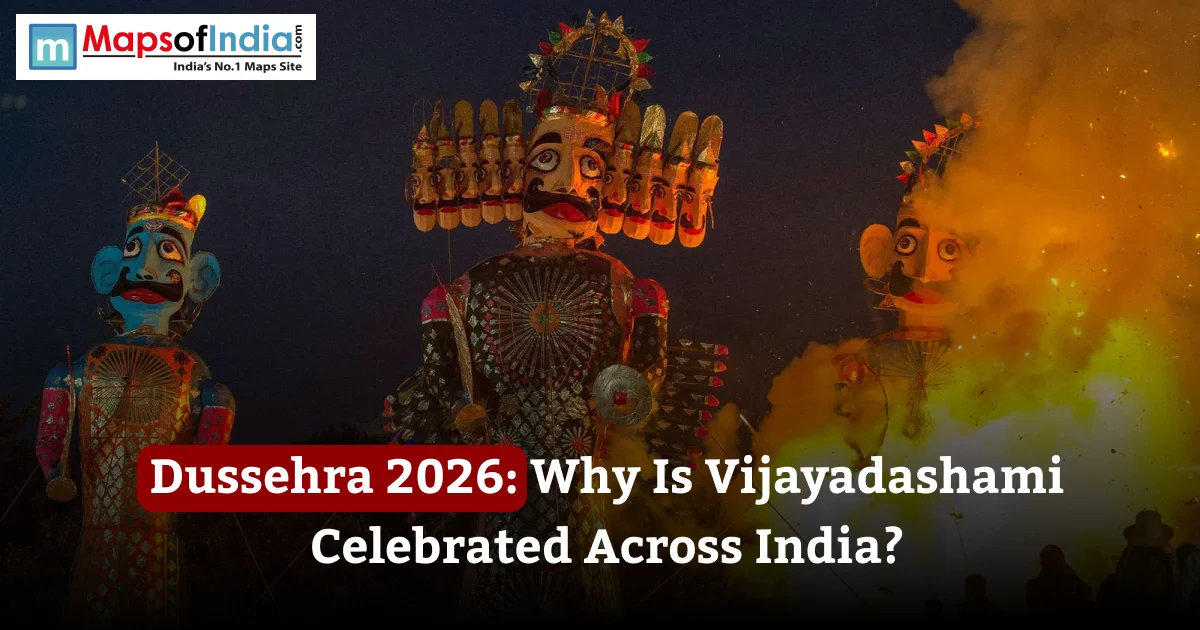
Rama defeated Ravana in a great fight and liberated Sita, thus ending Ravana's reign. The Ramlila, dramatization of the Ramayana, and the burning of large effigies of Ravana, his son Meghnad, and his brother Kumbhakarna are all the ways Dussehra is celebrated.
These effigies are burned as a symbol of the elimination of pride, avarice, wrath, and injustice. Ravana has often been described as a learned and powerful ruler, whose pride and misuse of power brought him down. Thus, the tale is a reminder that knowledge and strength are not excuses to be immoral.
Goddess Durga's Victory Over Mahishasura
Vijayadashami is very much related to Goddess Durga in the East and some parts of India. In Hindu mythology, the demon Mahishasura acquired a lot of strength and threatened to destroy the world and God. The gods united their forces to create Goddess Durga and engaged in a protracted battle with the demon to defeat him.
In the end, Durga vanquished Mahishasura and restored cosmic peace and order. Her triumph is honored at Durga Puja, especially in West Bengal, Assam, Odisha, Tripura, and some eastern states.
The last day of Durga Puja is Vijayadashami. Devotees pray before images of the goddess that are placed in processions before they are immersed in a river or another area where water accumulates. Known as Durga Visarjan, this ritual symbolises her return to her divine abode and the cyclical nature of life.
The festival is a reminder of the strength of the Divine Feminine and that even the strongest opposition can be faced with courage, strength, and righteousness.
How Dussehra Is Celebrated Across India
Dussehra celebrations vary considerably across Indian states, reflecting local traditions, historical influences and religious customs.
Northern India: States such as Uttar Pradesh, Delhi, Haryana and Punjab organise Ramlila performances in the days leading up to Dussehra. On the festival day, crowds gather at public grounds to watch Ravana Dahan, accompanied by cultural programmes and fireworks where permitted.
Mysuru, Karnataka: Mysuru Dasara is famous for its royal heritage, illuminated palaces, cultural performances and grand procession known as Jamboo Savari. The celebration reflects the region's historical association with royal patronage and the worship of Goddess Chamundeshwari.
Kullu, Himachal Pradesh: Kullu Dussehra is distinctive because its main celebrations begin on Vijayadashami and continue for several days. Deities from surrounding villages are brought together in processions, making it an important gathering of local religious and cultural traditions.
Bastar, Chhattisgarh: Bastar Dussehra is known for its unique tribal customs and strong association with Goddess Danteshwari. Its rituals extend over several weeks, making it very different from the conventional Ravana-burning celebrations seen elsewhere.
Eastern India: In West Bengal and neighbouring regions, Vijayadashami concludes Durga Puja. Women may participate in Sindoor Khela, while devotees bid farewell to Goddess Durga before the immersion of her idols.
These celebrations demonstrate that Dussehra is not a single uniform event but a collection of traditions united by themes of victory, devotion and renewal.
The Cultural and Moral Significance of Dussehra
Dussehra is not only religious, but it also has lessons that are applicable in modern life. The stories of Rama and Durga emphasise the importance of integrity, responsibility, courage, and the protection of others. They also caution against pride, wrong, and the abuse of authority.
Vijayadashami is seen as a good day for many to start new projects, education, buy tools, or do important things. In some parts of India, books, musical instruments, vehicles, machinery, and all other work tools are worshipped. These are traditions of thanksgiving for the resources and skills that enable them to live.
The festival also fosters the bonds of community through the public performances, fairs, processions, and family reunions. Ancient arts and culture, music, crafts and storytelling are brought into focus, thereby maintaining the cultural heritage from generation to generation.
Dussehra 2026: A Celebration of Victory and Renewal
With the religious ceremonies, the dramatic performances and regional festivities, millions of people will gather together once again on the eve of the festival of the end of the year, i.e., on the occasion of the festival of the end of the year, which is also called Durwa. Vijayadashami is celebrated in unique ways across India, in Ravana Dahan, Durga Visarjan, Mysuru's royal procession, or the unique rituals of Bastar and Kullu.
The festival communicates a message that is as old as the earth: although evil may seem strong, it will not last forever in opposition to truth and righteousness. In its celebration of Lord Rama's victory and Goddess Durga's triumph, Dussehra reminds people of the importance of standing up against evil and rectifying their own shortcomings and starting afresh with faith and resolve.
FAQs
1. When is Dussehra in 2026?
Dussehra, also known as Vijayadashami, will be celebrated on Tuesday, October 20, 2026. It falls on the tenth day of the bright fortnight of the Hindu lunar month of Ashwin and marks the conclusion of Navratri and Durga Puja celebrations.
2. Why is Vijayadashami celebrated across India?
Vijayadashami is celebrated to commemorate the victory of good over evil. In many parts of India, it marks Lord Rama's victory over Ravana, while in eastern India, it celebrates Goddess Durga's triumph over Mahishasura. Both traditions symbolise the restoration of righteousness and the defeat of negative forces.
3. What is the difference between Dussehra and Vijayadashami?
Dussehra and Vijayadashami generally refer to the same festival, celebrated on the tenth day of the Hindu month of Ashwin. The name Dussehra is commonly associated with Lord Rama's victory over Ravana, while Vijayadashami is also widely used for celebrations marking Goddess Durga's victory over Mahishasura.
4. Why is Ravana burned on Dussehra?
Ravana's effigies are burned on Dussehra to symbolise the victory of good over evil. The tradition commemorates Lord Rama's defeat of Ravana in the Ramayana and reminds people of the consequences of arrogance, greed and wrongdoing.
5. How is Dussehra celebrated in different Indian states?
Dussehra is celebrated through Ramlila performances and Ravana Dahan in northern India, grand royal processions during Mysuru Dasara in Karnataka, and Durga Visarjan in West Bengal. Kullu Dussehra in Himachal Pradesh and Bastar Dussehra in Chhattisgarh are also famous for their distinctive regional customs.
6. What is the religious significance of Vijayadashami?
Vijayadashami represents the triumph of righteousness, courage and divine power over evil. It commemorates the victories of Lord Rama and Goddess Durga and is considered an auspicious day for new beginnings, learning, worship and the pursuit of important goals.
7. Which are the most famous places to celebrate Dussehra in India?
Some of the most famous places to experience Dussehra celebrations include Mysuru in Karnataka, Kullu in Himachal Pradesh, Bastar in Chhattisgarh, Kolkata in West Bengal, and Delhi for its traditional Ramlila performances and Ravana Dahan events. Each destination offers a distinctive cultural and religious experience.