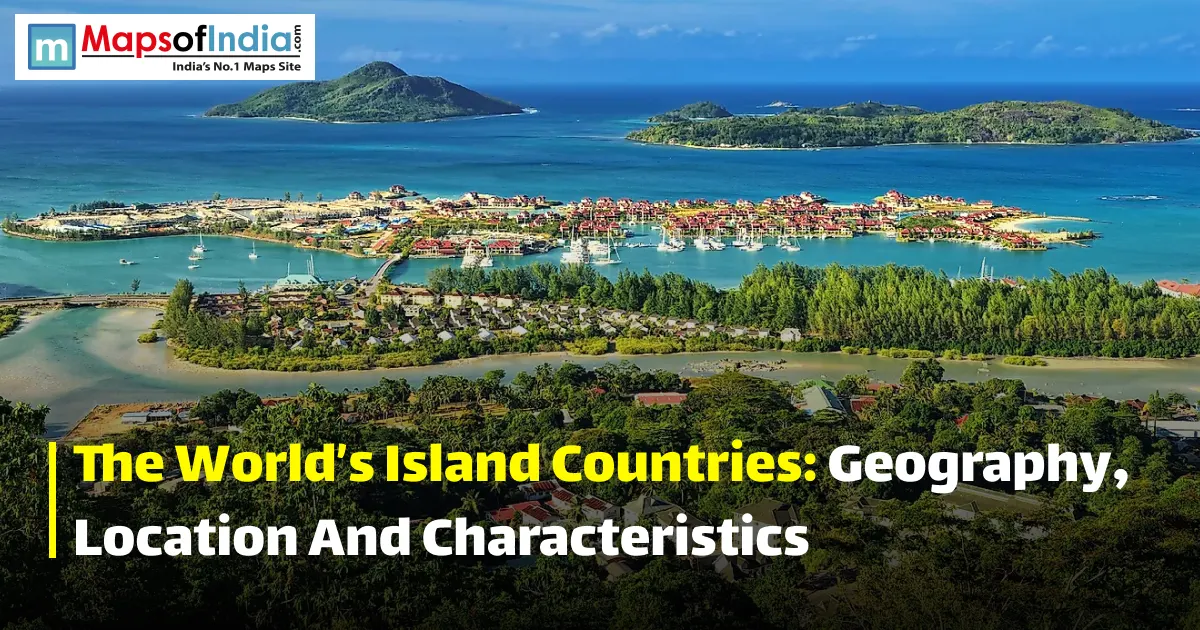
Island countries of the world are states whose territory consists entirely of one or more islands or parts of islands without any territory on a continental mainland. A cited count is 46 sovereign island countries, although totals vary depending on how shared islands, associated states, disputed territories, and borderline cases such as Australia are treated. From Indonesia and Japan to tiny Pacific states such as Nauru and Tuvalu, island countries occupy geographic settings across the world's oceans. This guide explains how island countries are defined, where they are located, how they form, their characteristics, major examples, and the challenges they face.
What Is an Island Country?
An island country is a state whose national territory is made up entirely of an island or group of islands rather than including a portion of a continental mainland. Island countries may consist of an island, several large islands, or hundreds of small islands and atolls. Their geography strongly influences settlement, transport, resources, economies, and political relationships.
Island Country vs. Archipelagic Country
An island country can consist of one island or multiple islands, while an archipelagic country is specifically a state made up of an archipelago or extensive group of islands. Indonesia and the Philippines are examples of archipelagic countries. Therefore, all archipelagic countries are island countries. Not every island country needs to be described as an archipelago.
Island Country vs. Country That Shares an Island
An island country should not be confused with a country that occupies part of an island. Ireland, for example, is an island country. The island of Ireland is politically divided between Ireland and the United Kingdom. Similarly, Haiti and the Dominican Republic share the island of Hispaniola while Timor-Leste shares the island of Timor with Indonesia.
Why Australia, Greenland and Borderline Cases Are Treated
Australia is geographically an island surrounded by water but is generally classified as a continent and country rather than an island country. Greenland is geographically the world's largest island, but it is an autonomous territory within the Kingdom of Denmark rather than a sovereign country. These examples show why the number of island countries depends on the definition being applied.
How Many Island Countries Are There in the World?
A cited geographical count is 46 sovereign island countries. This figure refers to recognised sovereign states whose territories are entirely composed of islands or island groups, while excluding Australia as a continent and excluding dependent territories and most disputed states. Other sources produce totals because they may include associated states, territories or disputed political entities.
The United Nations does not maintain an official list titled "island countries." Its Small Island Developing States (SIDS) classification is a category: it identifies countries and territories with particular development, environmental, and geographic characteristics. The current UN SIDS framework includes 39 states, demonstrating why the number of SIDS should not be used as the number of island countries.
Editorial criterion used in this article: 46 island countries, excluding Australia, dependent territories and entities with limited or disputed international recognition.
Where Are the World's Island Countries Located?
Island countries occur in every major ocean and sea, but they are especially concentrated in the Pacific Ocean and Caribbean region. Other important clusters occur in the Indian Ocean, Atlantic Ocean, Mediterranean Sea, and Southeast Asia.
Pacific Ocean Island Countries
The Pacific contains one of the world's concentrations of island states. Examples include Japan, the Philippines, New Zealand, Fiji, Samoa, Tonga, Tuvalu, Kiribati, Nauru, Palau, the Marshall Islands, the Federated States of Micronesia, Solomon Islands and Vanuatu.
These countries vary dramatically in size and physical geography. Japan and New Zealand contain mountainous islands while Tuvalu and the Marshall Islands consist largely of low-lying atolls and coral islands.
Indian Ocean Island Countries
Important Indian Ocean island countries include Sri Lanka, Maldives, Madagascar, Mauritius, Seychelles and Comoros.
Their landscapes range from the island of Madagascar to the small coral islands and atolls of the Maldives. Their locations also make trade, fishing and tourism important parts of many economies.
Atlantic Ocean Island Countries
Atlantic island countries include Iceland, Cabo Verde and São Tomé and Príncipe. Their physical environments are very different: Iceland is dominated by glacial landscapes while Cabo Verde and São Tomé and Príncipe are tropical island groups with volcanic origins.
Caribbean Island Countries
The Caribbean has a high concentration of sovereign island states. Examples include Cuba, Jamaica, The Bahamas, Barbados, Haiti, the Dominican Republic, Dominica, Grenada, Saint Lucia, Saint Kitts and Nevis, Saint Vincent and the Grenadines, Antigua and Barbuda and Trinidad and Tobago.
The region contains islands, limestone islands, coral islands and mixed geological landscapes.
Mediterranean Island Countries
Malta and Cyprus are the two island countries commonly classified in the Mediterranean region. Their strategic location has historically connected Europe, North Africa and western Asia through trade and migration.
Southeast Asian Archipelago Countries
Southeast Asia contains some of the world's most complex island systems. Indonesia and the Philippines are archipelagic countries, while Singapore, Brunei and Timor-Leste are also associated with the region's island geography.
Indonesia is particularly notable for its number of islands and its position between the Indian and Pacific oceans.
Types of Islands and How Island Countries Form
Island countries are not formed in one way. Their islands may originate from geology, volcanic activity, coral growth, tectonic movement, or combinations of these processes.
Continental Islands
Continental islands are connected geologically to landmasses or continental shelves. They may have separated from continents through processes or remain associated with submerged continental structures.
Sri Lanka is an example of an island located on the continental shelf south of India. Britain and other large islands around Europe also demonstrate the geological relationship between some islands and continental regions.
Volcanic Islands
Volcanic islands form when volcanic activity builds land above sea level. Some are created by volcanoes associated with plate boundaries, while others develop over hotspots.
Iceland, Japan, and many Pacific islands contain volcanic features. Volcanic islands often have terrain and soils that can support agriculture, although they may also face earthquakes and volcanic hazards.
Coral Islands and Atolls
Coral islands and atolls develop from reef systems that grow in warm shallow tropical seas. An atoll typically consists of a ring-shaped reef surrounding a lagoon.
The Maldives, Tuvalu and the Marshall Islands are examples. These islands are generally low-lying, making flooding and sea-level rise particularly important concerns.
Tectonic and Mixed-Origin Islands
Tectonic islands develop through movements of Earth's crust, including uplift, folding, faulting, and interactions between plates. Many island groups have geological histories involving more than one process.
New Zealand and parts of Japan and Indonesia illustrate how tectonic activity can create islands, earthquakes and varied landscapes.
Largest and Smallest Island Countries
"Large" and "small" can refer to land area, total surface area, population, or number of constituent islands. For comparisons, land or surface area is the clearest measure.
Largest Island Countries by Area
Using national area as the comparison:
1. Indonesia. About 1.9 million km²
2. Madagascar. About 587,000 km²
3. Papua New Guinea. About 463,000 km²
4. Japan. 378,000 Km²
5. Philippines. About 300,000 km²
6. New Zealand. About 268,000 km²
7. Cuba. 110,000 Km²
8. Iceland. About 103,000 km²
9. Ireland. 70,000 Km²
10. Sri Lanka. About 66,000 km²
Indonesia is the sovereign island country by area under this definition. Its enormous territory consists of an archipelago stretching between the Indian and Pacific oceans.
Smallest Island Countries by Area
The island countries are concentrated mainly in the Pacific, Caribbean, and Mediterranean.
- Nauru. 21 Km²
- Tuvalu. About 26 km²
- Marshall Islands. About 181 km²
- Saint Kitts and Nevis. About 261 km²
- Maldives. About 300 km²
- Malta. About 315 km²
- Grenada. About 345 km²
- Saint Vincent and the Grenadines. About 389 km²
- Barbados. About 430 km²
- Antigua and Barbuda. About 440 km²
Nauru is the smallest sovereign island country by area, at roughly 21 km².
Area figures can vary slightly between sources because national statistical systems use definitions of land and surface area.
Island Countries With the Most Islands
The number of islands belonging to a country is surprisingly difficult to establish precisely because countries use definitions of what qualifies as an island, islet or reef.
Indonesia, the Philippines, Japan, the Maldives, the Marshall Islands, Solomon Islands, Papua New Guinea and the Federated States of Micronesia are among the island countries that have large numbers of islands.
The Maldives and Marshall Islands are especially known for their numbers of small coral islands and atolls. Indonesia also has a large group of islands, although the total number of islands has changed over time as mapping and official identification have improved.
Because of this, statements like "the country with the islands" should always mention the source and how the count was made instead of just giving one number as the final answer.
Shared Geographic Characteristics of Island Countries
Even though island countries are very different in climate, size, and economy, many have shared features because they are separated from large landmasses.
Climate and Weather Patterns
The ocean around island countries has a big effect on temperatures and humidity, leading to maritime climates with smaller temperature changes than in the middle of continents. Tropical island countries can have monsoons, tropical storms, and cyclones, while islands at latitudes like Iceland have much colder maritime climates.
Biodiversity and Endemism
Being isolated can help species evolve in ways that make them unique to that place. Madagascar is one of the well-known examples of island endemism, and Pacific islands also have special ecosystems and species.
However, being isolated can also make island ecosystems very sensitive to species loss, habitat loss, and changes in the environment.
Limited Land and Resources
Many island countries have little land that is good for farming and not much water to use. Small islands might also have a narrow economy, which means they need to bring in a lot of food, fuel, and other things they need.
Maritime Boundaries and the Exclusive Economic Zone
The importance of an island country goes beyond the land it has. According to the law of the sea, coastal countries can have Exclusive Economic Zones around their land.
This means some small island countries have control over ocean areas that are much bigger than their land. These areas can help with fishing, shipping, tourism, and other things related to the ocean.
Economies Built on the Sea
Island economies rely a lot on fishing, shipping, tourism, and other activities connected to the ocean. Some islands are really important for transport and trade because of where they are.
Tourism is especially important for countries like the Maldives, Seychelles, Mauritius, and some Caribbean countries, while fishing and marine services are important in Pacific island economies.
Challenges Facing Island Countries
Island geography brings both chances and problems.
Rising Sea Levels and Climate Change
Low islands that are made of coral are very affected by sea level rise, flooding, erosion, and saltwater getting into the land. Tuvalu, Kiribati and the Marshall Islands are often talked about in climate discussions because they are so low and exposed.
The United Nations says climate change and weak natural environments are some of the problems for Small Island Developing States.
Natural Disasters
Many island countries face dangers like cyclones, earthquakes, volcanoes, and tsunamis. The risk depends on where they are and what kind of land they have.
Islands in the Pacific that are near tectonic areas can have earthquakes and volcanoes, while islands in the Caribbean and Pacific can have strong cyclones.
Economic Vulnerability and Isolation
Being far from markets can make it more expensive to move things in and out. Small local markets can also make it hard to have many kinds of jobs.
The UN says many Small Island Developing States have high costs for importing and exporting and are at risk from outside problems because of where they are and the limited things they have.
Small Island Developing States and International Cooperation
Small Island Developing States, or SIDS, are a group in international development, not just any island country. The UN now lists 39 SIDS along with members of UN regional groups.
SIDS work together on things like adapting to climate change, being safe from disasters, developing in a way that manages the ocean, getting money and using technology.
Island Countries by Region
Pacific Ocean
- Australia. Canberra. Considered a continent-country rather than a regular island country.
- Fiji. Suva. An island group in the South Pacific.
- Kiribati. South Tarawa. A lying island state in the Pacific.
- Marshall Islands. Majuro. An atoll country.
- Micronesia. Palikir. A group of four island states.
- Nauru. Yaren. One of the smallest countries in the world.
- New Zealand. Wellington. A big island country in the South Pacific.
- Palau. Ngerulmud. An island state in the western Pacific.
- Papua New Guinea. Port Moresby. A large island country in Melanesia.
- Philippines. Manila. A big group of islands in Southeast Asia.
- Samoa. Apia. A Polynesian island state.
- Solomon Islands. Honiara. An island group in Melanesia.
- Tonga. Nuku'alofa. A Polynesian island kingdom.
- Tuvalu. Funafuti. A low-lying island state in the Pacific.
- Vanuatu. Port Vila. An island group in Melanesia.
Indian Ocean
- Comoros. Moroni. An island state.
- Madagascar. Antananarivo. A big island off the southeast coast of Africa.
- Maldives. Malé. A country made of coral islands and atolls.
- Mauritius. Port Louis. A volcanic island state.
- Seychelles. Victoria. An island group in the western Indian Ocean.
- Sri Lanka. Sri Jayawardenepura Kotte. A big island south of India.
Atlantic Ocean
- Cabo Verde. Praia. An island group in the Atlantic.
- Iceland. Reykjavík. A country with volcanoes and glaciers in the North Atlantic.
- São Tomé and Príncipe. São Tomé. An island state in the Gulf of Guinea.
Caribbean
- Antigua and Barbuda. Saint John's. An island state in the Caribbean.
- Bahamas. Nassau. A group of islands in the Atlantic and Caribbean.
- Barbados. Bridgetown. An island country in the eastern Caribbean.
- Cuba. Havana. The biggest island country in the Caribbean.
- Dominica. Roseau. A mountainous island with volcanoes.
- Dominican Republic. Santo Domingo. Covers the eastern part of Hispaniola.
- Grenada. St. Georges. An island state in the southern Caribbean.
- Haiti. Port-au-Prince. Covers the western part of Hispaniola.
- Jamaica. Kingston. A big island in the Caribbean.
- Saint Kitts and Nevis. Basseterre. A group of two islands.
- Saint Lucia. Castries. An island with volcanoes in the Caribbean.
- Saint Vincent and the Grenadines. Kingstown. A chain of islands.
- Trinidad and Tobago. Port of Spain. An island state in the southern Caribbean.
Europe and the Mediterranean
- Cyprus. Nicosia. An island country in the Mediterranean.
- Ireland. Dublin. Covers most of the island of Ireland.
- Malta. Valletta. A small group of islands in the Mediterranean.
- United Kingdom. London. An island country that includes Great Britain and other islands.
Asia and Southeast Asia
- Bahrain. Manama. An island country in the Persian Gulf.
- Brunei. Bandar Seri Begawan. Located on the island of Borneo. Has no mainland.
- Indonesia. Jakarta. The biggest island country in the world by area.
- Japan. Tokyo. A big country made of islands in East Asia.
- Maldives. Malé. An island group in the Indian Ocean.
- Philippines. Manila. An island group in Southeast Asia.
- Singapore. Singapore. A city-state at the tip of the Malay Peninsula.
- Sri Lanka. Sri Jayawardenepura Kotte. An island south of India.
- Timor-Leste. Dili. Covers the eastern part of Timor and nearby islands.
Conclusion
The island countries of the world range from island groups like Indonesia to very small Pacific countries like Nauru and Tuvalu. Their geography affects everything from where people live to how they deal with nature, trade, tourism, control of the ocean, and the risks from climate change. To understand island countries, we need to look beyond the islands themselves and consider the oceans, resources, and the systems that connect them.
FAQs
How many island countries are there in the world?
A number often used is 46 island countries. This includes countries that are not seen as a continent and usually leaves out areas and disputed states. The exact number can change based on how different countries, territories, and shared islands are treated.
Which is the most island country in the world?
Indonesia is the largest sovereign island country in terms of area, covering about 1.9 million square kilometres. It is a large group of islands between the Indian and Pacific oceans. If "largest" is about the area of the country, Indonesia is the first among countries that are entirely made of islands.
Which is the most island country in the world?
Nauru is a country that is entirely made of islands, covering around 21 square kilometres. It is an island made of coral in the middle of the Pacific. Nauru is also one of the countries in the world followed by other small island states like Tuvalu and the Marshall Islands.
Is Australia an island country?
Australia is not usually seen as an island country because it is considered a continent as well as a country. Even though it is surrounded by water, geography classes see continents and islands as different. So most lists of island countries do not include Australia.
Which island countries are most affected by rising sea levels?
Island countries that are low and made of coral, like Tuvalu, Kiribati, and the Marshall Islands, are among the most at risk from rising sea levels. Their low height makes them more likely to face problems like flooding, erosion, and saltwater getting into the land. How much they are affected depends on where they are, what they do to prepare, and what happens with the climate.
What is the difference between an island country and an archipelago?
An island country is a country that is entirely made of islands. An archipelago is a group of islands. An island country can be made of one or many islands. An archipelagic country, like Indonesia or the Philippines, has a number of islands.
Which island country has the islands?
There is no answer that everyone agrees on because different countries have different ways of counting islands, small islets, and reefs. Indonesia, the Philippines, Japan, the Maldives, and many island nations in the Pacific are known for having a large number of islands. The official numbers can change over time as better maps are made and the way islands are classified becomes more accurate.
Which island countries are in the Indian Ocean?
Major island countries in the Indian Ocean include Madagascar, Sri Lanka, Maldives, Mauritius, Seychelles, and Comoros.