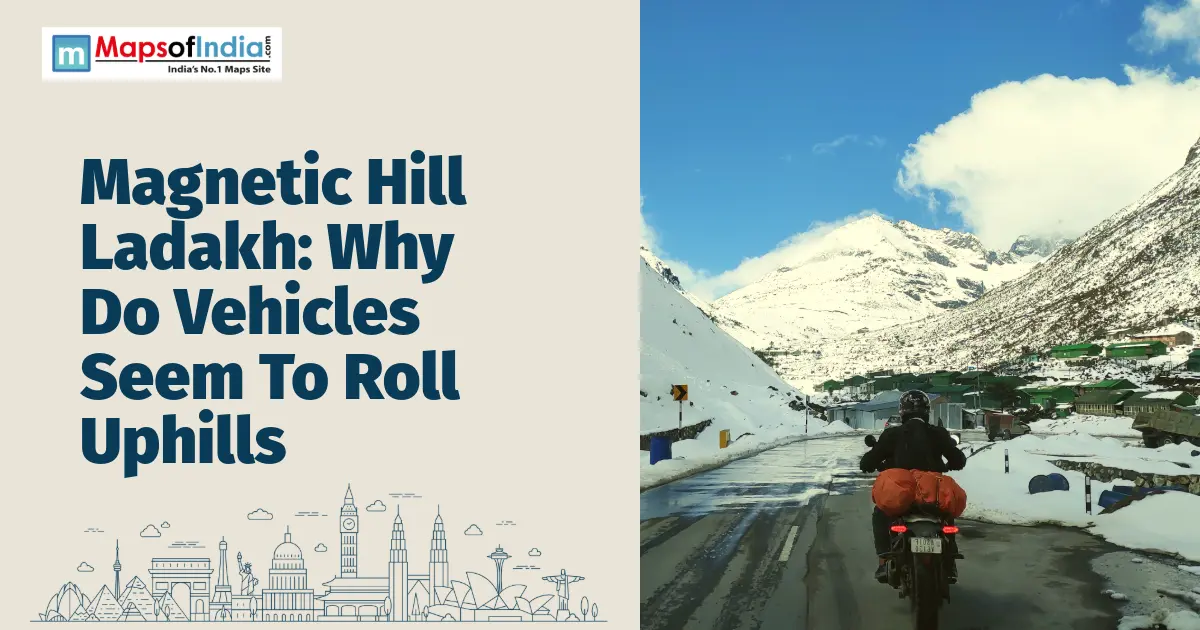
Park your car in neutral at Magnetic Hill Ladakh. Something strange happens. It starts rolling. Uphill. No engine. No push. Nothing. So what's going on? Magnetism? Something else? Short answer: it's a visual illusion. Created by the terrain around it. Not a vehicle actually beating gravity. Let's get into why.
What Is Magnetic Hill in Ladakh?
Magnetic Hill sits near Leh, right along the Leh–Kargil highway. People call it "gravity-defying." That reputation alone pulls in a steady stream of visitors, season after season. The setting is stark too. Barren mountains. One stretch of road. Not much else for miles. And that emptiness? Turns out it's part of the trick.
Why Do Vehicles Seem To Roll Uphill at Magnetic Hill?
Here's the real answer, straight up. The vehicle is moving downhill. It just doesn't look that way. Your brain judges slope using visual cues. Mainly the horizon and the land around you. Take those away, or bend them slightly, and your brain can genuinely get it wrong. That's exactly what happens here. The landscape hides the road's true slope. So a road sloping down reads to your eyes as sloping up. Gravity's doing exactly what gravity always does. Pulling the car downhill. Your perception is just lagging behind reality.
The Role of the Horizon
Normally, your eyes lean on the horizon to judge whether a road climbs or drops. Works well, most of the time. But block that horizon, or swap it for a misleading one, and the whole system breaks down fast.
How the Surrounding Landscape Creates the Illusion?
At Magnetic Hill, the mountain slopes and the road's own angle team up to hide the ground's actual gradient. No familiar vertical or horizontal reference point to check yourself against. So the "uphill" direction you think you see? Could be exactly backwards.
Is Magnetic Hill Really Magnetic?
Short answer: no. Not in any real, physical sense. No giant magnet buried under Ladakh's soil, pulling vehicles toward it.
So why the name? Probably because "magnetic" sounds a lot more thrilling than "optical illusion." And it stuck. Popular belief ran with the magnetic-force idea for years. The accepted explanation is far less mystical. It's your brain, misreading a slope. Nothing more. Even the official Incredible India tourism page calls it an optical illusion, caused by the surrounding terrain.
Is Magnetic Hill really magnetic? No. It's not generally considered to pull vehicles uphill through any actual magnetic force. The apparent movement is an optical illusion, where a downhill road appears to rise, thanks to the surrounding landscape and a missing, reliable horizon.
The Science Behind Magnetic Hill
Let's break it down further. Plain terms only.
Gravity Still Pulls the Vehicle Downhill
Gravity does one thing, always. Pulls objects toward the ground. A car in neutral, on a sloped road, rolls downhill because of that pull. That's it. Nothing exotic going on. What makes Magnetic Hill special isn't the physics. It's that the road's real downhill slope gets disguised by everything around it. So the motion looks like it's headed the wrong way.
Why Our Eyes Can Misjudge a Slope?
Human depth perception leans hard on visual reference points. Horizon lines. Nearby slopes. Familiar verticals, trees, buildings, that sort of thing. Strip those away, or distort them, and your sense of up and down can genuinely flip. This isn't some rare glitch either. It's a well-documented quirk of how human vision works.
What Is a Gravity Hill?
This whole category of phenomenon actually has a name. A gravity hill. Similar illusions show up elsewhere around the world too, all built on the same trick: a misleading landscape hiding a road's true slope. Magnetic Hill in Ladakh is just Ladakh's own, particularly dramatic version.
Magnetic Hill Legend: The Road to Heaven
Before science stepped in, locals had their own explanation. Worth knowing, purely as folklore. One legend says a road once ran through this exact spot, leading straight to heaven. Those who deserved to reach it got pulled forward on the path. Those who didn't felt nothing at all. It's a lovely story. Clearly helped build the site's mystique over generations too. But let's be clear. This is local legend, not science. The optical illusion is what actually explains what visitors experience today.
How to Experience the Magnetic Hill Phenomenon?
Keep it simple. Find the marked spot on the road, usually a painted box with clear signage. Park there. Shift into neutral. Watch. You'll typically feel the car start rolling within seconds, sometimes picking up real speed. What you're seeing is straightforward physics, dressed up by a landscape that's hiding the truth from your eyes.
One safety note, genuinely important this one. Don't block highway traffic while parked there. And don't release your vehicle's controls anywhere outside the marked, designated zone.
Where Is Magnetic Hill Located?
Fact | Details |
| Location | Near Leh, Ladakh |
| Region | Union Territory of Ladakh |
| Road | Leh–Kargil highway |
| Phenomenon | Apparent uphill vehicle movement |
| Scientific explanation | Optical illusion |
| Type | Gravity hill |
| Nearby attractions | Gurudwara Pathar Sahib, Sangam Point |
The District Leh administration places Magnetic Hill about 30 km from Leh, along the Leh–Kargil highway.
Best Time to Visit Magnetic Hill
May through September. That's your window. Roads stay clear. Weather stays manageable. Ladakh generally looks its best during these months. Winter's a different story entirely. Heavy snow can block the route completely, so this isn't really a winter destination. Most visitors pair the stop with nearby sights, turning it into a half-day loop rather than a standalone trip. The official Incredible India tourism page recommends this same May to September window.
Places to Visit Near Magnetic Hill
Gurudwara Pathar Sahib
A Sikh shrine, built around a boulder linked to Guru Nanak Dev Ji. Just a short drive away.
Sangam Point
Where the Indus and Zanskar rivers physically meet. Turquoise water merging into brown, right in front of you.
Spituk Monastery
A working Buddhist monastery, perched on a hilltop. Sweeping views back across the valley.
Quick Facts
- Magnetic Hill is located near Leh, in Ladakh.
- Vehicles appear to move uphill when placed in neutral.
- The phenomenon is commonly explained as an optical illusion.
- The surrounding terrain makes the actual downhill gradient genuinely hard to perceive.
- Magnetic Hill belongs to a broader category of sites known as gravity hills.
- It remains one of Ladakh's most popular roadside attractions.
Conclusion
Magnetic Hill doesn't actually overturn gravity. Not even close. The real magic here is perceptual, not physical. A landscape that quietly hides a downhill slope, tricking your eyes into reading it as uphill instead. And honestly? That's what makes the place worth visiting in the first place. An entirely ordinary effect of gravity, made to look genuinely extraordinary, just by the shape of the land around it.
FAQs
Why do vehicles roll uphill at Magnetic Hill?
They don't, not really. The vehicle rolls downhill, following ordinary gravity. The surrounding terrain just hides the true slope, making the motion look like it's headed uphill instead.
Is Magnetic Hill Ladakh really magnetic?
No. No magnetic force is at play here. The name stuck because it sounds dramatic. The actual cause is a visual illusion, not magnetism.
Is Magnetic Hill an optical illusion?
Yes. The surrounding landscape, plus a missing, reliable horizon, combine to make a downhill road look like it's sloping upward.
Does Magnetic Hill defy gravity?
No. Gravity works exactly as expected here. The vehicle moves downhill the whole time. Only your perception of the slope gets it wrong.
Where is Magnetic Hill located?
Near Leh, in the Union Territory of Ladakh, along the Leh–Kargil highway.
How far is Magnetic Hill from Leh?
Roughly 30 km, according to the District Leh administration. An easy half-day trip from the city.
What is the best time to visit Magnetic Hill?
May through September. Roads are clear, and the weather's at its most manageable for travel.
What is the science behind Magnetic Hill?
The surrounding mountain slopes and road alignment hide the road's true downhill gradient. Your brain, relying on cues like the horizon, misreads the slope. So a car rolling downhill ends up looking like it's rolling up instead.