Dhanushkodi is a coastal town at the southeast tip of Rameswaram Island in Tamil Nadu, about 18–20 km from Rameswaram. It was once a port and railway town linking India with Ceylon, now Sri Lanka. The 1964 Rameswaram cyclone destroyed the town, and the government later said it could not be lived in again. Today, Dhanushkodi is known for its ruins, beaches, religious significance, and location near the India–Sri Lanka sea border. It remains a place for travellers and history enthusiasts.
Quick Facts
- Location: The tip of Rameswaram Island, Tamil Nadu
- Distance from Rameswaram: Roughly 18–20 km by road
- Best time to visit: From October to March
- Entry fee: No separate ticket for sightseeing is listed on the official district tourism page; local vehicle or check‑post charges may apply
- Ideal visit duration: Roughly 2–4 hours
- Access: Usually only in daylight; local access times may change with weather and security
What Is Dhanushkodi?
Where Is Dhanushkodi on the Map?
Dhanushkodi sits at the end of Pamban Island in Ramanathapuram district, Tamil Nadu. It lies between the Bay of Bengal and the Gulf of Mannar, close to the end of the Palk Strait. A road now links Rameswaram to Dhanushkodi, making it accessible to visitors after once being isolated.
Why Is It Called "the End of India"?
People often call Dhanushkodi the 'End of India' because Dhanushkodi is at one of the southeastern points of the country, and Sri Lanka is just across the Palk Strait. The name Dhanushkodi also comes from the Hindu epic Ramayana. Local religious belief says that the area of Dhanushkodi is linked to Ram Setu, a bridge that people say was built between India and Sri Lanka.
The History of Dhanushkodi Before 1964
A Thriving Port and Railway Town
Before the 1964 cyclone, Dhanushkodi was not an empty town. Dhanushkodi worked as a port and railway town where passengers travelled, trade happened, and ferries connected to Ceylon.
The railway line linked Dhanushkodi to the mainland via Pamban. The old Boat Mail train ran from Madras, now called Chennai, to Dhanushkodi. From Dhanushkodi, passengers could board a ferry to Talaimannar in Ceylon. Indian Railways records say the railway link to Dhanushkodi was destroyed by the 1964 cyclone.
Religious Significance and the Ramayana Connection
Dhanushkodi has been important for religion because of its link with the Ramayana. Local tradition ties the area of Dhanushkodi to Lord Rama and the building of Ram Setu. The nearby Kothandaramaswamy Temple is also linked to the story of Vibhishana surrendering to Rama. These are beliefs, not proven historical facts.
The 1964 Cyclone: How Dhanushkodi Was Destroyed
The Night of the Storm
On the night of December 22–23, 1964, a strong cyclone hit the Rameswaram area. A study by the India Meteorological Department says the storm waves reached about 5–6 metres above sea level at places close to the sea, like Dhanushkodi. The waves swept across the island. Caused great damage.
The Pamban Passenger Train Tragedy
One of the remembered parts of the disaster was the Pamban–Dhanushkodi passenger train. The IMD study says the train, with 120 passengers, was swept off the track by the storm waves near Dhanushkodi. Indian Railways records that the Boat Mail train and the railway tracks to Dhanushkodi were destroyed by the cyclone.
Why the Government Declared It Unfit for Living
The amount of damage made it impossible to rebuild Dhanushkodi the way it was. The government of Madras said Dhanushkodi could not be lived in anymore, so the town was left mostly in ruins. The Ramanathapuram district administration says the town was completely washed away by the 1964 cyclone. The Kothandaramaswamy Temple stayed.
What Remains Today: Ruins and Landmarks
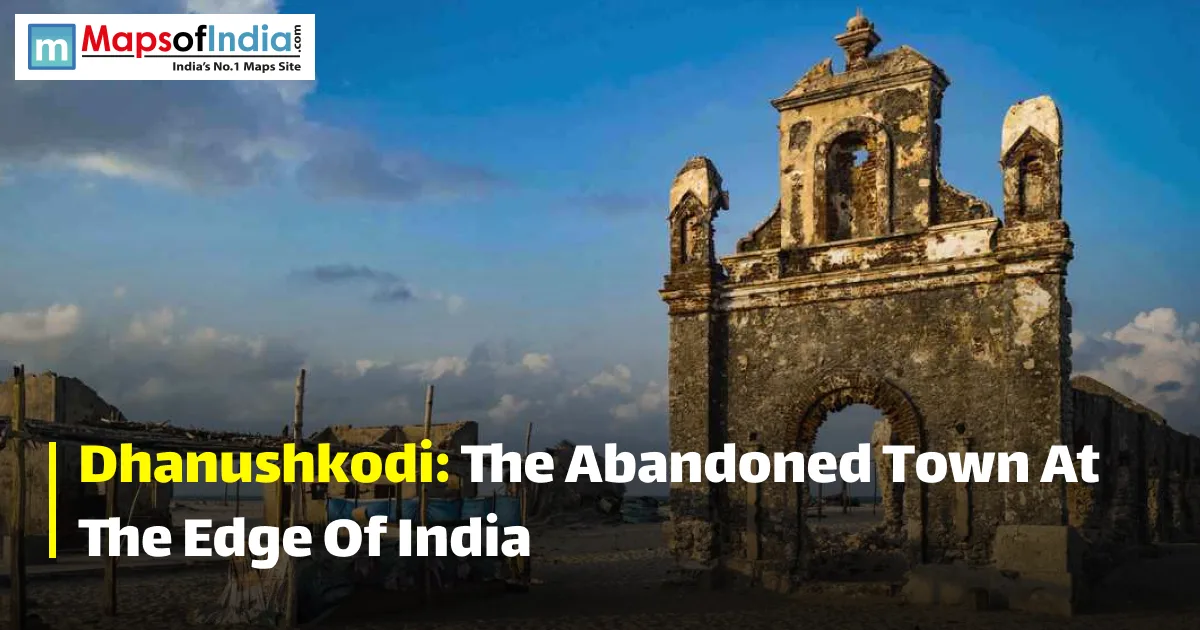
The Ruined Church
The old church ruins are among the recognizable parts of Dhanushkodi. The damaged walls show the town that existed before the cyclone. The district administration lists the Dhanushkodi church ruins as one of the area's attractions.
The Railway Station and Post Office Remains
Pieces of the railway and other civic buildings still lie in the sand and among the plants. They show how Dhanushkodi used to be a working transport and administrative centre.
Ram Setu (Adams Bridge) Viewpoint
The Dhanushkodi area gives views toward the chain of shoals known as Ram Setu or Adams Bridge. The Dhanushkodi area has importance in the Ramayana tradition, while its physical features belong to the shallow marine environment between India and Sri Lanka.
Arichal Munai, Where Two Seas Meet
Arichal Munai is the southeastern tip of the Dhanushkodi road. The Dhanushkodi area surrounding the landscape is striking because the Bay of Bengal lies on one side while the Gulf of Mannar lies on the other. Tamil Nadu Tourism says that the meeting of these waters is one of the Dhanushkodi area's attractions.
Kothandaramaswamy Temple
Unlike most of Dhanushkodi, the Kothandaramaswamy Temple survived the 1964 cyclone. The Ramanathapuram district administration says that the Kothandaramaswamy Temple is the structure that remained intact after the disaster.
Things to Do in Dhanushkodi
- Explore the ruins: Photograph the surviving church, railway, and other remnants of the Dhanushkodi settlement.
- Visit Arichal Munai: See the narrow coastal landscape at the end of the Dhanushkodi road.
- Enjoy beach views: Dhanushkodi has beaches on both sides of the narrow landform.
- Watch sunrise or sunset: The open coastal setting provides horizons for photography.
- Visit Kothandaramaswamy Temple: Include the Kothandaramaswamy Temple for its religious and historical significance.
- Try food: Small local stalls may offer refreshments. Facilities are limited compared with Rameswaram.
How to Reach Dhanushkodi
From Rameswaram by Road
Dhanushkodi is 18 km from Rameswaram according to the Ramanathapuram district administration. Public and private transport can be used from Rameswaram. The road continues toward Arichal Munai.
From Madurai and Chennai by Rail, Road and Air
The nearest railway station is Rameswaram. Madurai is the nearest major airport, around 175–200 km from Rameswaram/Dhanushkodi depending on the reference point. From Madurai, visitors can continue to Rameswaram by road or rail. Then travel to Dhanushkodi by road.
Notes on the New Pamban Bridge
The New Pamban Rail Bridge was inaugurated in April 2025. It is India's vertical-lift railway sea bridge and connects Rameswaram Island with mainland India. The bridge is 2.08 km long. Has a 72.5-metre vertical-lift span that can rise to allow ships to pass.
The bridge is a railway bridge, so visitors travelling to Dhanushkodi by road still use the road connection to Rameswaram Island.
Best Time to Visit and Visiting Hours
Dhanushkodi should be treated as a daytime destination. Local travel information generally places access around 6 AM to 6 PM, with entry toward the end often restricted around 5 PM. These timings can change because of weather, sea conditions, or local restrictions, so visitors should confirm the day's access conditions locally.
- October to February: Generally the comfortable period for sightseeing with less intense heat.
- March to June: Hot and humid; early-morning visits are more comfortable.
- July to September: Coastal winds and rain can affect travel conditions.
Tamil Nadu Tourism describes Dhanushkodi as a year-round destination, while its destination guide identifies October to March as the suitable sightseeing period.
Travel Tips and Safety Guidelines
- Carry drinking water, especially during warmer months.
- Use sun protection such as a hat, sunglasses, and sunscreen.
- Carry some cash as facilities and digital-payment options can be limited.
- Do not expect the range of shops, medical facilities or accommodation available in Rameswaram.
- Do not plan to stay at the Dhanushkodi tip. Plan to return to Rameswaram before access restrictions begin.
- Stay away from ruins and unstable structures.
- Follow local instructions around beaches and the sea, particularly during rough weather.
- Check weather and local access conditions before travelling.
Where to Stay and Eat
Rameswaram is the practical base for a Dhanushkodi trip. It has more accommodation, restaurants, transport options and other visitor facilities than the remote tip of the island.
A typical itinerary can combine Dhanushkodi with the Ramanathaswamy Temple, Pamban Bridge, and other Rameswaram attractions, allowing visitors to return to the town after the daytime visit.
Is Dhanushkodi Really Haunted? Myths vs Facts
Dhanushkodi is frequently described as a "ghost town" because the 1964 cyclone destroyed the settlement, and it was subsequently declared unfit for habitation. The term describes its abandoned character and tragic history; it does not establish that the location is haunted.
Stories about ghosts and supernatural experiences have become part of Dhanushkodi's image, but there is no established scientific evidence that the ruins are haunted. The documented explanation for the area's appearance is the 1964 cyclone and the decision not to rebuild the original settlement as a normal town.
Dhanushkodi and Sri Lanka: How Close Are They?
Dhanushkodi is near Sri Lanka on the map. Talaimannar is on the Sri Lankan side of the Palk Strait. Tamil Nadu Tourism says the distance to Talaimannar is 18 miles or roughly 29 kilometres, but the exact number changes with the points you measure.
This proximity does not let people walk or drive from Dhanushkodi to Sri Lanka. There is no tourist crossing at Dhanushkodi. The water between India and Sri Lanka is an international border, and Ram Setu is not a road or footpath that links the two lands.
Conclusion
Dhanushkodi is a spot where land, past and faith meet at the corner of Rameswaram Island. The broken railway buildings and church keep the story of a town that the 1964 cyclone wiped out. Arichal Munai, the coast, and the view of Ram Setu now attract people. It is best to plan a day trip from Rameswaram, watching the weather and local rules. Dhanushkodi looks amazing exactly because it keeps the remains of a town that was once very different from what people see.
FAQs
Why was Dhanushkodi abandoned?
Dhanushkodi was hit hard by the 1964 Rameswaram cyclone. The storm broke homes, roads, and the train line. The Government of Madras then decided the place was not safe to live in. So the old town was not rebuilt as a living area.
Is Dhanushkodi safe to visit?
Dhanushkodi is known as a tourist spot. It is far out on the coast and open to the elements. You should go during the day when it is allowed to obey the rules, stay away from shaky ruins, and be careful around the water. Bad weather or security issues may change how you can enter.
How far is Dhanushkodi from Rameswaram?
The Ramanathapuram district says Dhanushkodi is 18 kilometres from Rameswaram. Other travel guides say it is closer to 20 kilometres, depending on where you start and where you end.
Can we stay overnight in Dhanushkodi?
Dhanushkodi is usually a day trip, not a place to stay. There are a few tourist facilities far out there, and rules may stop you from staying after dark. Rameswaram is the place to sleep.
How far is Dhanushkodi from Sri Lanka?
Tamil Nadu Tourism puts Dhanushkodi 18 miles from Talaimannar, or roughly 29 kilometres. The real distance changes with the points you choose. There is no tourist crossing between Dhanushkodi and Sri Lanka.
What is the best time to visit Dhanushkodi?
From October to March, the weather is usually nicer because temperatures are easier to handle. Early mornings can be better when it gets hot. Coastal weather can shift fast, so check the conditions before you go.
Is there an entry fee for Dhanushkodi?
The Ramanathapuram district website does not say there is a ticket for Dhanushkodi. You might have to pay for transport, parking, or a check‑post, and those fees can change. Check the costs when you go.