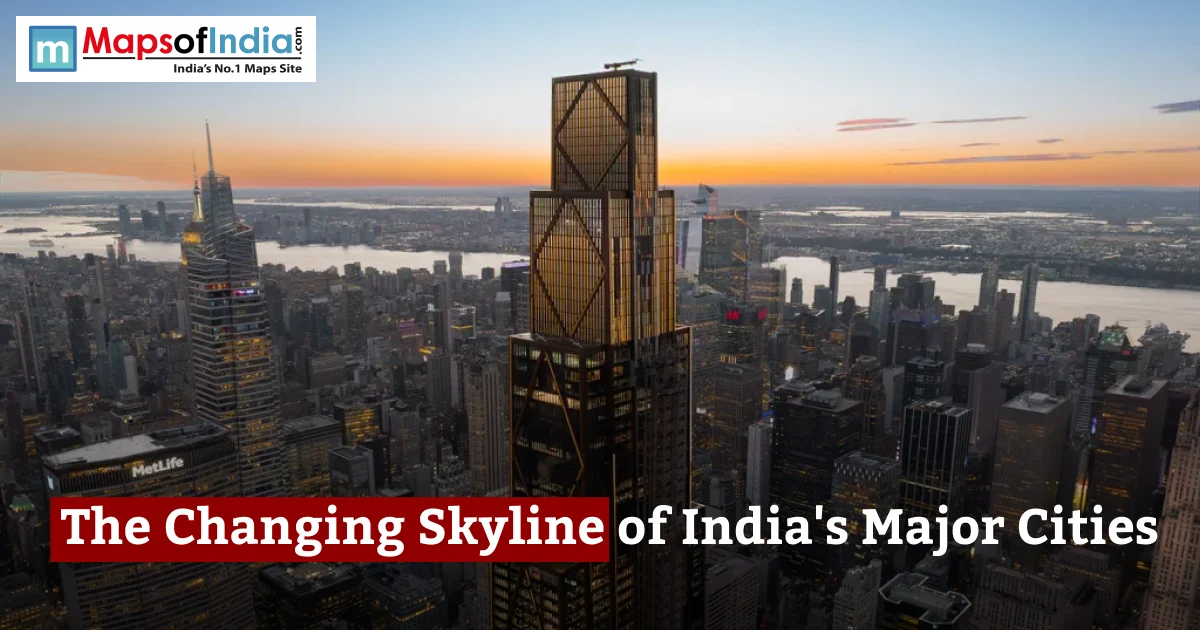
India's urban landscape is changing quickly. The changing skyline of cities shows that people want more places to live, more train systems, more businesses, and more projects to make cities better. Mumbai is still the city with the tallest buildings, but cities like Gurugram, Noida, Bengaluru, Hyderabad, and GIFT City are also adding more tall buildings. This article talks about why buildings are getting taller, how city skylines have changed, and what the future of the skyline in India will look like.
The changing skyline of cities is happening because there is not enough land, there are rules to make new buildings possible, there is better train access, and people want more nice homes and offices. Mumbai has the most homes in the country, while Gurugram, Bengaluru, Hyderabad, and GIFT City are also building taller buildings.
Key Takeaways
- Mumbai has the tallest residential skyline in the country.
- More train systems are making tall buildings more common.
- GIFT City is becoming a place with buildings for business.
- Buildings that are good for the environment and have uses are growing in number.
- Tall buildings show that cities are changing how they grow.
Why Are Indian Cities Growing Vertically?
Land Scarcity and rising population
People are moving to cities, and this makes the land for building more expensive. In cities where there is no land, taller buildings help more homes and offices fit into small areas, making tall buildings a good choice.
FSI/FAR policy changes and redevelopment
Floor Space Index (FSI), also called Floor Area Ratio, says how much can be built on a piece of land. Some cities have changed these rules, which makes it easier to rebuild areas and build buildings.
Metro and infrastructure-led density
Train systems have changed the way cities grow. Places near train stations are getting taller homes, offices, and places that have both homes and businesses because it is easier to get to these places.
Demand for premium housing and Grade A offices
More businesses and more workers mean more people want houses and good offices. This is making more buildings taller.
How Has India's Skyline Evolved Over the Years?
From colonial and low-rise cities to the first high-rises
For most of the century, Indian cities had small buildings, old-style buildings, and small neighbourhoods. Tall buildings were rare.
The post-liberation building boom
When the economy changed in the 1990s, cities started growing. Business areas got bigger, big companies came to cities, and tall office buildings became more common.
The 2010s to now: supertall ambitions
The last decade has seen many new houses that are very tall places with different uses and big buildings. New business areas and planned cities have made tall buildings more common.
The Changing Skyline of Major Indian Cities
Mumbai: India's Skyscraper Capital
Mumbai has the most famous skyline in the country. It has tall buildings because there is not much land, and there are big projects to make cities better. Areas like Lower Parel, Worli, and the Bandra-Kurla Complex have homes and business buildings that are getting bigger.
Delhi NCR: The Growth of Gurugram and Noida
Delhi has restrictions on how tall buildings can be. Nearby places like Gurugram and Noida have big skylines. Places like Cyber City, Golf Course Road and the business areas of Noida are now full of buildings for offices and homes.
Bengaluru: Technology Areas of Tall Buildings
Bengaluru's skyline is more about technology campuses than very tall buildings. Areas like Whitefield, the Outer Ring Road, and the Electronic City have new offices and homes.
Hyderabad: HITEC City and the Financial District
Hyderabad has become one of the fastest-growing areas with tall buildings. HITEC City and the Financial District have offices, technology areas and homes that are tall.
Pune, Chennai, Kolkata and Ahmedabad: The Next Big Growth
These cities are slowly adding buildings as business areas grow and cities change. Their skylines are not as full as Mumbai's. They are getting taller.
GIFT City and New Cities: Skyscrapers Built on Purpose
GIFT City is different because it was planned from the start. It has tall buildings for business, offices, and good transport systems.
Tallest Buildings in India
Rank | Building | City | Height | Year Completed | Primary Use |
| 1 | Palais Royale | Mumbai | 320 m | 2024 | Residential |
| 2 | Lokhandwala Minerva | Mumbai | 301 m | 2023 | Residential |
| 3 | World One | Mumbai | 280 m | 2020 | Residential |
| 4 | World View | Mumbai | 277.6 m | 2020 | Residential |
| 5 | The Imperial I | Mumbai | 254 m | 2010 | Residential |
| 6 | The Imperial II | Mumbai | 254 m | 2010 | Residential |
| 7 | Three Sixty West Tower B | Mumbai | 260 m | 2022 | Residential |
| 8 | Nathani Heights | Mumbai | 262 m | 2020 | Residential |
| 9 | The Park | Mumbai | 268 m | 2023 | Residential |
| 10 | Omkar 1973 Tower A | Mumbai | 267 m | 2023 | Residential |
Building rankings may change as new projects are completed.
Which Indian City Has the Tallest Buildings?
Mumbai has the tallest buildings in India. The city has a lot of homes because there is not enough land. There are big projects to make cities better, and people want nicer homes. Gurugram, Noida, Hyderabad, Bengaluru, and GIFT City are also building tall buildings very quickly.
What Is the Effect of the Changing Skyline on Indian Cities?
Economic and Home Market Effects
New skylines bring businesses, money, and expensive homes. These help bigger business areas grow.
Transport, Water and More People
More people in cities mean pressure on roads, public transport, water and electricity. This makes planning cities more important.
Old Places, Looks and Identity
Many cities mix tall buildings with old buildings. This creates skylines that have both old and new styles.
Environment and Weather
Tall buildings need ways to save energy, use water, and help the environment. This is important as cities grow taller.
What Will the Future Skyline of India Look Like?
Tall Buildings and Mixed Areas
Many cities are planning more tall homes, business areas and places that have different uses near growing business areas.
Green Buildings and Better Designs
New buildings are becoming more eco-friendly. They use energy efficiently, collect rainwater, have smart systems, and are better for the environment.
Rules to Watch
Projects to rebuild cities, more train systems, and new ways to build will keep helping the change.
Conclusion
The changing skyline of cities shows that cities are changing a lot. More people, money for building, rules to change cities, and more businesses are making cities taller and more modern. As Indian cities grow, the future skyline will have tall buildings and better ways to plan cities.
FAQs
What is the tallest building in India?
The tallest building in India is Palais Royale in Mumbai. It is 320 meters tall and is mostly for homes.
Which Indian city has tall buildings?
Mumbai has the tallest buildings in India, especially for homes. Gurugram, Hyderabad, and Bengaluru are also growing fast.
Why are Indian cities making buildings taller?
There is no land; there are projects to build new buildings, train systems are better, and people want more homes and offices.
How has Mumbai's skyline changed?
Mumbai's skyline has changed because of projects in places like Lower Parel, Worli, and the Bandra-Kurla Complex. These areas now have tall buildings.
Is Delhi or Bengaluru growing with tall buildings?
Both cities are growing. Gurugram and Noida have much of the tall building growth in the Delhi area. Bengaluru's growth is connected to its technology areas.
Are buildings good for Indian cities?
Tall buildings can be good for cities if they have systems for water, electricity, and transport. They also use ways to save energy and build in a good way.