Hidden Gems In Northeast India Every Traveller Should Explore
Vidyut Vardhan June 27, 2026
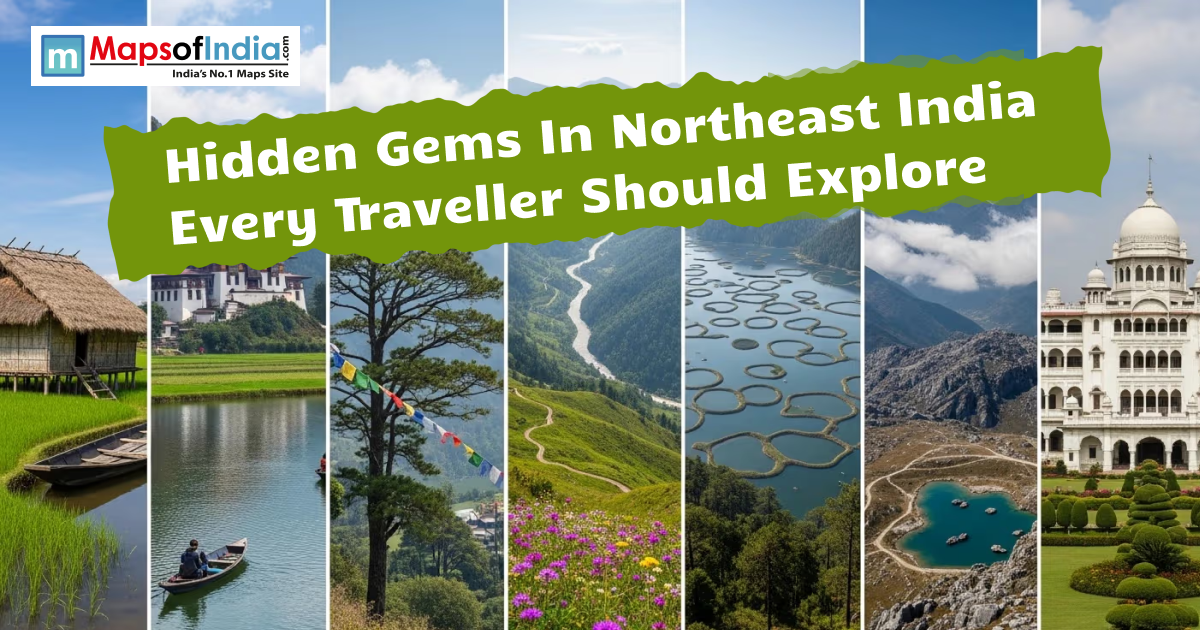
Beyond the few travellers who venture that far go steep green hills. There's something timeless in this corner of the Indian subcontinent between its folds. There are seven states, with each state having its own rhythm, as some call them. Mist ascends like smoke about dawn's peaks. Clear runs the river through stone-cut gorges. After decades of slow tending, bridges formed by root-shaped bridges span streams. Stories are preserved through song, cloth and dance among tribes. That's for sure, crowds stay away from here. On lakes, islands float, and in holes of wood, monks sing. Clouds cover the valleys for days with no break. To enter these locations is to greet Earth before the postcards.
Majuli Island, Assam
Located in the middle of the Brahmaputra, Majuli is the largest river island in the world and claims to be so. It's the place of Satras that have been in existence for centuries, and that's where the Vaishnavite devotions can be seen, and handmade masks recite old stories. Rain falls, and waters rise, and the earth is green, the birds are alive and flying about. Life here involves staying in huts which the Mishing people have built, and they leave early in the morning at the rise of the sun. Art breathes, belief goes deep, hands the watch, the trees, time has carved the balance.
Nongriat Village, Meghalaya
Nongriat is a peaceful village down three thousand steep steps in the eastern hills of Meghalaya. The bridges, grown out of the roots of rubber fig trees, are not for their grandeur, but for their living, strong, and well-formed lines. Here, the rivers flow clear, running through rock under a sudden aerial fall of waterfall mist. Staying involves sleeping on bamboo floors with thatched roofs, close to the way the Khasis live daily. Only a few come, those who are prepared to go the distance and toss aside noise. Hidden it may be, but found by feet that keep moving.
Tawang Monastery, Arunachal Pradesh
Tawang Monastery is situated in the western region of Arunachal Pradesh, just close to the border of Tibet and is at a high altitude. This enormous monastery is one of the two biggest in the world. From this point, the snow-clad mountains on the horizon are captured. It is remote but alive with religious activity, with its sacred texts, centuries old, and with its vibrant wall paintings. Outside the walls, the valley spreads out wild and unspoiled, in silence. Here in the midst of silence and mist, Heaven does not seem to be a myth.
Loktak Lake, Manipur
Loktak Lake is an unusual lake in Manipur, with floating islands called phumdis that are clusters of plants bound together on the water's surface. It is the most water-rich length of land in north-east India. It has one of the world's only floating National Parks, Keibul Lamjao. Very few people get to see the shy Sangai deer, which are protected by that piece of land. Nightly, people sleep in rafts that float up with the tide as they move into their houses. Mild paddling in the morning over the smooth water. A half dreamland, where no ground is set, and man is still planted for the better.
Ziro Valley in Arunachal Pradesh
Nestled among the pine-covered hills and dense bamboo forests, Ziro Valley is a tranquil place in the Lower Subansiri district of Arunachal Pradesh. Farmers of wet rice growers and Apatani people with ancestral facial markings are found in this highland. Peace blankets all over here, welcoming those who walk the long trails and stroll through quiet landscapes. Bird lovers rejoice, feathers dance, and unheard music surrounds. Not far from the usual paths is this cradle of a mountain where moments become thin and deep green breathes.
Khonoma Village, Nagaland
Khonoma is located close to Kohima in the state of Nagaland, where it is the first green village in India. By the locals, it has been prohibited for a long time, and has been called Hunting Restricted. People take a close interest in the forests surrounding the settlement, which makes them flourish. The hands that build stone houses are rooted in custom, and they ascend quietly amidst the hills. Legends of resistance resound from previous rebellions of colonial days. The rice field is partially cleared, and any walking is permitted from step to step. Life goes on without any discards, moulded by the return of the earth to us, by season. There is no one who wears a mask here, but nature is well taken care of. This is a place of balance that's not boisterous but solid.
Mawlynnong, Meghalaya
Mawlynnong is Asia's cleanest village, which comes from the hills of Meghalaya. A decently maintained residential street lined with homes where residents take pride in their homes and gardens, with people walking quietly between homes. Rubbish bins are no longer overflowing, but are empty, while brooms are leaning on walls and flowers can be spotted by doorsteps. Root-bridges are not fabricated of steel but of man and time. Over the trees, on the foggy night air, there are paths on the ground to the trees that say softly, quietly, quietly. The inlets remain in wooden huts, which are close to the ground and whose roofs have a sloping pattern corresponding to the rain. Here in the world of life, the more important and guiding element is care and not haste. A sanctum sanctorum where purity is a natural thing and not forced.
Mechuka Valley, Arunachal Pradesh
Mechuka Valley lies in a secluded part of West Siang, Arunachal Pradesh, in close proximity to Tibet. It is nestled among snow-capped mountains and dense, lush forests, with their green hues. It is surrounded by snow-capped mountains, lush forests, and has a tranquil greenish colour. It's a leisurely, quiet life, under the stars, that never fades away. Relive the tradition of past ages in a little village of the Buddhist Memba people. Their spiritual heart is the nearby old stone-built Mechuka monastery. In the middle of the stream, the waters of the Siyom River shimmer as they flow along the narrow sandy trails, the peaks of the rocky beds are visible, and hanging bridges are suspended overhead and swing when stepped on. It's a place of peace that people have long forgotten.
Cherrapunji (Sohra), Meghalaya
Cherrapunji, the wettest place in the world, is situated in the East Khasi Hills district of Meghalaya, India, where more than 400 cm of rainfall is recorded. Best known for its thundering falls, natural bridges of roots, and odd rock formations eroded by time. The rainy seasons see the entire landscape turn green, shimmer and sparkle with magic. They discover hidden caves, then observe Nohkalikai tumbling down sharply away and then cross the rare two-level tree bridge. It's surrounded by fog, it's pouring rain, but it's not a place; it's as if nature is breathing.