Jharkhand to Delhi Air Ambulance Crash on Feb 23, 7 Killed
Abhishree Sharma February 24, 2026
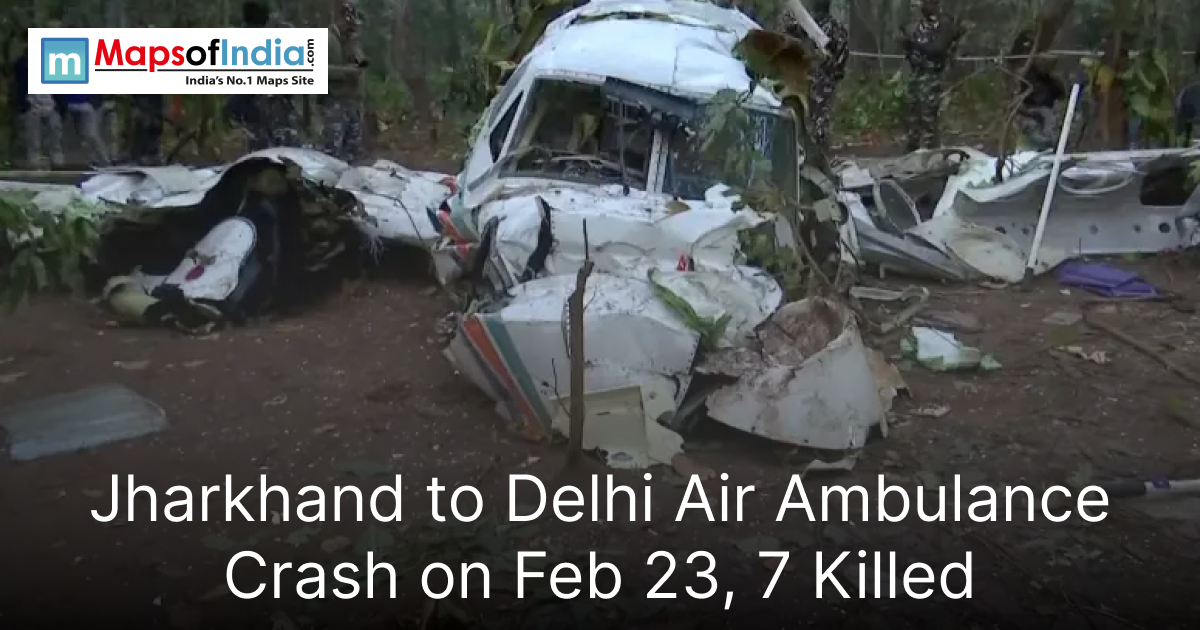
On 23rd February, there was a catastrophic aviation accident when a chartered air ambulance from Jharkhand to Delhi crashed a few minutes after take off, and the seven passengers on board died. The flight, which was to transport a critically ill patient to get advanced medical care, turned out to be the heartbreaking memory of the frailty of life, even in missions that are supposed to save lives.The accident is reverberating throughout the state and the nation, causing deep concerns about aviation safety, emergency medical transportation, and, in times of emergency responses, issues that are time-sensitive.
The Purpose of the Flight
It had been in the evening that the air ambulance with Delhi as its destination had taken off from Ranchi. The patient was a severely injured individual who needed special medical attention that could not be performed in the locality. The patient was accompanied by two attendants, a medical team comprising a doctor and a paramedic. There were two trained pilots, who were also used to working with chartered medical flights, operating the aircraft.The Air ambulance services are very critical to the healthcare system of India. They are frequently applied in those cases when patients require urgent treatment in the advanced medical facilities that are in the larger cities. In life-threatening situations, such as critical care of severe burns, trauma, organ failure, or life-threatening cases, a minute may matter. Air transport saves a lot of time in travelling relative to road or rail transportation, giving a patient an improved opportunity to survive.On this night, the airplane was launched with hope and haste. The patient was believed to arrive in Delhi soon and get the treatment required. However, as it turns out, fate decided otherwise.
Loss of Contact and the Crash
Communication between the aircraft and the Air Traffic Control was lost during the period of about 20 to 25 minutes of takeoff. Soon after that, the aircraft was said to vanish off radar. The loss of contact came abruptly, causing instant alarm among the aviation authorities.Immediately, there were search operations, and after that, the plane was found in a distant part of the Jharkhand, Chatra district. Rescue teams rushed to the scene of the crash, going through hard terrain and darkness. The sight that they were exposed to proved the worst: there were no survivors.The accident killed all seven occupants on board. The tragedy not only terminated a crucial medical evacuation mission, but also orphaned several families with an inconceivable tragedy.
The Human Cost of the Disaster
Behind the headlines and official pronouncements is the reality of the tragedy, human. Even the patient who was being transported with the hope of having a chance to recover did not make it to the hospital. The two attendants who were escorting the patient also died. The medical crew, which consisted of a doctor and a paramedic who were going to save a life were killed in the course of duty. The two aircraft pilots who were to guarantee safe passage were also victims of the crash.Every member of the board had his/her family, duties, dreams and aspirations. To their loved ones, the crash is not only a news item but also an irreparable gap that will always remain. The aviation and medical communities have also been devastated by the death of hard-working professionals who were in high-pressure occupations.
Possible Causes Under Investigation
Although there have been initial reports that the bad weather conditions could have contributed to the crash, the real cause of the crash has not been known. It has been suggested that the pilots had requested the diversion of the route on account of weather disturbances just before the loss of contact. Nevertheless, there is hardly one cause of accidents in aviation.They should investigate weather information, aircraft maintenance history, communication and technical state of the airplane. They are also going to determine how the decision-making process was conducted during the flight and whether there were any mechanical or structural problems that led to the crash.This kind of investigation is complicated and must be thoroughly analyzed. The government will strive to recreate the last flight moments in order to find out what actually went wrong and whether the tragedy could have been avoided.
The Risks of Emergency Medical Aviation
Air ambulance services work in special conditions. As compared to commercial flights, which are planned and operate under a well-regulated route, medical evacuation flights are usually provided in a surge and at times with unfavourable weather or time conditions. Pressures that require patients to be rushed may contribute to complications in the operation.The smaller aircraft, which are usually applied in the air ambulance service, are generally reliable and are used in various parts of the world. They are, however, more vulnerable to turbulence and harsh weather than larger commercial jets. This accident has brought up once again the debate of safety measures, weather risk evaluation and that the regulatory supervision of chartered medical flights should be improved with constant renewal.Emergency aviation is a serious matter that saves lives, yet it requires observing all security measures and making careful decisions. Striking a balance between urgency and safety is also among the largest issues in such operations.
A Wake-Up Call for Aviation Safety
Although it is true that air travel is statistically one of the safest forms of transportation, the very occurrence of every crash acts as a sharp reminder that no system is absolutely risk-free. The tragedy of February 23 shows the need to conduct thorough maintenance inspections and real-time weather forecasting, train pilots, and implement effective regulatory systems.The government is supposed to examine the current safety requirements and determine whether the medical evacuation flights require extra protection. The experience of this incident might result in changes that would enhance the safety of the aviation area and minimize risks in the future.
Grief, Reflection, and the Road Ahead
An investigation is going on to find the families of the victims, leaving them without any answers. Their loss cannot be measured in reports and statistics. The tragedy is very personal and paradigm-shifting to them.The crash is a sombre point to remember the bravery of pilots and medical workers who have to make emergency missions daily. These people work under great pressure and, in most cases, fly in unpredictable circumstances in order to save lives. Their efforts are to be appreciated even during times of severe loss.The air ambulance crash that happened on February 23 will not be remembered as an aviation accident but as a human tragedy. It was a mission that resulted in seven lost lives to save one. With the country still thinking about the incident, there is a hope that the lessons learnt will help provide greater safety to the country as future missions will serve their life-saving mission without endangering the lives of the people who perform the missions.