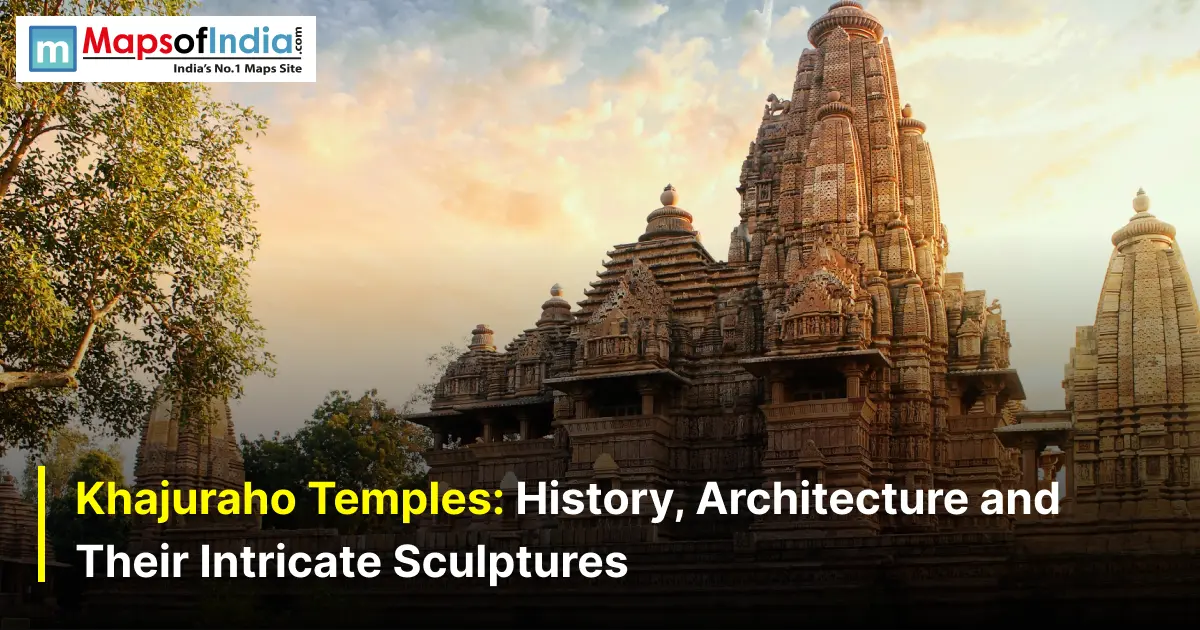
The Khajuraho Temples in Madhya Pradesh are among India’s finest examples of medieval temple architecture. Famous for their detailed stone carvings, graceful structures and sculptural variety, they offer a glimpse into the religious, artistic and social life of central India. Built mainly between the 9th and 12th centuries, the temples are admired for their sacred imagery, architectural balance and exceptional craftsmanship.
History of the Khajuraho Temples
The temples were built under the patronage of the Chandela dynasty, which ruled parts of the Bundelkhand region. The Chandelas became a powerful ruling family around the 9th century and encouraged art, religion and architecture.
Historical accounts suggest that Chandela rulers commissioned temples dedicated to different Hindu and Jain traditions. The complex is believed to have contained around 85 temples at its height. About 20 survive today.
As political centres changed, Khajuraho gradually lost importance, and many temples became neglected. They attracted wider attention in the 19th century, and conservation efforts subsequently helped protect the monuments. In 1986, the Khajuraho Group of Monuments was recognised as a UNESCO World Heritage Site.
Architecture and Design
Khajuraho’s temples are outstanding examples of the Nagara style of Hindu temple architecture, which developed in northern India. Most stand on elevated platforms called jagatis, giving them a distinctive presence.
A typical temple includes a porch, a hall known as a mandapa and a sanctum called the garbhagriha. The sanctum houses the principal deity and forms the spiritual centre of the structure. Above it rises the shikhara, a tall, curving tower symbolising a sacred mountain. Smaller towers often gather around the main one, creating a layered and rhythmic skyline.
The temples were built largely from sandstone, shaped and assembled with remarkable precision. Their walls display horizontal bands of sculptures, decorative motifs and architectural details. The combination of balanced proportions and elaborate ornamentation gives each monument its distinctive character.
The Intricate Sculptures
The sculptures are the most recognisable feature of Khajuraho. They appear across exterior walls, pillars, entrances and other architectural surfaces. Although erotic figures receive much attention, they form only one part of a much wider collection of imagery.
The carvings depict Hindu gods and goddesses, celestial beings, attendants, musicians, dancers, warriors and animals. Other panels portray everyday activities, including applying make-up, playing instruments and conversing.
The famous mithuna figures show couples and intimate relationships. Their graceful poses and expressive details have encouraged different interpretations. They have been associated with fertility, auspiciousness, the union of complementary forces and the relationship between worldly experience and spiritual life.
The sculptors displayed extraordinary skill in representing movement and emotion in stone. Detailed ornaments, expressive faces and carefully shaped bodies demonstrate their technical ability. These carvings are integrated into the architecture and contribute to the monuments’ symbolic meaning.
Important Temples to Explore
The surviving monuments are grouped into western, eastern and southern clusters. The Western Group is the best-known and includes several outstanding examples.
The Kandariya Mahadeva Temple, dedicated to Lord Shiva, is celebrated for its soaring tower and extensive sculptural decoration. The Lakshmana Temple, dedicated to Vishnu, is known for its elaborate platform and detailed carvings.
The Vishvanatha Temple is another important Shiva shrine, while the Chitragupta Temple is dedicated to Surya, the Sun God. Its principal image depicts the deity riding a chariot.
The Eastern Group includes Jain monuments such as the Parsvanatha Temple, alongside Hindu shrines. The Southern Group features temples including Duladeo, recognised for its graceful sculptural work.
Religious and Cultural Significance
Khajuraho reflects a period when different religious traditions flourished in the same region. Most surviving temples are Hindu, while the Jain monuments demonstrate the presence of Jain communities. Their coexistence reveals a varied religious environment.
The monuments are not only places of worship but also records of the cultural imagination and achievements of their age. Sacred figures communicate religious ideas, while musicians, dancers and ordinary human characters expand the world represented on the temple walls.
Visiting Khajuraho
Khajuraho is in Chhatarpur district of Madhya Pradesh and can be reached by air, rail and road. October to March is generally a comfortable period to explore the temples. Visitors should set aside time for the western, eastern and southern clusters to appreciate the variety of monuments.
The temples are arranged to be experienced from several viewpoints, allowing changing light to reveal the depth of the carvings. Morning and late afternoon can be rewarding for observing details on the sandstone surfaces. A guided visit can help explain differences between temple plans, deities and sculptural themes. Photography is popular, but examining smaller panels often reveals details that are easy to miss at first glance.
The annual Khajuraho Dance Festival brings classical dance performances to the historic setting, connecting India’s living performing arts with its architectural heritage.
A Lasting Legacy
The Khajuraho Temples remain a remarkable achievement of Indian art and architecture. Their history, carefully planned structures and intricate carvings reveal the creativity of the Chandela period. Beyond their celebrated sensual imagery, they present a rich world of religious symbols, human experiences and artistic expression. Their enduring beauty makes Khajuraho an essential destination for anyone interested in India’s heritage.
FAQs
1. Where are the Khajuraho Temples located?
The Khajuraho Temples are located in Chhatarpur district of Madhya Pradesh, India. They are situated in the Bundelkhand region and are among the most famous historical attractions in the state.
2. Who built the Khajuraho Temples?
The Khajuraho Temples were built by rulers of the Chandela dynasty between the 9th and 12th centuries. The Chandela rulers supported art, architecture and religious traditions, resulting in the construction of numerous Hindu and Jain temples.
3. Why are the Khajuraho Temples famous?
The Khajuraho Temples are famous for their intricate stone carvings, Nagara-style architecture and detailed sculptures depicting gods, goddesses, dancers, musicians and everyday life. Their erotic sculptures have also attracted worldwide attention.
4. Why do Khajuraho Temples have erotic sculptures?
The erotic sculptures represent themes associated with love, relationships, fertility and human experiences. They are considered part of the temples' broader artistic and symbolic programme, reflecting the cultural and religious ideas of the period.
5. How many temples are there in Khajuraho?
Historical accounts suggest that approximately 85 temples were originally constructed at Khajuraho. Around 20 temples survive today. They are divided into three main groups: Western, Eastern and Southern.
6. Is Khajuraho a UNESCO World Heritage Site?
Yes, the Khajuraho Group of Monuments was declared a UNESCO World Heritage Site in 1986. The recognition highlights the outstanding architectural design, sculptural craftsmanship and historical importance of these medieval Indian temples.
7. What is the best time to visit the Khajuraho Temples?
The best time to visit the Khajuraho Temples is between October and March, when the weather in Madhya Pradesh is generally pleasant. These months are suitable for exploring the temple complexes, appreciating the carvings and attending local cultural events such as the Khajuraho Dance Festival.