Sambhar Salt Lake is the largest inland salt lake in India. It is found in the state of Rajasthan. The shallow waters of Sambhar Salt Lake grow larger when the monsoon rains come and shrink when the hot summer sun beats on them. This process leaves a brine that Sambhar Salt Lake uses to make salt. The seasonal changes of Sambhar Salt Lake also feed migratory birds, such as flamingos. To understand Sambhar Salt Lake, one must look at how rivers bring water to its basin, why minerals stay in the water, how Sambhar Salt Lake pulls salt from the brine, and why it is important to protect this wetland that is recognised worldwide. The NASA page explains that the water area of Sambhar Salt Lake changes a lot with the seasons.
What is Sambhar Salt Lake?
Sambhar Salt Lake is a seasonal saltwater wetland that is the largest inland salt lake in India. The water of Sambhar Salt Lake comes mainly from rain and seasonal streams. Sambhar Salt Lake has no natural river outlet, so evaporation keeps the minerals in the water. This keeps the salt industry of Sambhar Salt Lake alive. Gives a home to migratory birds.
The area of Sambhar Salt Lake changes a lot. When it is full, Sambhar Salt Lake covers 230 square kilometres. When it dries, Sambhar Salt Lake shows mudflats and ground covered in salt.
Where Is Sambhar Lake Located?
Location in Rajasthan
Sambhar Salt Lake is southwest of Jaipur. The wetland of Sambhar Salt Lake covers parts of Jaipur, Nagaur, and Ajmer districts. The town of Sambhar is a settlement nearby. Sambhar Salt Lake sits in the interior of Rajasthan, where seasonal rains and high evaporation change the land.
Geography and Setting
Sambhar Salt Lake occupies a shallow basin that is surrounded by dry plains and the larger Aravalli region. The salty flats, seasonal water channels, and scrubland around Sambhar Salt Lake create a landscape that changes a lot during the year.
How Does Sambhar Lake Work? The Science Behind the Salt
Where the Water Comes From
Rain and seasonal streams bring water into Sambhar Salt Lake’s basin. Important streams are the Mendha and Rupangarh rivers, plus other seasonal streams. These streams flow during and after the monsoon, but the amount of water that reaches Sambhar Salt Lake depends on how much rain falls and on the catchment.
Why the Lake Has No Outlet
Sambhar Salt Lake is a basin. That means the water of Sambhar Salt Lake never flows out through a river to the sea. Water and dissolved minerals arrive at Sambhar Salt Lake by runoff and groundwater. Most of the water of Sambhar Salt Lake leaves through evaporation.
How Evaporation Makes It Salty
The sun and dry air make the water of Sambhar Salt Lake evaporate. Most of the dissolved salts stay behind in the water of Sambhar Salt Lake. As the water volume of Sambhar Salt Lake shrinks, the brine of Sambhar Salt Lake becomes more concentrated. When conditions are right, salt of Sambhar Salt Lake crystallises. It can be gathered.
The Source of the Salts
Weathering of rocks and soils puts minerals into the basin of Sambhar Salt Lake. These minerals move into Sambhar Salt Lake by runoff and groundwater. Repeated evaporation of Sambhar Salt Lake concentrates these minerals over time. The exact mix of groundwater inputs is complex, so it is best not to say that all of the salt of Sambhar Salt Lake comes from one source.
The Seasonal Cycle
When the monsoon comes, rain and runoff make Sambhar Salt Lake larger. Water may stay in Sambhar Salt Lake after the rains, giving birds a place to feed. As the dry season goes on, evaporation of Sambhar Salt Lake lowers the water level. Concentrates the brine. This exposes more of the lakebed of Sambhar Salt Lake. Helps with salt harvesting.
How Is Salt Made at Sambhar Lake?
From Brine to Crystals
Salt production uses energy to remove water from saline brine.
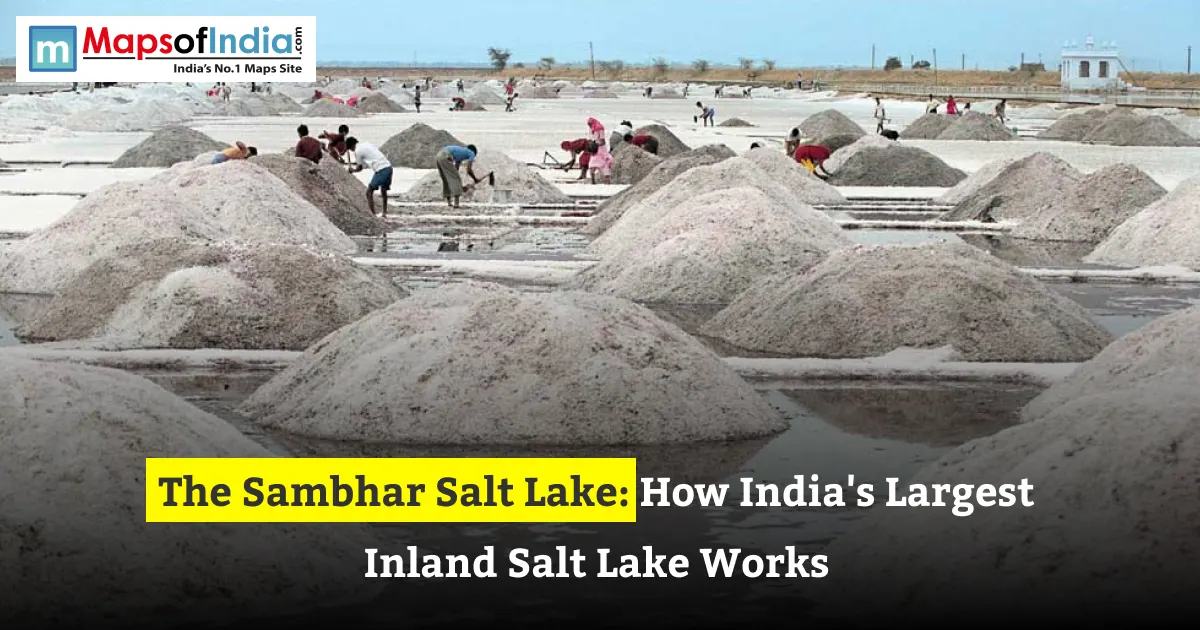
1. Brine collection: Saline water of Sambhar Salt Lake is taken from places that are suitable.
2. Channelling: The brine of Sambhar Salt Lake is moved into shallow salt pans or reservoirs.
3. Evaporation: The sun and dry weather slowly remove water from the brine of Sambhar Salt Lake.
4. Crystallisation: When the brine of Sambhar Salt Lake gets concentrated, salt crystals appear.
5. Harvesting: Workers gather the salt crystals of Sambhar Salt Lake for processing and sale.
Who Operates the Salt Works?
Salt extraction at Sambhar has a history. Sambhar lake has a well‑established salt‑working infrastructure. The company Sambhar Salts Limited has historically been linked to Sambhar lake’s production. Because ownership, management, and operating arrangements can change, check the operator details before publishing.
Why Sambhar Salt Matters
Sambhar contributes to India’s salt supply. Sambhar also provides livelihoods that are linked to salt harvesting and related work. Unlike salt production, which generally uses seawater, Sambhar relies on naturally saline water that comes from an inland basin.
Ecology and Wildlife of Sambhar Lake
Ramsar Site Status
Sambhar Lake was designated a Ramsar Site on 23 March 1990. This designation recognises Sambhar Lake’s importance as a wetland. The designation highlights the need to conserve Sambhar Lake’s habitats and ecological functions while allowing uses such as salt production.
Flamingos and Migratory Birds
Greater and lesser flamingos are among Sambhar’s best‑known visitors. The wetland also attracts waders, gulls, ducks and other migratory waterbirds in winter. Algae and tiny aquatic organisms give food at the base of the food web helping sustain birds that feed in saline water. Bird numbers vary with rainfall, water conditions and available habitat.
Other Wildlife and Vegetation
Salt‑tolerant plants survive around Sambhar Lake’s saline margins. The surrounding dry scrub supports wildlife that is adapted to arid conditions. The mix of wetland, exposed mudflat and scrub habitats makes the wider area ecologically valuable.
Challenges Facing Sambhar Lake
The wetland faces pressure from changes to water inflows, pollution, unauthorised salt pans and encroachment. A 2019 bird die‑off drew attention to Sambhar Lake’s vulnerability, although causes should not be simplified without evidence. In September 2026, the National Green Tribunal ordered an inspection committee following allegations involving encroachments and unauthorised activity. These concerns underline the need for monitoring and careful management.
Visiting Sambhar Lake
Best Time to Visit
Winter is generally the season for birdwatching, when migratory species arrive. The monsoon transforms the landscape with water coverage, while summer often reveals broad salt flats. Conditions vary each year. Check local access and weather information before travelling.
Nearby Attractions
Visitors can explore Sambhar town and the Shakambhari Devi Temple, a local religious site. Respect restricted wetland areas. Avoid disturbing birds or entering active salt pans.
Getting There
Sambhar Lake is accessible by road from Jaipur and the Ajmer region. Check transport options and local guidance before setting out, as access to specific lake areas may vary.
Sambhar Lake vs Other Salt Lakes in India
Sambhar differs from Chilika Lake in Odisha, a lagoon connected to the Bay of Bengal and known for its brackish water and birdlife. Didwana and other saline lakes in Rajasthan are also important. Sambhar is widely recognised as India’s largest inland salt lake. These water bodies differ in size, water sources, salinity, and ecological character.
Conclusion
Sambhar Salt Lake shows how seasonal water inflow and intense evaporation can create an inland salt resource. Sambhar Lake’s closed basin concentrates dissolved minerals, while Sambhar Lake’s changing water levels sustain bird habitats. Protecting Sambhar requires balancing salt production and local livelihoods with the conservation of Sambhar Lake’s wetland ecosystem.
FAQs
Where is Sambhar Lake located?
Sambhar Lake is in Rajasthan, southwest of Jaipur, across parts of Jaipur, Nagaur, and Ajmer districts. Sambhar town lies nearby. Sambhar Lake is accessible by road from Jaipur and the Ajmer region.
Why is Sambhar Lake salty?
Seasonal streams and runoff carry dissolved minerals into Sambhar Lake’s basin. Since Sambhar Lake has no natural river outlet, evaporation removes water while salts remain. As Sambhar Lake shrinks during the summer, the brine becomes more concentrated, and salt can crystallise.
How is salt made at Sambhar Lake?
Saline brine is channelled into shallow salt pans at Sambhar Lake. Channelled into shallow salt pans at Sambhar Lake. Sunlight and dry air evaporate the water, concentrating the brine until salt crystals form. Workers harvest the crystals for handling and distribution.
Which rivers feed Sambhar Lake?
The Mendha and Rupangarh are two seasonal rivers that feed Sambhar Lake. Other seasonal streams also contribute water. Their flow depends on rainfall, so Sambhar Lake’s water levels can change considerably from one season or year to another.
Is Sambhar Lake a Ramsar site?
Yes. Sambhar Lake became a Ramsar Site on 23 March 1990. This international designation recognises Sambhar Lake’s importance as a wetland for waterbirds and reinforces the need to protect Sambhar Lake’s ecological character.
Which birds can you see at Sambhar Lake?
Birds that are seen at Sambhar Lake include flamingos, lesser flamingos, gulls, waders, ducks, and many other migratory waterbirds. How many you see can change with the season and the amount of water. The food that is around. In winter, many of these birds come, and you can see them more easily.
What is the best time to visit Sambhar Lake?
Winter is usually the season for birdwatching at Sambhar Lake because many migratory birds arrive and stay. When the monsoon rains, the lake fills up more, which can be good for some species. The water level goes down in summer, and the lake turns into salt flats. It is a good idea to look up the current water level and any travel advice before you go.