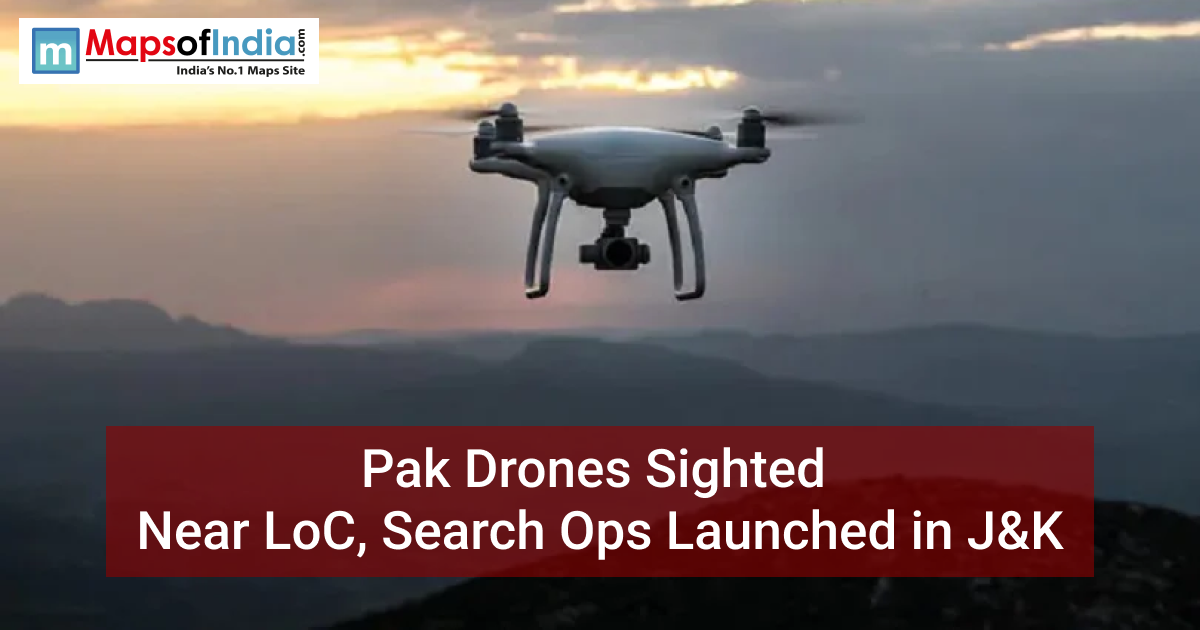
New security threats have arisen in the Indian northern borders after suspected Pakistan-origin drones were spotted flying over various places in the Line of Control (LoC) and the International Border (IB) in Jammu and Kashmir. The three border districts reported sightings, and within no time, the search operation was going on, and the level of alert was raised among the security forces stationed in the area.
Drone activity on the India–Pakistan border has emerged as a more serious challenge over the past few years. The recent event is a contributing factor to an increasing number of aerial infiltrations that leave doubts on the issue of surveillance, cross-border smuggling, and the changing face of border security threats.
Drone Sightings Trigger Immediate Response
Security inputs reported that late in the night, several drone-like objects had been observed above forward locations off the LoC and IB. These were reported sightings in the neighbouring villages in the districts that have a commonality in neighbourhood with the Pakistan-controlled territory. The drones were seen flying around briefly and then disappearing, before making one wonder whether they were doing reconnaissance or dropping a payload.
In reaction to this, security forces carried out large-scale search operations in the affected regions. Ground troops were placed to search agricultural fields, patches of forest and residential outskirts to detect any suspicious objects, weapons, or materials that might have been left behind. The forces in at least one area opened fire as a precautionary measure after tracking the movement of an aerial object.
The local police units, the Army, and the other security agencies worked together to make sure that there was no security breach. Night patrol was enhanced, and border surveillance systems were put on high alert.
Why Drone Incursions Are a Serious Concern
The drones have become a choice of tools in cross-border mischief since they are cheap, user-friendly, and can avoid conventional surveillance devices. As compared to the traditional infiltration efforts, the drones do not involve physical trespassing of the border, which makes it harder to detect and intercept.
In previous accidents, the drones have been employed to drop:
- Small arms and ammunition
- Explosives and grenades
- Communication devices
- Narcotics
Drone sightings usually signify intelligence operations like troop movement, surveying, or security installations, or civilians, even in cases where no payload is recovered. This data can be further utilized in future to execute specific attacks or penetrations.
Areas Placed on High Alert
Security forces had put the affected districts on high alert following the sightings. The villages that are near the border were recommended to watch and report on unidentified objects and unusual behaviour. The people were warned not to touch or get anywhere near any suspicious objects since they may be dangerous.
The search activities went on till the night and until the next day. No immediate recovery during the event was reported, but authorities insisted that such operations are preventative in nature and are necessary in ensuring border security.
Rising Trend of Drone Activity in Border Regions
There is a significant upsurge in the use of drones at the India-Pakistan border over the last few years, especially in Jammu, Samba, Kathua, Rajouri and Poonch districts. This trend manifests itself as a change of strategy whereby hostile elements are increasingly employing technology as opposed to physical intrusion.
The experts on security consider drone incursions as a wider plan to test the ability of India to counter drone attacks, determine their ability to identify the weak points in surveillance and to put some form of pressure on the security in the border regions. Regardless of whether the incident is minor or not, it is taken seriously because of the implications it may have.
Counter-Drone Measures and Preparedness
The Indian security agencies have been gradually enhancing their counter-drone operations. These are radar detection, radio frequency, jammer, thermal imaging and multi-agency coordinated response mechanisms. The recent appearance indicates the success of early detection systems, though the enemy tries to develop new techniques.
Training has also been advanced to assist troops in determining drone patterns, flight routes and also react promptly without collateral damage. These response strategies are increasingly using civil administration and local police.
Impact on Civilians in Border Areas
To those people who reside along the LoC and IB, they are a reminder that the security environment is quite delicate. An increase in troop movement, nighttime operations and temporary restrictions are common occurrences that result from drone sightings and may disrupt normal life.
Nevertheless, a significant number of residents are now active members of the security. The information provided by the locals in time has frequently served to help forces react to the suspects in a timely manner. Governments still emphasize the significance of citizens knowing about and collaborating.
Looking Ahead
Although no direct threat was established after the recent drone spotting incidents, the episode highlights the changing dynamic of the issue of security in Jammu and Kashmir. With the increasing role of technology in the dynamics of borders, vigilance, flexibility, and coordination are vital.
This is being closely monitored, and the security agencies are highly profiled in sensitive regions. The new directions involved in drone activity will be met with a quick and calculated response to preserve the lives of civilians and troops.