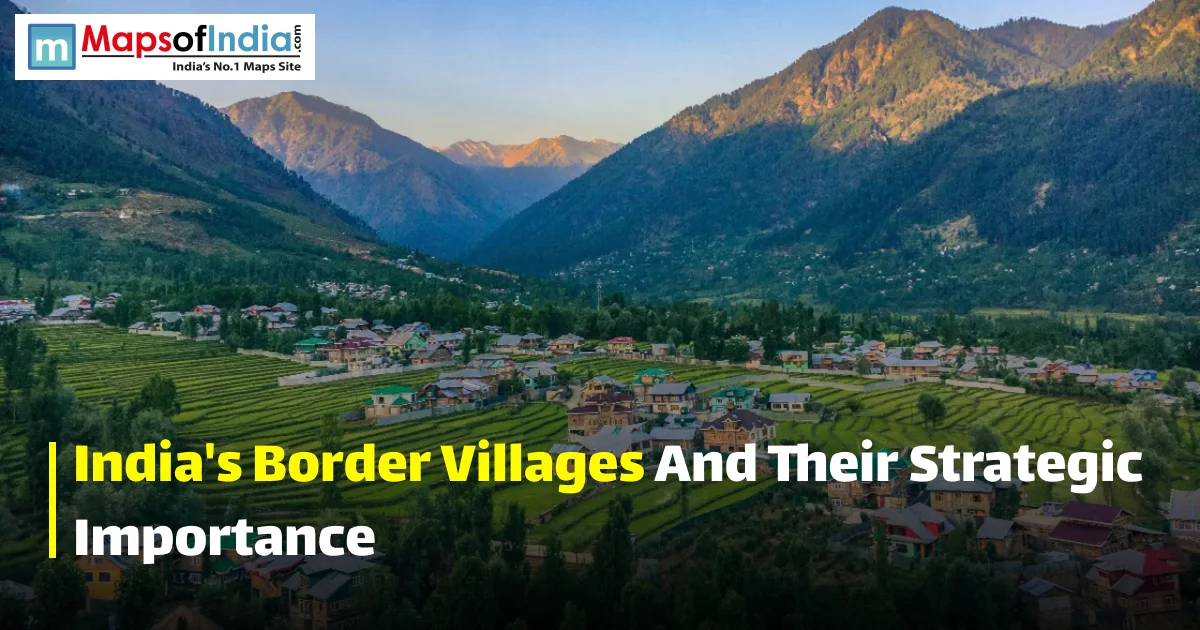
India's border villages are found along the country's land borders with China, Pakistan, Nepal, Bhutan, Bangladesh, and Myanmar. They serve both as homes for thousands of people living near the country's edge and as important parts of the nation's security network. Once seen as remote and ignored as "last villages," they are now called "first villages," the starting point for welcoming people and watching over India's borders. This article explains what border villages are, why they matter, and which villages are most important today. It also examines the government's Vibrant Villages Programme and the problems these villages still face.
What Are India's Border Villages?
Border villages are the places found in areas next to India's international land borders, covering the frontiers with China, Pakistan, Nepal, Bhutan, Bangladesh and Myanmar. It's important to understand that India's border with China is not a line but a disputed area called the Line of Actual Control (LAC). The border with Pakistan in Jammu and Kashmir is a ceasefire line known as the Line of Control (LoC). India's other borders with Nepal, Bhutan, Bangladesh, and Myanmar are mostly settled borders. All these places are considered border villages even though the lines they sit next to can be very different.
Why Are Border Villages Strategically Important for India?
Eyes and ears on the frontier
People living in border villages act as a presence along some of the most difficult-to-watch parts of India. Their daily activities include farming, travelling between places, and caring for animals. They help security forces by sharing local knowledge that cameras or patrols cannot fully capture. This also helps show that India is present in these areas.
Support for border forces and logistics
People in these areas often help the security forces by guiding them, carrying things, and providing knowledge, especially in places that are too hard to reach. This help is really important during emergencies, bad weather or times when the border's tense.
Countering depopulation and strengthening claims
If there are no people in a border village, it can be a problem. People have been moving away from these areas to cities and lower lands for a time. This makes it harder to support the security forces. Weakens the idea that India is present in these places.
Comparison with infrastructure
India started focusing more on border villages after seeing what China was doing. China has villages near the LAC that are being developed. Indian officials have said this has influenced their efforts. However, it's hard to know how much China is doing because of the distance and the difficulty in checking.
Which Are the Important Border Villages of India?
Mana, Uttarakhand
Mana is known as India's " village" and is in the Chamoli district. It is at 3,200 meters, 24 to 26 km from the India-Tibet border and just a few kilometres from Badrinath. Recently, the government has been calling it India's " village," a title that Prime Minister Modi and Home Minister Amit Shah have used publicly.
Kibithoo, Arunachal Pradesh
Kibithoo is in the Anjaw district. It is near the LAC, close to Kaho and the India-China-Myanmar tri-junction at Diphu Pass. Like Mana, it is now officially called one of India's "villages," and Amit Shah has encouraged people to visit.
Chitkul, Himachal Pradesh
Chitkul is in the Baspa Valley in the Kinnaur district. It is seen as the last real village on an old trade route between India and Tibet. It is different from Manas' status as a " village."
Nako, Himachal Pradesh
Villages like Nako in Kinnaur district are close to the Tibet border along trade routes. They have a culturally Tibetan feel, which is similar to many other border areas.
Villages in Ladakh near the LAC
Places like Turtuk near the Pakistan border in the Nubra Valley and other small villages along the LAC are part of Ladakh's border villages. Many are now part of the Vibrant Villages Programme.
A western border example
In the west villages in Rajasthan, Gujarat and Punjab that are near the India-Pakistan border have their problems. Like dry land and smuggling. But they also deal with the same issues of connecting people and keeping them in the area.
What Is the Vibrant Villages Programme?
The Vibrant Villages Programme (VVP) is part of the Government of India. It is run by the Ministry of Home Affairs. It aims to develop villages along India's land borders. The goal is to improve roads, jobs, and the quality of life to stop people from leaving and to help these villages be the eyes and ears of the security forces.
Vibrant Villages Programme-I (borders)
This part of the programme was approved in February 2023. Had a budget of ₹4,800 crore for the years 2022-23 to 2025-26. It focused on 2,967 villages in 46 blocks across 19 districts in five states and union territories. Arunachal Pradesh, Himachal Pradesh, Sikkim, Uttarakhand, and Ladakh.
Vibrant Villages Programme-II (extension to land borders)
VVP-II was approved and started in February 2026 in Assam's Cachar district. It expands the programme to the borders. With Pakistan, Nepal, Bhutan, Bangladesh and Myanmar. It covers 1,954 villages in 334 blocks across 15 states and 2 union territories. The total budget is ₹6,839 crore for the years 2028-29. Together, both parts cover 4,900 villages and have a total budget of more than ₹11,600 crore.
Key components
Both parts of the programme focus on building basic infrastructure like good roads, 24/7 electricity, fast internet, and TV access. They also promote tourism and support jobs. Make sure people get all the government and state benefits they are entitled to.
The numbers and details of the programme may change as it develops, so it's important to check the information from the Ministry of Home Affairs and the Press Information Bureau before using any data.
Challenges Facing India's Border Villages
Even with new attention, these villages still face many problems. People, especially young ones, are moving to cities for better jobs and education. The tough landscape and weather in the Himalayas make it hard to build things and provide health services. Many villages still don't have health care or emergency connections, even with recent efforts to improve telecom. Few jobs and poor access to markets keep people from farming and herding. Development is also limited in some places because of the sensitivity of being near a border that is contested or heavily guarded.
How Development Is Changing Life in Border Villages
Where improvements have happened, the changes are clear. Under VVP-I, 111 road projects around ₹2,482 crore have connected 134 villages. Then 327 tourism projects worth about ₹145 crore have also been started. Villages like Kibithoo and Mana, once visited only by pilgrims or security workers, are now being promoted as places to visit. Homestays and guesthouses are becoming a source of income.
Telecom has been a focus. In some border areas of Jammu and Kashmir, all selected villages now have 4G service. Electricity is also available in some places.
Future Outlook: Border Villages and National Security
If the development continues, this effort could change how the border areas work. Better roads and connections help the military. Give people better jobs. Keeping people in the villages helps the role these places play as the eyes and ears of the security forces. The risk is that just building roads won't stop people from leaving if they don't have jobs and health care. Villages need reasons to stay, not just better roads to leave from. How well VVP-II works in the future will decide if these villages become "first villages" or still remain "last villages."
Conclusion
India's border villages are special because they are at the place where national security and rural development meet. Few other places are as important as these villages. Their people, how connected they are, and their ability to support themselves all help India watch over, protect, and take control of its frontiers. The Vibrant Villages Programme is the government's effort so far to see these villages as important places, not places that are forgotten. It is changing how these villages are seen from the " villages" to the "first villages."
FAQs
Why are border villages important for India?
Border villages are important for India because they have people living along the sensitive borders. They help the security forces by offering knowledge and supplies. They also help reduce the risk of problems that come from having few people living near the borders.
What is the Vibrant Villages Programme?
The Vibrant Villages Programme is a plan by the Ministry of Home Affairs. It is for improving villages that are near India's borders. The goal is to make these villages better by building roads, schools, and jobs. This helps stop people from leaving and makes the borders safer. It has two parts. VVP-I is for the border that faces China, and VVP-II is for other borders.
Which is the village of India?
Mana in the Chamoli district of Uttarakhand is officially seen as India's "village". The government is now calling it the "first village" instead. Chitkul in Himachal Pradesh is also seen as the village that still lived along the old Indo-Tibetan trade route.
How many villages are included in the Vibrant Villages Programme?
VVP-I includes 2,967 villages in five states and union territories. VVP-II includes 1,954 villages in 15 states and two union territories. That means 4,900 villages in total are part of the programme.
What are the main problems faced by border villages?
Border villages face problems. People keep leaving. The land is hard to live on because of the weather and the mountains. There is no health care or good roads. People have trouble finding work and selling their goods. There are limits on development because these places are near sensitive areas.
Which states have border villages under the scheme?
VVP-I includes Arunachal Pradesh, Himachal Pradesh, Sikkim, Uttarakhand, and Ladakh. VVP-II covers 15 states and two union territories. These are the places near the borders with Pakistan, Nepal, Bhutan, Bangladesh, and Myanmar.