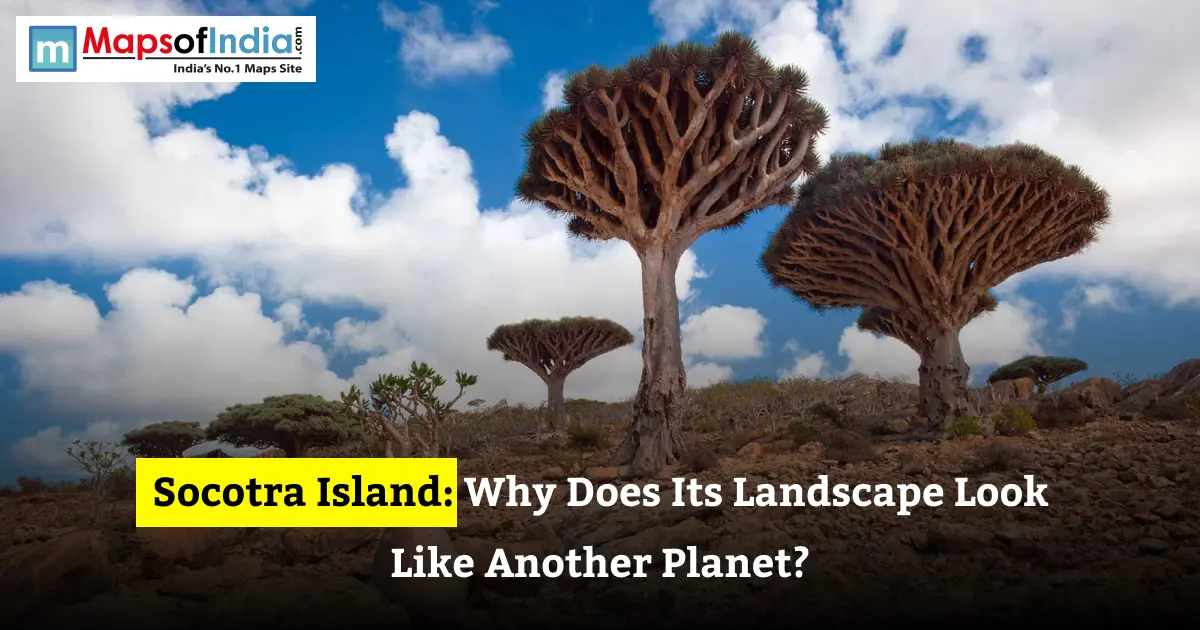
The Socotra Island landscape looks otherworldly because millions of years of change, long isolation and a harsh monsoon-influenced climate have shaped an extraordinary collection of plants, animals and landforms. Its recognisable feature is the dragon blood tree, with an umbrella-shaped canopy that looks almost unreal against the rocky plateaus. Yet Socotra is not a world: it is a Yemeni island archipelago in the Arabian Sea home to communities with distinctive languages and traditions. Its limestone landscapes, trees, caves, dunes, and turquoise lagoons make it one of the Indian Ocean’s most remarkable natural environments.
Where Is Socotra Island Located?
Socotra is an island in the Socotra Archipelago, which belongs to Yemen and lies in the northwestern Indian Ocean near the Gulf of Aden and the Arabian Sea. The archipelago appears connected to the Horn of Africa, while its political status is Yemeni. Hadiboh, also spelt Hadibu, is the town and administrative centre on Socotra Island.
The archipelago comprises four islands—Socotra, Abd al-Kuri, Samhah and Darsa—along with two small rocky islets. Socotra is the most visited island, but travel across it can involve long drives on rugged roads and tracks.
Why Does Socotra Look Like Another Planet?
The Socotra Island alien landscape is the result of factors working together: prolonged geographic isolation, ancient geological formations, seasonal monsoon winds, and plants that evolved distinctive ways to survive. These features create a landscape unlike familiar tropical islands.
Millions of Years of Isolation
Socotra’s isolation allowed many plants and animals to evolve separately from their relatives elsewhere. Island ecosystems often develop levels of endemism—the presence of species found naturally in one place and nowhere else. Socotra’s dragon blood trees, bottle trees, and many reptiles illustrate this process. Isolation does not mean the island had no contact with people or neighbouring regions; it means that its ecosystems developed under geographic and environmental conditions over long periods.
Ancient Geology and Limestone Plateaus
Socotra is an island rather than a volcanic island formed by a hotspot. Its geological foundation includes old basement rocks, while younger layers of limestone, sandstone, and other sedimentary rocks cover parts of the landscape. Limestone has been shaped by water over periods, producing plateaus, caves, and other karst features. The contrast between the Hajhir Mountains, pale limestone surfaces and coastal sands gives Socotra its dramatic scenery.
A Harsh Monsoon-Driven Climate
Socotra’s climate is strongly influenced by monsoon winds. Conditions vary by elevation and coast. The summer monsoon can bring strong winds and rough seas, particularly from roughly June to September. Many interior areas are dry for periods, while mountain slopes can receive moisture from clouds and mist. Plants must cope with rainfall, wind exposure, and water stress. These conditions help explain the island’s vegetation, but climate alone does not account for its biodiversity; geology and isolation are also essential.
Plants That Evolved Strange Shapes to Survive
Socotra’s plants have developed forms suited to their habitats. Dragon blood trees have umbrella-shaped crowns, while bottle trees and cucumber trees develop swollen trunks that help them cope with dry conditions. These shapes are not simply curiosities: they are linked to water management, exposure to wind, and the need to survive in challenging environments. The result is a landscape of silhouettes, particularly across the island’s high plateaus and rocky slopes.
How Was Socotra Island Formed?
Socotra’s geological history is tied to the breakup of supercontinents and the later separation of Arabia from Africa. It was once part of the landmass associated with Gondwana, which included areas that are now Africa, Arabia, India, and Madagascar. Tectonic movements gradually changed the region, while the opening of the Gulf of Aden helped establish Socotra’s geographic position.
The exact timeline depends on which geological event is being described. Geological studies distinguish the breakup of Gondwana from later rifting and separation associated with the Gulf of Aden. This continental history helps explain why Socotra’s geology differs from that of oceanic islands formed by volcanic activity.
Its isolation also matters biologically. Over time, plant and animal populations adapted to conditions, producing a high concentration of endemic species. Socotra’s biodiversity is therefore connected to both its past and its long-term ecological development.
The Dragon Blood Tree: Socotra’s Most Iconic Plant
The dragon blood tree (Dracaena cinnabari) is one of Socotra’s most well-known plants. Its dense umbrella-shaped canopy and thick branches make it look like an enormous mushroom growing from the rocky plateau. The tree produces a red resin known as dragon’s blood, which has a long history of traditional use and trade. It is a flagship species of the archipelago and a symbol of its natural heritage.
Why Is the Dragon Blood Tree Shaped Like an Umbrella?
The dragon blood tree’s broad crown is an adaptation to dry and exposed environments. Its canopy provides shade. Can intercept moisture from fog and cloud allowing water to reach the ground beneath the tree. The shade also reduces sunlight on the soil, helping create a cooler microenvironment for seedlings and other plants. This is especially valuable in habitats where rainfall is irregular, and moisture is limited.
The crown develops as the tree grows and branches repeatedly. Mature trees often have a dome-like outline, while young trees look different and do not yet have the familiar umbrella shape. This makes the species particularly distinctive in photographs of Socotra’s upland forests.
What Is Dragon’s Blood Resin Used For?
Dragon’s blood is a red resin obtained from the tree. Historically, it has been used as a pigment, dye, and varnish, as well as in traditional medicine on Socotra and in wider trade networks. Ethnobotanical research records uses for skin, dental, eye and digestive complaints. These are traditional uses, not proof that the resin is a safe or effective treatment for a medical condition.
The resin’s distinctive colour and long cultural history have made it valuable. Harvesting can damage trees when bark is cut deeply. Protecting trees and allowing young trees to survive are important for maintaining dragon blood tree forests.
Other Strange Plants and Animals on Socotra
The dragon blood tree is one part of Socotra’s biodiversity. The island’s plant communities include bottle trees, cucumber trees, frankincense species and other plants adapted to dry, windy or rocky habitats. Its reptiles, birds, land snails and invertebrates also include species found nowhere else. The combination of life and varied habitats is central to the island’s global conservation importance.
Bottle Trees and Cucumber Trees
Socotra’s bottle trees and cucumber trees are known for their trunks, which give them unusual, sculptural shapes. These thickened trunks help plants manage water in their environments. The desert rose, another distinctive plant found on Socotra, has a striking form. Such adaptations allow plants to persist through periods when rainfall is scarce, and they create a landscape that looks very different from the leafy forests associated with wetter tropical islands.
Endemic Reptiles, Birds and Invertebrates
Socotra’s wildlife includes geckos and other reptiles, land snails, insects and birds adapted to its habitats. Some birds are endemic to the archipelago while many others are migratory species. The island’s coastal and marine environments add another layer of diversity, including reef-building corals, coastal fish, and crustaceans. Conservation is important because species with geographic ranges can be particularly vulnerable to habitat loss, invasive species, and rapid environmental change.
How Many Species Are Found on Socotra?
UNESCO’s World Heritage profile records 307 endemic plant species out of 825 plant species, meaning about 37% of the recorded plants are found naturally nowhere else. It also reports that 90% of Socotra’s reptile species and 95% of its land snail species are endemic. These figures vary slightly across publications as surveys and classifications change, so they should be cited with their source and date.
The Most Alien-Looking Places on Socotra
Diksam Plateau
Diksam Plateau is one of Socotra’s recognizable upland landscapes. Its rocky limestone terrain, broad views, and clusters of dragon blood trees create a scene, especially around the Firmihin woodland. The plateau is valued for its scenery and its plant communities. It is not a manicured park: visitors should expect remote conditions, limited facilities and journeys that may require a local driver or guide. Stay on established routes. Avoid damaging vegetation or disturbing wildlife.
Homhil Protected Area
Homhil is known for its vegetation, rocky terrain, and viewpoints over the island’s coast. The area contains bottle trees and other distinctive plants, with walking routes leading to pools and scenic overlooks. Its mixture of upland vegetation and exposed rock makes it a useful place to observe how plants occupy microhabitats. Access and walking conditions can vary, so visitors should follow guidance, take adequate water, and avoid collecting plants or resin.
Detwah Lagoon
Detwah Lagoon, on Socotra’s side near Qalansiyah, is known for turquoise water, pale sand and a broad coastal landscape. The lagoon is also ecologically important. It is recognised as a Ramsar wetland site. Tides, weather and sea conditions can affect what visitors can safely do in the area. Respect fishing activity, avoid leaving waste, and follow local guidance around sensitive coastal habitats.
Hoq Cave
Hoq Cave is a cave made of limestone that is famous for its hanging rock formations called stalactites and the ones that grow up from the ground called stalagmites. There are other kinds of rock shapes that were made by water moving through the rock for a very long time. This cave gives a look at the rocks and land of Socotra compared to the flat areas and the beaches on the island. Visiting this cave needs attention: the ground is not smooth, it is dark inside, and the rock shapes are very delicate, so it is hard to move. People who go into the cave should have a guide, not touch the rock formations, and follow any rules that help keep the cave's rocks and history safe.
Dihamri and the Coastal Dunes
Dihamri is known for its sea life, like corals and fish. It is a favourite place for people who want to swim and look underwater when the water is calm. Along the coast of Socotra, there are beaches and big sand dunes, including special dunes where the desert and the sea come together. These places by the sea are easily affected by storms, wind, and people walking around. The sea can change quickly, so activities in the water should only be done when local people say it is safe and right.
Why Is Socotra a UNESCO World Heritage Site?
The Socotra Archipelago was added to the list of places that UNESCO says are very important in 2008 because of the different kinds of plants and animals that live there and the fact that many of them are only found on Socotra. UNESCO says there are 825 kinds of plants, and 307 of them are on Socotra, along with many kinds of reptiles and snails that are also only on Socotra. The area has both land and sea parts, which makes it important for keeping nature safe.
Socotra is sometimes compared with the Galápagos because both places are famous for plants and animals that have changed because they were isolated on the islands. The comparison is helpful to show similarities, not to say that the rocks, how the plants and animals changed, or the places are the same. Socotra was part of the mainland. It is near the Horn of Africa, which makes it different in rocks and the way nature works. UNESCO's choice shows that Socotra has its special natural value.
How Do Local People Live? Protect the Landscape?
Socotra is not a place with no people. The people who live there have used fishing, taking care of animals, farming, and using plants and sea things for a long time. The Soqotri language is a part of the island's culture, along with Arabic and traditions that are about the sea, taking care of animals, and the environment. Old ways of knowing help explain how people have adjusted to the island's changing weather.
Local traditions and old knowledge can help protect the land. New problems are changing how the land is used. Many animals can stop young trees from growing. Plants that come from other places can mess up the local plants and the way the land works, and not taking care when building or letting too many visitors can hurt the land. Climate change adds problems because it changes how hot it is, how much rain there is, and how often bad weather happens. Keeping the plants and animals safe works best when it also helps the people who live there and when the people help make the choices.
Threats to Socotra’s Ecosystem
The plants and animals on Socotra are also at risk. Because many of them are only found here, if a certain place is damaged, the plants and animals that live there can be in trouble.
- Storm damage: Big storms can break plants, change the places by the sea, and affect people and buildings.
- Not growing dragon blood trees: Animals like goats can eat young trees, so there are not enough new ones to replace the old ones.
- Too much eating by animals: Too many animals can reduce the plants and slow down the recovery of the plants.
- Plants from other places: New plants can compete with the local ones or change how the place works.
- Building and visiting: Roads, trash, many visitors, and buildings can break up the land or hurt special places.
- Climate change: Changes in how hot it is, how much rain there is, and the weather can add more problems for plants and animals that are used to certain conditions.
UNESCO has said that new plants and the weak places in Socotra's nature are important to take care of. Keeping the islands needs checking the land, being careful with visitors, taking care with animals and plants, and making sure people who live there are involved in the work.
When Is the Best Time to Visit Socotra?
The best time to go to Socotra is usually around October to April, when the weather's often better for exploring the island. The hot season from June to September can bring winds, rough water, and problems with travelling. These are times, not promises: the weather can be different each year, and the sea, roads and the mountains can change quickly.
Socotra is far away, so planning a trip needs more care than a normal island trip. Flights, permits, local transport and where to stay can be limited. Help from doctors and other services can be limited. The situation in Yemen means it is important to look at the travel advice before making plans. Check the flight and entry details with reliable and up-to-date sources and don't assume older travel information is still correct.
Conclusion
The land of Socotra looks like it is from another planet because of three things that are connected: being alone for a time, old rocks, and plants that have learned to live in a tough place with a lot of rain. The dragon blood trees, the bottle trees, the big rocks, the caves, and the beaches make the place look very different, and the special plants and animals make it very important for science and keeping nature safe. Learning about Socotra means looking past the pictures to the plants, animals, and people that keep it alive. For people who want to visit, the next step is to check the travel advice and find ways to visit that are careful and kind to the place.
FAQs
Why does Socotra look like another planet?
Socotra looks strange because it was alone for a time. It has different rocks and a dry place with a lot of rain that has made unusual plants and big shapes in the land. The big trees that look like umbrellas, the trees that look like bottles, the big rocks, the caves, and the sand dunes make a place that's not like many other islands. Its look is the result of nature on Earth, not from a planet.
Where is Socotra Island?
Socotra is an island in the Socotra Archipelago, which is part of Yemen and is in the northwestern Indian Ocean near the Gulf of Aden and the Arabian Sea. The group of islands is close to the Horn of Africa. Hadiboh, also called Hadibu, is the town where the government is on the island.
What is Socotra famous for?
Socotra is famous for the different kinds of plants and animals, the special plants that only live there, and the strange places. The dragon blood tree is known, but the island also has bottle trees, cucumber trees, caves, rocks, sand dunes, and places with water. Its special nature made UNESCO say it is very important.
Is Socotra a UNESCO World Heritage Site?
Yes. UNESCO said the Socotra Archipelago is very important in 2008 because of the different plants and animals. The plants include 307 that're only on Socotra out of 825 and many of the reptiles and snails are also only there. The place includes land and sea areas.
What is the dragon blood tree?
The dragon blood tree (Dracaena cinnabari) is a plant from Socotra that has a crown that looks like an umbrella and red juice. Its top can collect water from fog. It gives shade in dry areas. The juice has been used in the past as a colour and in medicine, but using it does not mean it works.
How many plants are found on Socotra?
UNESCO says there are 307 plants that are only on Socotra out of 825, which is about 37%. " In a certain place" means they are naturally found there. The numbers can be different in books, as research and how things are grouped change, so the number should be from its source, not as a fixed number.
Is it safe to travel to Socotra?
Conditions can change, and Socotra is part of Yemen, where the situation needs careful consideration. Access, flights, permits, and local help may change. Change over time. Before making plans check your governments travel advice and confirm entry and travel details with up-to-date sources and don't think old information is still correct.
When is the best time to visit Socotra?
The time from around October to April is usually the best time to visit Socotra. The hot season, usually June to September, can bring winds, rough water, and travel problems. The weather changes, so check forecasts, flight details, local situations, and travel advice before choosing a date.