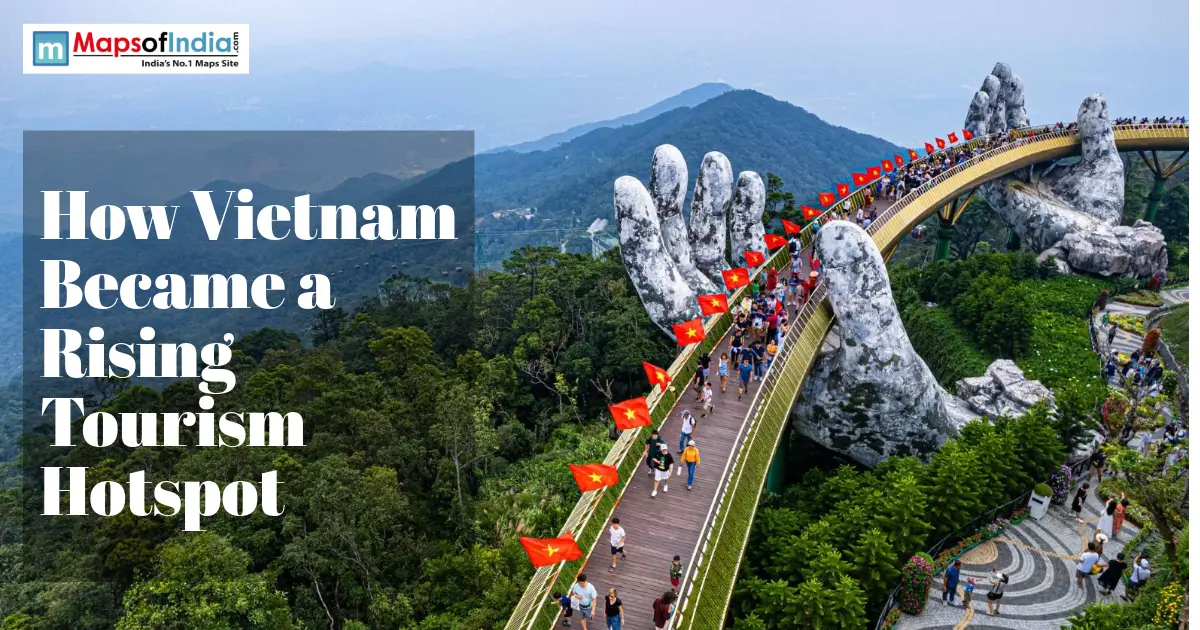
Vietnam welcomed 13.9 million international visitors between January and July 2026 alone. That is a 13.8% jump over the same period last year. Meanwhile, neighbouring Thailand, long the region's tourism leader, actually saw its own visitor numbers fall. This guide explains exactly how Vietnam pulled that off. We will cover the numbers, the visa changes, the viral destinations, and what Vietnam still needs to fix before this growth becomes a long-term win rather than a short-term spike.
Vietnam Tourism by the Numbers
Visitor Growth Over the Last Decade
Vietnam's tourism story is really a story of collapse and comeback. Visitor numbers hit 18 million in 2019, Vietnam's best year ever at the time. Then COVID hit. Arrivals crashed to just 3.84 million in 2020, a drop of nearly 79%. Recovery took years, not months. By 2023, Vietnam was back up to 12.6 million visitors. By 2025, it had finally beaten its old 2019 record, reaching roughly 21.5 million. The government now targets 25 to 26 million visitors for 2026 alone.
Year | International Visitors |
| 2016 | 10 million |
| 2019 | 18 million (pre-COVID peak) |
| 2020 | 3.84 million (COVID collapse) |
| 2023 | 12.6 million |
| 2025 | ~21.5 million (new record) |
| 2026 (target) | 25–26 million |
Tourism Revenue and GDP Contribution
Tourism now contributes more than 6.4% of Vietnam's total GDP. For 2026, the government is targeting total tourism revenue of roughly VND 1.125 quadrillion, close to $42.9 billion. That is real money, and it is growing fast.
Key Reasons Behind Vietnam's Tourism Boom
Visa-Free and E-Visa Policy Changes
Vietnam has opened up its visa program for e-visas, increasing the number of countries able to obtain visas and allowing more border posts to accept visa applications via the web. It has also expanded visa waivers for certain markets, such as some European nations, including Poland, Switzerland and the Czech Republic. Those exemptions are paying off. Since January 2026, the number of visitors from Europe has increased by over 53%.
Affordable Cost of Travel
Vietnam remains genuinely cheap compared to many rival destinations. Food, accommodation, and local transport all cost a fraction of what similar experiences cost in much of Europe or even parts of neighbouring Thailand.
Direct Flight and Airport Expansion
More airlines are adding direct routes into Vietnam, and airport capacity keeps growing to handle the surge. Air travel still accounts for the large majority of arrivals, well over 80% of total visitors.
Rise of Social Media and Viral Destinations
TikTok and Instagram have turned specific Vietnamese locations into genuine viral moments, pulling in exactly the kind of younger, photo-driven travellers who used to default straight to Bali or Thailand.
Post-COVID Diversification Away from Traditional Hotspots
Many travellers are actively looking for alternatives to Thailand and Bali, both of which have dealt with overtourism complaints in recent years. Vietnam has positioned itself as the fresher, less crowded option, and the numbers back that shift up directly.
Top Destinations Driving the Growth
Ha Long Bay
This UNESCO World Heritage site draws visitors with its thousands of limestone islands rising straight out of turquoise water. It remains one of Vietnam's most photographed destinations by a wide margin.
Hanoi & Ho Chi Minh City
The two largest cities in Vietnam are quite different. Narrow streets and centuries of history lend a touch of historic charm to Hanoi. Ho Chi Minh City is faster, noisier, and more modern, the nucleus of the country's economic activity in the south.
Da Nang & Hoi An
Da Nang is now a real beach resort town, and the surrounding area of Hoi An is a city of colonial architecture and lantern-lit ancient streets. They make one of the most powerful tourism corridors in central Vietnam.
Sapa & Ninh Binh
Sapa offers dramatic mountain scenery and terraced rice fields in Vietnam's far north. Ninh Binh, often nicknamed "Halong Bay on land," draws visitors for its limestone karsts rising out of rivers and rice paddies, without the coastal crowds.
Phu Quoc Island
This island has grown rapidly into a beach and resort destination, increasingly marketed as Vietnam's answer to Phuket or Bali, complete with new direct international flight connections.
Government & Infrastructure Push
This development is supported by Vietnam's government's investment in physical infrastructure such as new airports, highway construction and a planned high-speed rail network linking the tourist hot spots. The growth of visitors has been closely mirrored by hotel investments, which have seen new international hotel brands open up in the nation's leading tourist destinations. The government has also organized active marketing campaigns abroad, such as tourism roadshows in France, Italy, Switzerland, Poland and the Czech Republic up to 2025 and 2026.
Vietnam vs. Other Southeast Asian Destinations
Vietnam's growth looks even more striking next to its regional rivals. Thailand recorded 18.5 million visitors in the first seven months of 2026, still more than Vietnam in raw numbers, but that figure actually fell by 3.19% compared to the year before. Indonesia and the Philippines both grew too, but at noticeably slower rates than Vietnam's 13.8% jump. On cost, Vietnam remains competitive with or cheaper than Thailand for most categories of travellers. In terms of crowding, Vietnam still offers a meaningfully less saturated experience than Bali's most popular areas.
Challenges Vietnam Still Faces
Rapid growth brings rapid strain. Ha Long Bay and Hoi An are both showing early signs of overtourism pressure during peak season. Infrastructure, especially outside the biggest cities, still lags behind the pace of visitor growth in some regions. Sustainability concerns are real too, particularly around Ha Long Bay's marine environment and Sapa's increasingly built-up mountain trails. None of this has slowed growth yet. But it is exactly the kind of pressure that turned Bali and parts of Thailand into cautionary tales for other destinations.
What's Next for Vietnam Tourism?
The government's 25 to 26 million visitor target for 2026 already looks within reach, based on mid-year numbers. Longer-term forecasts suggest continued growth toward 2028 and beyond, supported by planned high-speed rail expansion and continued airport investment. Whether Vietnam can hit those numbers while actually protecting the destinations driving the growth remains the real open question.
Conclusion
Vietnam's tourism boom did not happen by luck. Smart visa reform, aggressive overseas promotion, real infrastructure investment, and a genuine social-media moment all landed at the same time. The result is a country outgrowing its own pre-pandemic peak and gaining ground fast on regional rivals like Thailand. The next real test is whether Vietnam can manage that growth without repeating the overtourism problems its neighbours are still working through.
FAQs
Why is Vietnam becoming so popular right now?
A combination of eased visa policies, aggressive tourism promotion abroad, expanding direct flight routes, and viral social media exposure has pushed Vietnam's visitor numbers well past their pre-pandemic peak.
Is Vietnam cheaper than Thailand?
Generally, yes. Vietnam's competitiveness for the majority of travel items, especially food, hotels, and local transport, is also attracting budget-conscious travellers to the country, especially away from more traditional travel destinations.
Do I need a visa to visit Vietnam?
This will depend on your citizenship. Vietnam's e-visa programme has been greatly expanded and visa exemptions for certain countries lifted, so make sure to check the current situation before booking a visa, as these have changed frequently through 2025 and 2026.
What is the best time of year to visit?
This will depend on the region because Vietnam is a long north-to-south country and has different climate zones. In general, fall and spring are the best seasons of the year in most parts of the country, with the least rainfall from the monsoon and the least extreme heat in summer.
Which countries send the most tourists to Vietnam?
China and South Korea have been among the major source markets, as well as the significant growing markets of Japan, India and a steadily increasing number of European visitors.
Is Vietnam experiencing overtourism like Bali or Thailand?
Although on a smaller scale, early signs are appearing in some hot spots, such as Ha Long Bay and Hoi An, during peak periods, which is the type of pressure that also escalated slowly in Bali and certain parts of Thailand.
How does Vietnam's tourism growth compare to Thailand's in 2026?
Although Thailand did not receive as many tourists as Vietnam in the first seven months of 2026, it saw a 3.19% decline while Vietnam recorded a 13.8% increase.
What role has social media played in Vietnam's tourism boom?
TikTok and Instagram have made a few destinations in Vietnam go viral in recent years, attracting younger and more photo-obsessed tourists, who would otherwise have preferred more classic travel experiences such as staying in Bali or Thailand.