The seven wonders of the world are a set of seven monuments, chosen by a global public vote in 2007, that represent humanity's greatest feats of construction across different civilizations and centuries. A Swiss-based organization called the New7Wonders Foundation ran the campaign, and more than 100 million people cast votes over several years. This guide takes you through the full 7 wonders of the world list, along with the history, location, and standout facts behind each one, plus a look back at the original ancient wonders that inspired the whole idea.
What Are the Seven Wonders of the World?
Ancient vs. New Seven Wonders
The new seven wonders of the world are not the same list that people studied in school decades ago. The original Seven Wonders of the Ancient World were compiled around the 2nd century BCE, credited to the writer Antipater of Sidon. That list leaned heavily on structures around the Mediterranean and the Middle East. The new list, voted on by the public in the 21st century, spans a much wider stretch of the globe and reflects sites people can still visit today.
Who Chose the New Seven Wonders?
The New7Wonders Foundation, founded by Bernard Weber in 2001, launched the voting campaign, and the results were revealed on 07.07.07 at a ceremony in Lisbon, Portugal. Over 100 million votes came in through the internet and text messaging, out of an original shortlist of 21 finalists. Egypt refused to let the Great Pyramid of Giza compete, arguing it deserved automatic recognition, so organisers gave it an honorary spot outside the voted list.
Wonder | Location | Year Built | Civilisation |
| Great Wall of China | China | From the 7th century BCE | Chinese dynasties |
| Petra | Jordan | From the 4th century BCE | Nabataean |
| Christ the Redeemer | Brazil | Completed 1931 | Modern Brazilian |
| Machu Picchu | Peru | Around 1450 CE | Inca |
| Chichen Itza | Mexico | 600–1200 CE | Maya |
| Colosseum | Italy | 70–80 CE | Roman |
| Taj Mahal | India | 1632–1653 CE | Mughal |
Great Wall of China
History and Construction
Great Wall of China facts usually start with its age, since construction began as early as the 7th century BCE, with different dynasties adding sections over time. The most famous stretches, including the ones near Beijing, were built or reinforced during the Ming Dynasty, between 1368 and 1644, largely to keep out northern invaders.
Location and How to Visit
The wall winds across northern China, stretching for thousands of kilometres, though estimates vary depending on which branches get counted. The Badaling section, closest to Beijing, remains the most visited by tourists.
Interesting Facts
It stands as the longest human-made structure on the planet. Contrary to popular belief, it is not actually visible to the naked eye from space, despite the old myth.
Petra, Jordan
History of the Rose City
Petra, Jordan's history goes back to the Nabataeans, an Arab trading people who carved the city directly into sandstone cliffs starting around the 4th century BCE. It later fell under Roman control before slipping into relative obscurity for centuries.
Location and Geography
Petra sits in a narrow desert valley in southern Jordan, reached through a dramatic canyon entrance known as the Siq.
Interesting Facts
Its rose-coloured sandstone gave it the nickname "Rose City." The Treasury, its most photographed structure, gained global fame after appearing in an Indiana Jones film.
Christ the Redeemer, Brazil
History and Construction
Christ the Redeemer location aside, the statue's own story is worth knowing too. Construction ran through the 1920s, completed in 1931, designed by French sculptor Paul Landowski with engineering by Heitor da Silva Costa.
Location - Corcovado Mountain, Rio de Janeiro
It stands atop Corcovado Mountain, overlooking Rio de Janeiro, Brazil, visible from much of the city below.
Interesting Facts
The statue rises 38 metres, arms outstretched to a span of 28 metres. Lightning strikes have damaged it more than once over the decades, requiring ongoing restoration work.
Machu Picchu, Peru
History of the Inca Citadel
Machu Picchu facts point to its construction around 1450, under the Inca emperor Pachacuti. Historians still debate its exact original purpose, though many believe it served as a royal retreat.
Location in the Andes
It sits high in the Andes mountains of Peru, at roughly 2,430 metres above sea level, tucked between two peaks.
Interesting Facts
American explorer Hiram Bingham brought it to international attention in 1911, though local communities had long known of its existence. It remains remarkably well preserved for its age.
Chichen Itza, Mexico
History and the Maya Civilization
Chichen Itza's history stretches across several centuries, roughly 600 to 1200 CE, built and expanded by the Maya civilisation in what is now Mexico.
Location in the Yucatán Peninsula
It sits in the Yucatán Peninsula, in eastern Mexico, once a major political and religious centre for the region.
Interesting Facts
Its central pyramid, El Castillo, produces a striking shadow effect during the spring and autumn equinoxes, when light appears to form a serpent slithering down the staircase.
The Colosseum, Italy
History of Roman Gladiatorial Games
Colosseum Rome facts trace back to its construction between 70 and 80 CE, under emperors Vespasian and Titus, built specifically to host gladiatorial contests and public spectacles.
Location in Rome
It sits in the heart of Rome, Italy, close to the Roman Forum and Palatine Hill.
Interesting Facts
It once held somewhere between 50,000 and 80,000 spectators. Despite centuries of earthquakes and stone-scavenging, a large portion of the structure still stands today.
Taj Mahal, India
History - A Monument of Love
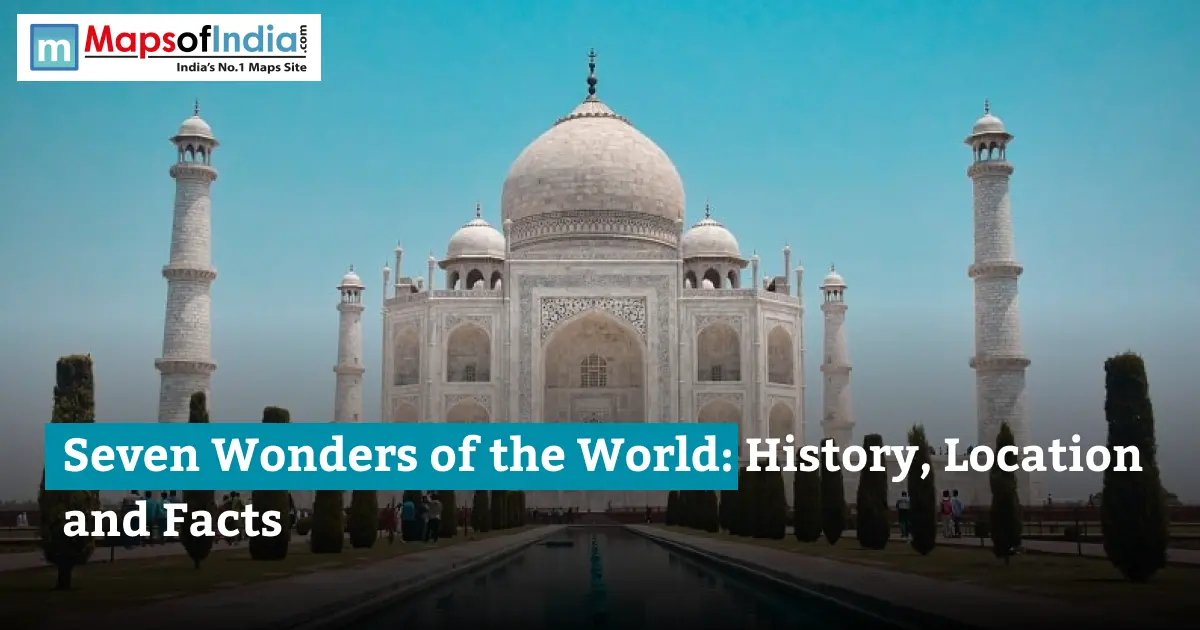
Taj Mahal history and facts begin with grief rather than celebration. Mughal emperor Shah Jahan commissioned it between 1632 and 1653 as a mausoleum for his wife, Mumtaz Mahal, who died during childbirth.
Location in Agra
It sits on the banks of the Yamuna River in Agra, India, in the northern state of Uttar Pradesh.
Interesting Facts
Built entirely from white marble, it shifts colour subtly throughout the day depending on the light. UNESCO recognises it as a World Heritage Site, and it remains one of the most visited monuments on Earth.
The Original (Ancient) Seven Wonders - What Happened to Them?
List of Ancient Wonders
The ancient seven wonders of the world included the Great Pyramid of Giza in Egypt, the Hanging Gardens of Babylon, the Statue of Zeus at Olympia, the Temple of Artemis at Ephesus, the Mausoleum at Halicarnassus, the Colossus of Rhodes, and the Lighthouse of Alexandria.
Why Only the Pyramid of Giza Still Stands
Earthquakes, fires, and centuries of warfare destroyed most of the others long ago. Only the Great Pyramid of Giza survives intact today, which is exactly why the New7Wonders Foundation gave it honorary status alongside the newly voted list, rather than forcing Egypt's most famous landmark to compete for a spot.
Seven Wonders of the World Map
Picture a line stretching across four continents. China and Jordan sit in Asia. Italy sits in Europe. Brazil, Peru, and Mexico sit across the Americas. India rounds out the list from South Asia. This seven wonders of the world map spread is exactly what the voting organizers hoped for: a genuinely global set of landmarks rather than one clustered around a single region.
FAQs
1. What are the seven wonders of the world?
They are the Great Wall of China, Petra, Christ the Redeemer, Machu Picchu, Chichen Itza, the Colosseum, and the Taj Mahal, chosen through a global public vote in 2007.
2. When were the new seven wonders chosen?
The results were announced on 7 July 2007, at a ceremony held in Lisbon, Portugal.
3. Which is the oldest of the seven wonders?
The Great Wall of China holds that title, with construction dating back to around the 7th century BCE.
4. Is the Great Pyramid of Giza still a wonder?
Yes, though not part of the voted list. It holds honorary status as the only surviving structure from the original ancient wonders.
5. How many of the original ancient wonders still exist today?
Only one, the Great Pyramid of Giza. The other six were destroyed by natural disasters, fire, or war centuries ago.
6. Who organised the vote for the new seven wonders?
A Swiss non-profit called the New7Wonders Foundation, founded by Bernard Weber, ran the campaign starting in 2001.
7. How many votes were cast in the 2007 election?
Organisers reported more than 100 million votes, cast through the internet and text messaging.
8. Why did Egypt refuse to let the pyramids be voted on?
Egyptian officials considered it an insult to put such an established wonder up for a popularity contest, so the foundation granted it honorary status instead.