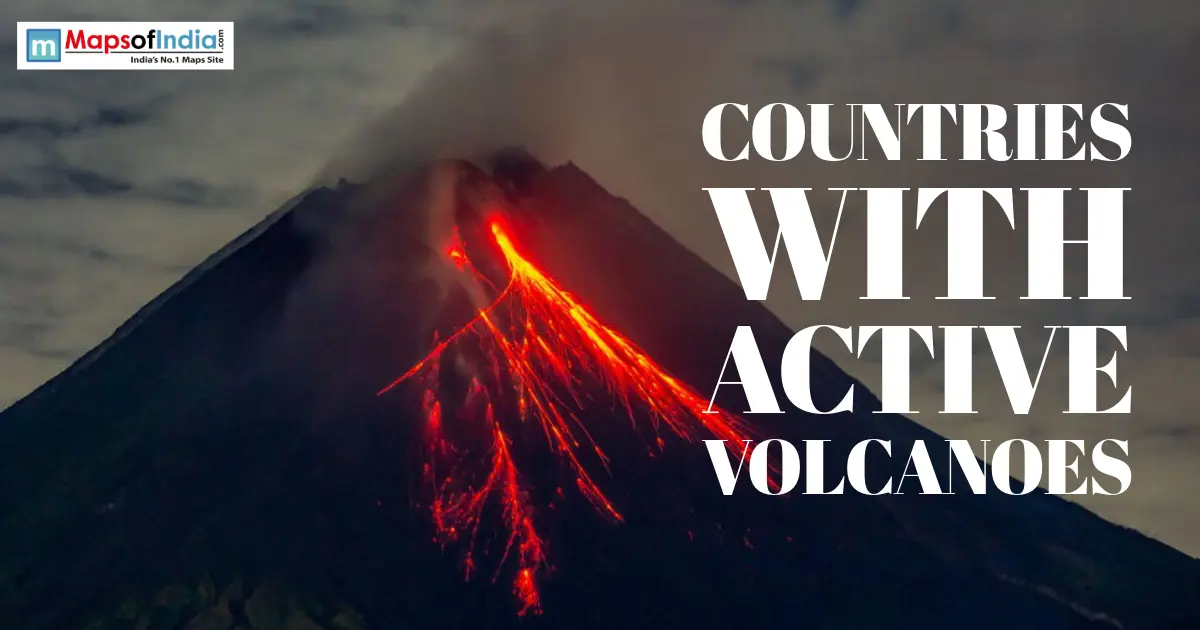
Indonesia is home to most of the world's active volcanoes, at about 130; next comes the USA at 160; followed by Japan with around 120 plus; Russia and Chile both have approximately 90 volcanoes. Many of these volcanoes are part of the Pacific Ring of Fire, where most of the volcanic activity takes place because of tectonic plate boundaries.
What Makes a Volcano "Active"? (Active vs. Dormant vs. Extinct)
Definition of an Active Volcano
A volcano is classed as active if it has erupted within the Holocene epoch (roughly the last 10,000–12,000 years) and retains eruption potential, the standard used for any list of countries with active volcanoes.
How Scientists Classify Volcanic Status
Volcanologists categorize volcanoes into three types: active, dormant (no recent eruption but retains a magma supply; Mount Fuji, quiet since 1707, is a classic example), and extinct (no remaining magma source). Because "extinct" volcanoes have occasionally reawakened, scientists apply that label cautiously.
Countries With the Most Active Volcanoes
Rank | Country | Active Volcanoes (approx.) | Notable Peaks |
| 1 | Indonesia | ~130 | Merapi, Sinabung, Krakatoa |
| 2 | United States | ~160 total, 39–63 active | Kilauea, Mount St. Helens |
| 3 | Japan | ~110–120, 40–44 active | Sakurajima, Aso, Fuji (dormant) |
| 4 | Russia | Kamchatka + Kurils | Sheveluch, Klyuchevskaya |
| 5 | Chile | ~90, 19 active | Villarrica, Llaima |
| 6 | Philippines | Multiple | Mayon, Taal, Pinatubo |
| 7 | Mexico | Multiple | Popocatépetl, Colima |
| 8 | Ethiopia/DR Congo | Multiple | Erta Ale, Nyiragongo |
| 9 | Iceland | Multiple | Hekla, Katla, Grímsvötn |
| 10 | Papua New Guinea | ~13 | Manam, Karkar |
1. Indonesia
Indonesia tops the list of most active volcanoes in the world, ranking with roughly 130 active sites, sitting at the junction of the Eurasian, Indo-Australian, and Pacific plates. Approximately 70 million Indonesians reside within proximity to a volcano, facing some level of hazard.
2. United States
The US counts around 160 total volcanoes, concentrated in Alaska's Aleutian arc, Hawaii, and the Cascades. Kilauea has erupted intermittently since 2021, one of the most closely tracked eruptions on the planet.
3. Japan
Japan holds 110to 120 volcanoes, with 40 to 44 active in the past century. Sakurajima and Mount Aso erupt regularly, while Japan runs some of the world's most advanced volcano-monitoring systems.
4. Russia
Russia's volcanism is focused around Kamchatka and the Kuril Islands, with Sheveluch and Klyuchevskaya among the most explosively active volcanoes on Earth.
5. Chile
Chile has approximately 90 volcanoes along the Andes, with some 19 considered active, over the subduction zone of the Nazca Plate.
6. Philippines
The Philippines is a very important country to include in the list of countries with active volcanoes. Mayon has erupted over 50 times in history. Taal and Pinatubo are major volcanoes.
7. Mexico
Two of the most notable volcanoes in Mexico are closely monitored and are very close to the main population centres: Popocatépetl and Colima.
8. Ethiopia/DR Congo
Erta Ale is one of the world's few active lava lakes, and the eruption of Nyiragongo has endangered the city of Goma in East Africa's Rift Valley.
9. Iceland
Iceland's volcanoes erupt an average of roughly every 3–5 years and are one of the most active per capita in the world, sitting as they are on the Mid-Atlantic Ridge.
10. Papua New Guinea
Papua New Guinea has approximately 13 active volcanoes, making it one of the most volcanic countries in the Pacific Ring of Fire.
The Pacific Ring of Fire: Why So Many Volcanic Countries Cluster Here
Countries Located on the Ring of Fire
This horseshoe-shaped belt runs through Indonesia, Japan, the Philippines, Russia, the US, Mexico, Chile, and Papua New Guinea, hosting roughly 75% of the world's active volcanoes and around 90% of its earthquakes.
Tectonic Plate Activity Explained Simply
Most Ring of Fire volcanism happens at subduction zones, where one plate slides beneath another, melting rock and forcing magma upward, distinct from Iceland's mid-ocean-ridge volcanism, where plates pull apart instead of colliding.
Most Dangerous Active Volcanoes in the World Today
Mount Merapi (Indonesia)
One of the most consistently active volcanoes globally, Merapi's proximity to Yogyakarta keeps evacuation planning a permanent feature of regional life.
Kilauea (USA)
Erupting intermittently since December 2024, following a near-continuous history from 1983–2018 and again from 2020, Kilauea remains a top entry among dangerous volcanoes in the world today.
Mount Etna (Italy)
Europe's most active volcano erupted again in July 2026, closing Catania's airport with an ash column, proof that active volcanism isn't confined to the Ring of Fire.
Popocatépetl (Mexico)
Regularly emitting ash within view of Mexico City and Puebla, "El Popo" is among North America's most closely watched volcanoes, given the millions living nearby.
Interactive Volcano Map by Country
A global volcano map shows dense clustering along three belts: the Pacific Ring of Fire (Indonesia, Japan, US, Russia, Chile, Philippines, Mexico, PNG), the Mid-Atlantic Ridge (Iceland), and the East African Rift (Ethiopia, DR Congo), the clearest visual for understanding which country has the most volcanoes and why.
How Volcanic Activity Affects These Countries
Economic Impact (Tourism, Agriculture)
The soil on the volcano is highly fertile. Ash enrichment is a major contribution to Indonesian agriculture, and Etna and Kilauea are both strong draws for tourists.
Human Safety and Evacuation Systems
Nations topping the active volcanoes by country 2026 list have built sophisticated monitoring: Japan's seismic networks, Indonesia's tiered alert system, and continuous USGS tracking at Kilauea all reflect decades of early-warning investment.
Environmental Effects (Ash, Climate)
The ash and sulfur dioxide emitted during large eruptions enter the atmosphere and can cool the regional or global climate for a short time, similar to what happened following the Pinatubo eruption in 1991
Conclusion
The majority of countries with active volcanoes are located along tectonic plate boundaries, and Indonesia, the US, Japan, Russia and Chile have most of the world's active volcanoes. Today, volcanic activity is a constant and well-observed part of our lives, with 40-50 volcanoes erupting somewhere on Earth each year.
Frequently Asked Questions
1. Which country has the most active volcanoes?
Indonesia has more than any other country, with around 130 volcanoes that are still active.
2. What is the most active volcano in the world?
Kilauea in Hawaii, which began erupting off and on in December of 2024, and Italy's Mount Etna and Russia's Sheveluch.
3. In Europe, do there exist active volcanoes?
Yes, Mount Etna and Stromboli in Italy are very active; also, the volcanoes of Iceland on the Mid-Atlantic Ridge.
4. In which countries would you not find a volcano?
In addition, most of Northern Europe, the Middle East, mainland Australia, and much of central/eastern Africa, because they are located well away from plate boundaries.
5. Can there be active volcanoes in a country without any eruption in many years?
A volcano is considered active even when it is not erupting, but is dormant for decades or centuries.
6. What is the Pacific Ring of Fire?
Earthquakes make up approximately 90% of the world's earthquakes, and the majority of the world's active volcanoes are found in a horseshoe-shaped band around the Pacific Ocean (the Ring of Fire).
7. How many volcanoes erupt in a year?
Generally, only 40-50 volcanoes erupt each year (only 10% of the world's 1350 or so potentially active volcanoes).
8. Why do so many active volcanoes cluster in the same countries?
Because volcanism concentrates at tectonic plate boundaries, subduction zones and rift zones, which is why Indonesia, Japan, the US, and Chile dominate global rankings.