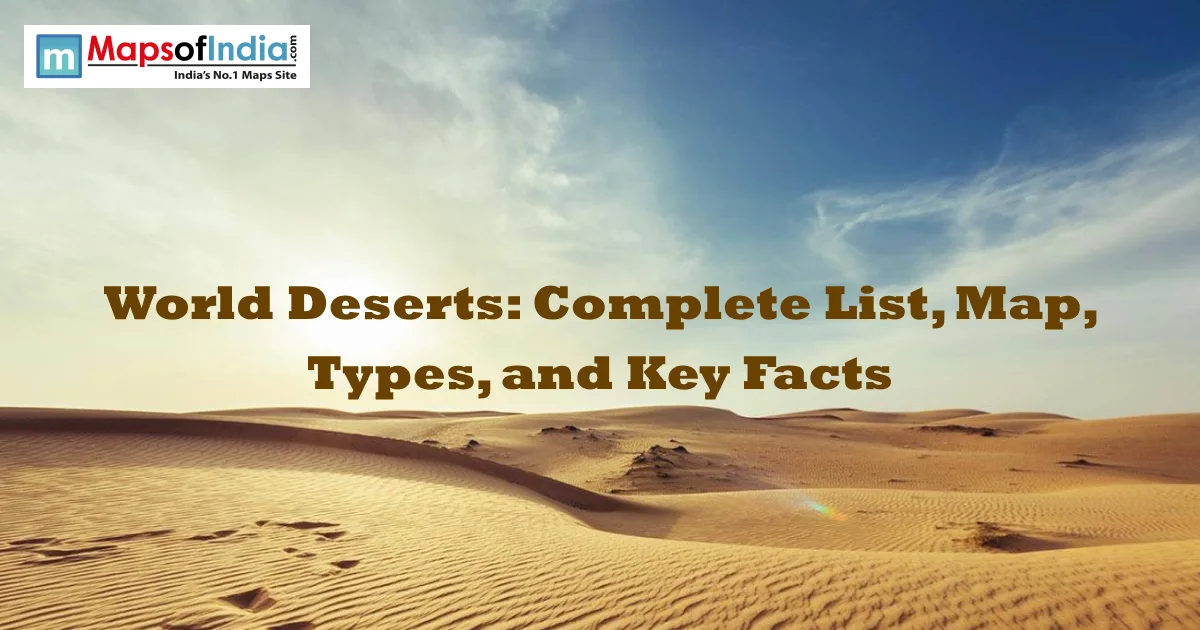
There are 20+ major world deserts, which make up about 1/3 of the Earth's land surface area. Antarctica is the largest desert in the world (cold desert), followed by the Sahara Desert. There are four types of deserts: hot, cold, semi-arid and coastal, and no desert is hot all the time.
What Is a Desert?
Rainfall Threshold That Defines a Desert
A region qualifies as a desert when it receives less than roughly 250mm of precipitation a year. This single rainfall threshold, not temperature, is what unites every entry on any list of deserts in the world, from the Sahara to the ice sheets of Antarctica.
Common Desert Misconceptions (Deserts Aren't Always Hot or Sandy)
The biggest misconception about world deserts is that they're defined by heat and sand dunes. In reality, most of Earth's largest deserts are cold, rocky, or ice-covered, a fact that surprises most people encountering desert facts for the first time. Understanding hot and cold deserts side by side is the fastest way to clear up this confusion.
Types of Deserts
Knowing the types of deserts makes the rest of this guide much easier to follow. Every desert on Earth falls into one of four categories below.
Type | Example | Temperature Range | Rainfall |
| Hot and Dry | Sahara, Sonoran | 5°C to 58°C | Under 250mm/year |
| Cold | Gobi, Antarctic | −89°C to 45°C | Under 250mm/year, mostly snow |
| Semi-Arid | Great Basin | −20°C to 40°C | 250–500mm/year |
| Coastal | Atacama | Mild, coastal-moderated | Among the lowest on Earth |
Hot and Dry Deserts (Sahara, Sonoran)
These sit in the subtropical "horse latitudes," where descending high-pressure air suppresses rainfall almost entirely, the classic image most people associate with hot and cold desert discussions.
Cold Deserts (Gobi, Antarctic)
Cold deserts are dry because frigid air simply can't hold much moisture. The Gobi swings from below −40°C in winter to over 45°C in summer, one of the widest temperature ranges of any desert and a textbook case among types of deserts.
Semi-Arid Deserts (Great Basin)
Semi-arid deserts receive slightly more rain, 250–500mm annually, and cover much of the western United States.
Coastal Deserts (Atacama)
Coastal deserts like Chile's Atacama stay dry because cold ocean currents chill offshore air, preventing it from picking up moisture, making the Atacama the driest hot desert on Earth.
List of the World's Major Deserts (Ranked by Size)
This list of deserts in the world, ranked by area, is the fastest way to see how dramatically size and climate diverge across desert types.
Rank | Desert | Area (approx.) | Type | Location |
| 1 | Antarctic Desert | 14.2 million km² | Polar | Antarctica |
| 2 | Arctic Desert | 13.9 million km² | Polar | Canada, Greenland, Russia |
| 3 | Sahara Desert | 9.2 million km² | Hot | North Africa |
| 4 | Arabian Desert | 2.33 million km² | Hot | Arabian Peninsula |
| 5 | Gobi Desert | 1.295 million km² | Cold | Mongolia & China |
| 6 | Kalahari Desert | ~900,000 km² | Semi-arid | Southern Africa |
| 7 | Patagonian Desert | ~673,000 km² | Cold | Argentina & Chile |
| 8 | Great Victoria Desert | ~348,750–424,400 km² | Hot | Australia |
| 9 | Syrian Desert | ~520,000 km² | Hot | Middle East |
| 10 | Chihuahuan Desert | ~362,000 km² | Hot | USA & Mexico |
1. Antarctic Desert
The undisputed largest desert in the world, at 14.2 million km², Antarctica's interior receives under 51mm of precipitation a year, technically drier than the Sahara, despite being buried in ice.
2. Arctic Desert
Spanning northern Canada, Greenland, and Russia at 13.9 million km², the Arctic actually receives more moisture than Antarctica, but its frigid air can't hold much of it.
3. Sahara Desert
The largest hot desert on the desert map of the world, the Sahara covers 9.2 million km² and has expanded over 10% since 1920.
4. Arabian Desert
This desert spreads over an area of 2.33 million km² over the Arabian Peninsula and frequently rises above 50°C during the summer.
5. Gobi Desert
The Gobi Desert, at 1.295 million km2 is the best example of a cold desert and has a seasonal temperature range of 85°C.
6. Kalahari Desert
A semi-arid desert, comprising approximately 900,000 km² in Southern Africa, that has a greater amount of vegetation and wildlife than most deserts.
7. Patagonian Desert
South America's largest desert (~673,000 km2) is the result of the rain shadow produced by the Andes.
8. Great Victoria Desert
Australia's biggest desert reaches up to 424,400 km², and the temperature is warm in the summer and surprisingly cold at night.
9. Syrian Desert
The region of the Middle East affected by this desert has an area of about 520,000 km², and it has been and will continue to affect the trade routes and settlement patterns for thousands of years.
10. Chihuahuan Desert
It is the largest desert in North America, covering an area of ~362,000 km² along the border with Mexico.
World Desert Map (By Continent)
Mapped by continent, deserts and their locations cluster in three recognizable belts: subtropical hot deserts, continental cold deserts, and the two polar giants at the top and bottom of the globe.
Deserts in Africa
The Sahara dominates North Africa, while the Kalahari and Namib cover the south. South Africa hosts both the largest hot desert and one of the world's oldest coastal deserts.
Deserts in Asia
Asia's deserts and their locations span the Gobi (Mongolia/China), Arabian Desert, and Syrian Desert, the continent with the widest range of desert types.
Deserts in North America
The Chihuahuan, Sonoran, Mojave, and Great Basin deserts cover the southwestern US and northern Mexico.
Deserts in South America
The Atacama (coastal) and Patagonian (cold) deserts dominate, shaped by the Andes' rain-shadow effect.
Deserts in Australia
The Great Victoria Desert leads a network of interconnected deserts covering nearly 20% of the Australian continent.
Deserts in Antarctica/Polar Regions
Antarctica and the Arctic together account for the two largest entries on any list of deserts in the world, despite being covered in ice rather than sand, proof that the desert map of the world extends well past the tropics.
Key Facts About World Deserts
This section rounds up the most-searched desert facts in one place.
Largest Desert in the World
Antarctica, at 14.2 million km² a fact that surprises most readers unfamiliar with the precipitation-based definition of "desert."
Driest Place on Earth
Antarctica's McMurdo Dry Valleys are considered the driest place on Earth, having possibly gone without rain for millions of years, drier even than Chile's Atacama Desert, itself long cited as the driest hot desert.
Hottest Recorded Desert Temperature
Death Valley holds the official air-temperature record at 56.7°C (1913), while satellite-measured land surface temperatures in Iran's Lut Desert and the Sonoran Desert have reached 80.8°C.
Deserts That Are Growing (Desertification)
The Gobi Desert expands by an estimated 3,600 km² a year, and the Sahara has grown by more than 10% since 1920, key evidence in any discussion of desertification.
Animals and Plants Adapted to Desert Life
Saharan silver ants tolerate body temperatures up to 53.6°C, the highest heat tolerance of any land animal, one of the most striking desert facts in the animal kingdom.
Why Deserts Matter (Climate & Ecological Role)
Desert Ecosystems and Biodiversity
Despite their harsh conditions, world deserts support surprisingly specialised biodiversity, from Kalahari wildlife to Atacama's rare fog-dependent plant species.
Deserts and Global Climate Patterns
Deserts play an active role in global weather systems. Saharan dust, for instance, regularly crosses the Atlantic and fertilises the Amazon rainforest with mineral-rich particles.
Human Life and Settlements in Deserts
The Thar Desert (India/Pakistan) is the most densely populated hot desert in the world, showing that human settlement and desert life aren't mutually exclusive.
Conclusion
Aridity is what defines a world desert, and, strictly, the list of world deserts changes when Antarctica and the Arctic are considered as the two biggest deserts in the world. The four types of deserts, from the ever-changing deserts of the Sahara to the temperature extremes of the Gobi, and the almost rainless deserts of the Atacama, cover one third of the planet and have an impact on ecosystems, climate and human settlement, long before the desert is mostly made of dunes.
FAQs
1. Which is the largest desert in the world?
Antarctica is 14.2 million km². It is almost one and a half times the size of the world's largest hot desert (the Sahara Desert), at 9.2 million km².
2. Is Antarctica a desert?
Yes. It has less than 51mm of annual rainfall and is drier than the Sahara, which fits the scientific definition of a desert.
3. List the four types of deserts.
Hot and dry, cold, semi-arid and coastal based on rainfall and temperature conditions, reflecting the absence of sand cover.
4. Which desert is the hottest?
By air temperature, Death Valley (56.7°C) and by satellite-measured surface temperature, Lut Desert in Iran (80.8°C).
5. How many deserts are there in the world?
Deserts comprise more than one-third of the world's land surface, and there are more than 20 named deserts.
6. What is the smallest desert?
The Carcross Desert in Yukon, Canada, is a dry dune patch (but not a climatic desert), covering an area of around 2.6 km².
7. What's the difference between hot and cold deserts?
They both have a low amount of rain, not cold temperatures. Hot deserts form at high pressure and under subtropical air, whereas cold deserts stay dry because cold air has little moisture in it.
8. Which continent has the most desert coverage?
Antarctica has the single largest desert by area, but Africa and Asia together host the greatest number and variety of named deserts on the standard desert map of the world.