What Does "Population Density" Mean?
Population density simply measures how many people live within a given area, usually expressed as people per square kilometre. It sounds like a straightforward calculation, but as you will see throughout this list, tiny islands make that calculation genuinely wobbly, since even a small shift in population estimate or boundary definition can swing the final number by tens of thousands per square kilometre.
How We Ranked These Islands
This list draws on a mix of sources, including Guinness World Records, Wikipedia's island population data, and national statistics offices, cross-checked against each other wherever possible. A genuine caveat upfront: for the smallest islands on this list, some barely bigger than a football pitch, published density figures vary enormously depending on the year, the population count used, and exactly where the island's boundary is drawn. Where sources disagreed significantly, we have flagged it rather than picking whichever number sounded most dramatic.
Top 10 Most Densely Populated Islands in the World
Rank | Island | Country | Population | Area (km²) | Density (per km²) |
| 1 | Santa Cruz del Islote | Colombia | ~500–1,200 (disputed) | 0.012 | ~40,000–100,000+ (disputed) |
| 2 | Migingo Island | Kenya | ~1,000 | ~0.002 | Extremely high figures are unreliable at this scale |
| 3 | Ap Lei Chau | Hong Kong | ~80,000–87,000 | 1.3 | ~60,000–67,000 |
| 4 | Ebeye | Marshall Islands | ~8,400–10,000 | 0.36 | ~23,000–27,000 |
| 5 | Malé | Maldives | ~211,900 | 8.3 | ~18,900 |
| 6 | Manhattan | USA | ~1.6 million | 59.1 | ~27,000 |
| 7 | Île Saint-Louis | France | ~4,500 | 0.2 | ~22,000 |
| 8 | Singapore | Singapore | ~6.1 million | 710 | ~8,500 |
| 9 | Ilet à Brouée | Haiti | ~500 | 0.004 | ~125,000 (single-source, unverified) |
| 10 | Java | Indonesia | ~153 million | ~130,000 | ~1,177 |
1. Santa Cruz del Islote
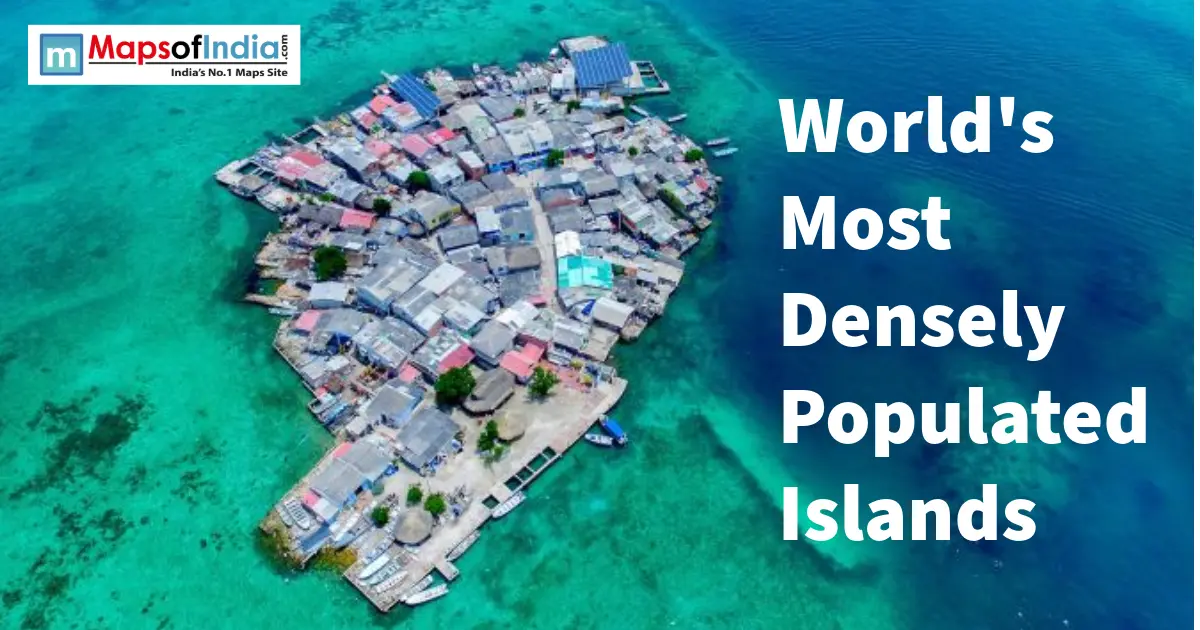
Located off Colombia's Caribbean coast within the Archipelago of San Bernardo, this artificial coral island is often cited as the world's most densely populated. Its entire land area covers barely more than a football pitch, and population estimates for the island range from around 500 to over 1,200 residents, depending on the source and year, which is exactly why quoted density figures for this one swing so wildly, anywhere from roughly 40,000 to over 100,000 people per square kilometre.
2. Migingo Island
This tiny rocky outcrop in Kenya's portion of Lake Victoria hosts around 1,000 people crammed onto barely a fifth of a hectare, drawn almost entirely by the fishing industry in the surrounding waters. Its history involved a genuine ownership dispute between Kenya and Uganda, resolved through a 2016 agreement. At this scale, precise density figures become almost meaningless statistically, though the raw crowding is very real and visible in photographs of the island.
3. Ap Lei Chau
Often cited by Guinness World Records as the most densely populated island on Earth, this small island off Hong Kong Island holds a population of roughly 80,000 to 87,000 people across just 1.3 square kilometres, working out to somewhere between 60,000 and 67,000 people per square kilometre. Unlike many entries on this list, Ap Lei Chau's figures are unusually well documented, connected to the rest of Hong Kong by a four-lane road bridge.
4. Ebeye
Part of the Marshall Islands' Kwajalein Atoll, Ebeye packs roughly 8,400 to 10,000 residents onto just 0.36 square kilometres of land, giving it a density somewhere in the range of 23,000 to 27,000 people per square kilometre. Its population grew substantially after nearby Kwajalein Island was taken over for US military use, pushing displaced islanders onto this comparatively tiny patch of land instead.
5. Malé
The capital of the Maldives holds close to 212,000 people across its 8.3 square kilometre urban footprint, giving it a density of around 18,900 people per square kilometre by that measure, though figures shift noticeably depending on whether the calculation uses just the original city island or the wider metro area, including reclaimed land like Hulhumalé.
6. Manhattan
New York City's most iconic borough houses around 1.6 million people across roughly 59 square kilometres, giving it a density close to 27,000 people per square kilometre. It remains one of the most reliably documented entries on this list, offering a genuinely useful large-scale comparison point against the tiny fishing and coral islands elsewhere in this ranking.
7. Île Saint-Louis
This small island in the middle of the Seine, right in central Paris, holds roughly 4,500 residents across just 0.2 square kilometres, working out to a density of around 22,000 people per square kilometre. It offers a useful European comparison point, dense urban living achieved through historic architecture rather than modern high-rise construction.
8. Singapore
As both a country and an island, Singapore holds around 6.1 million people across roughly 710 square kilometres, giving it a density of around 8,500 people per square kilometre. Extensive land reclamation has actually expanded Singapore's total area by around 25% since 1965, meaning its density growth has been partly offset by the island physically growing larger over time.
9. Îlet à Brouée
This small sand spit off Haiti's coast is sometimes cited as having the highest density of any inhabited island on Earth, with around 500 residents packed onto a strip of land covering only about 4,000 square metres. It is worth flagging honestly that this figure comes from a single source we could not independently cross-verify elsewhere, so treat this particular entry with more caution than the others on this list.
10. Java
Indonesia's most populous island offers a genuinely different kind of density story. With roughly 153 million people spread across about 130,000 square kilometres, its density sits at a comparatively modest 1,177 people per square kilometre, yet it remains one of the most densely populated large landmasses on Earth, driven by fertile volcanic soil and major economic hubs like Jakarta.
Densely Populated Islands by Country
Hong Kong, the Maldives, and the Marshall Islands each appear among the world's most crowded island territories despite ranking quite differently by overall size, a reminder that national population density and island-specific density often tell very different stories within the same country.
Why Are These Islands So Densely Populated?
Geographic Constraints
Small, fixed land area with nowhere left to expand forces vertical building and tightly packed housing, particularly visible on islands like Ap Lei Chau and Malé, where every available metre gets used.
Economic/Trade Importance
Fishing access, port infrastructure, or proximity to a larger economic hub, as with Ap Lei Chau's bridge link to Hong Kong Island, draws population growth that the land area simply cannot comfortably absorb.
Historical Migration Patterns
Displacement, military land use, or historic settlement patterns, as seen on Ebeye following the US military's use of neighbouring Kwajalein, have pushed populations onto smaller islands than they might otherwise have chosen.
Most Densely Populated Islands vs. Most Densely Populated Countries
It is worth separating these two ideas clearly. Monaco holds the title of the world's most densely populated country, at around 18,343 people per square kilometre, yet it is not an island at all. Meanwhile, several islands on this list, Ap Lei Chau, Santa Cruz del Islote, and Ebeye, among them, far exceed even Monaco's figure, simply because they represent tiny pockets of extreme crowding rather than an entire nation's average.
Conclusion
Extreme population density on islands tends to tell one of two stories: either a tiny fishing or trading community that outgrew its footprint generations ago, or a major global city that simply ran out of room to expand outward. Both patterns show up clearly across this list, from Santa Cruz del Islote's few hundred residents to Manhattan's 1.6 million, and both raise genuinely similar questions about sustainability, infrastructure, and how much crowding a small patch of land can reasonably support.
FAQs
What is the most densely populated island in the world?
Santa Cruz del Islote in Colombia is most commonly cited, though exact density figures vary enormously across sources due to its tiny size and disputed population count.
Which inhabited island has the highest population density?
Depending on the source, either Santa Cruz del Islote or Ap Lei Chau in Hong Kong claims this title, with Ap Lei Chau generally considered the more reliably documented of the two.
Are densely populated islands sustainable in the long term?
Many face real strain on sanitation, freshwater access, and housing, and some, like Santa Cruz del Islote, have already reached a point where residents describe running out of physical space to build further.
What's the difference between population density and total population?
Population density measures people per unit of area, while total population simply counts total residents. A tiny island with 1,000 people can have a far higher density than a massive island with millions, if its land area is proportionally much smaller.
Why do density figures for small islands vary so much between sources?
Because tiny land areas make the calculation extremely sensitive to small changes in either population estimates or exactly where an island's boundary is drawn, so even a modest counting difference produces a wildly different final figure.
Is Manhattan technically an island?
Yes, Manhattan is a genuine island, separated from the rest of New York City by the Hudson, East, and Harlem Rivers, and it ranks among the most densely populated islands globally by any measure.
Is Singapore an island or a country?
Both. Singapore is a sovereign city-state that occupies a single main island plus several smaller ones, making it a useful example of a country and an island being essentially the same landmass.
How does Migingo Island's ownership dispute affect its population count?
The long-running dispute between Kenya and Uganda over Migingo made reliable population counting genuinely difficult for years, and even after the 2016 resolution, published figures for the island still vary somewhat between sources.