The Nile and the Amazon are the world's longest rivers, locked in a genuine scientific dispute over which one actually holds the top spot, while the Amazon carries far more water than any other river system on Earth by a wide margin. This article covers the world's largest river systems from three different angles, since "biggest" can mean length, drainage basin size, or water discharge, and a river that tops one list often ranks quite differently on another. Understanding which measure is being used matters more than most articles let on, and it explains why you will see conflicting "biggest river" claims across the internet.
How Are River Systems Ranked?
By Length
This measures the total distance a river travels from its furthest source to where it meets the sea. It sounds simple, but pinpointing an exact source is often genuinely contested, which is exactly why the Nile-versus-Amazon debate has dragged on for decades.
By Basin (Drainage) Area
A river's basin covers the entire land area that drains into it, tributaries included. This measure often tells a very different story than length alone, since a shorter river with a wide, sprawling network of tributaries can out-drain a longer, narrower one.
By Water Discharge (Volume)
Discharge measures how much water actually flows out of a river's mouth, usually in cubic metres per second. This depends heavily on rainfall across the basin rather than length, which is exactly why the Amazon, despite ranking only second or third in length, dominates every discharge ranking by an enormous margin.
World's Largest River Systems
Rank | River System | Length (km) | Basin Area (km²) | Countries | Continent |
| 1 | Nile | 6,650 | ~3,300,000 | 11 | Africa |
| 2 | Amazon | ~6,400 (disputed) | ~7,050,000 | 8 | South America |
| 3 | Yangtze | 6,300 | ~1,800,000 | 1 (China) | Asia |
| 4 | Mississippi-Missouri | ~6,275 | ~3,202,000 | 2 | North America |
| 5 | Yenisei | 5,539 | ~2,580,000 | 2 | Asia |
| 6 | Yellow River (Huang He) | 5,464 | ~745,000 | 1 (China) | Asia |
| 7 | Ob-Irtysh | 5,410 | ~2,972,000 | 4 | Asia |
| 8 | Parana | 4,880 | ~2,583,000 | 3 | South America |
| 9 | Congo | 4,700 | ~3,700,000 | 9 | Africa |
| 10 | Amur | 4,444 | ~1,855,000 | 3 | Asia |
A quick, honest note here: the Nile-Amazon length gap sits at under 3%, well within the margin of measurement uncertainty, so treat ranks 1 and 2 as effectively tied depending on which study you trust.
World's Largest River Systems
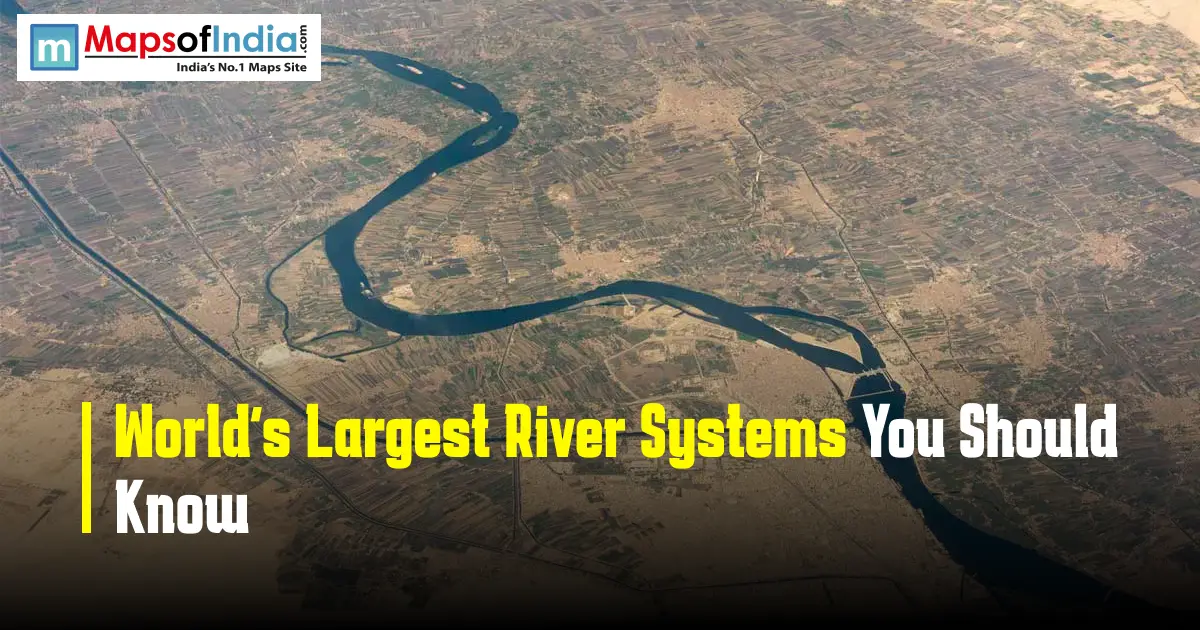
1. Nile River System
Length: 6,650 km. Basin area: roughly 3.3 million km². The Nile draws from two main sources, the White Nile from Lake Victoria and the Blue Nile from Lake Tana in Ethiopia, before flowing north through eleven countries and emptying into the Mediterranean Sea. It holds the record for flowing through more countries than any other major river system on Earth, and it sustained one of history's earliest and longest-running civilizations along its banks.
2. Amazon River System
Length: approximately 6,400 km, though some studies push this closer to 6,575 km, keeping the Nile comparison genuinely unsettled. Basin area: about 7,050,000 km², the largest of any river on the planet, covering more than a third of South America. It rises in the Peruvian Andes and empties into the Atlantic Ocean, carrying a discharge of roughly 209,000 cubic metres per second, more than the next seven largest rivers combined. Around one-third of all known species on Earth live within its surrounding basin.
3. Yangtze River System
Length: 6,300 km. Basin area: approximately 1.8 million km². It rises on the Tibetan Plateau and flows entirely within China before reaching the East China Sea near Shanghai, making it the longest river running through just a single country anywhere in the world. The Three Gorges Dam, the largest hydroelectric structure on Earth, sits along its course, and roughly a third of China's population lives within its basin.
4. Mississippi-Missouri River System
The total length is around 6,275 km, made up of the two rivers. The basin area is approximately 3,202,000 km², with approximately 41% drainage of the contiguous United States. The Missouri flows out of the Rocky Mountains, and the Mississippi begins at Lake Itasca in Minnesota, both of which empty into the Gulf of Mexico. This combined system has been a force in American trade, agriculture and settlement since the early history of the nation.
5. Yenisei River System
Length: 5,539 km. Basin area: roughly 2,580,000 km². It flows north through Russia to the Kara Sea, which is a part of the Arctic Ocean, and is born in the Mongolian region. It transports a huge amount of fresh water into the Arctic annually and has significant effects on the regional climate and the sea-ice distribution.
6. Yellow River (Huang He) System
Length: 5,464 km. Basin area: approximately 745,000 km². It rises in the Bayan Har Mountains of Qinghai province and flows through northern China before reaching the Bohai Sea. Its nickname, "China's Sorrow," comes from a long history of devastating floods, caused partly by the huge volume of yellow silt it carries, which gives the river its name and colour.
7. Ob River System
The total length of the river is 5410 km, including the Ob and Irtysh rivers. Basin area: approximately 3 million km², which covers Russia, Kazakhstan, China, and Mongolia. It flows north into the Arctic Ocean through the Gulf of Ob. It is estimated that 30% of the world's peat bogs and is therefore a significant carbon sink on a global scale.
8. Congo River System
Length: 4,700 km. Basin area: around 3.7 million km², the second-largest of any river system, straddling the equator twice as it winds through Central Africa. It holds the record as the world's deepest river, with measured depths exceeding 220 metres in the Congo Canyon, and ranks second only to the Amazon in total water discharge. Its basin supports the Congo rainforest, the second-largest tropical rainforest on Earth after the Amazon's.
9. Amur River System
Length: 4,444 km. Basin area: approximately 1,855,000 km². It forms much of the natural border between Russia and China before flowing into the Sea of Okhotsk. It remains one of the least dammed major rivers left on Earth, giving it an unusually intact, free-flowing ecosystem compared to most rivers of its size.
10. Parana River System
Length: 4,880 km. Basin area: roughly 2,583,000 km². It rises in Brazil and flows south through Paraguay and Argentina before draining into the Río de la Plata estuary. It is South America's second-longest river after the Amazon, and its basin supports Itaipu Dam, one of the largest hydroelectric plants in the world.
River Systems by Continent
Rivers of Asia
Asia holds an unusually large share of the world's biggest river systems, including the Yangtze, Yenisei, Yellow River, Ob-Irtysh, and Amur, largely thanks to its sheer landmass and the Tibetan Plateau's role as a source for so many major waterways.
Rivers of Africa
The Nile and Congo dominate this continent, together draining a huge portion of Africa's interior, though they take almost opposite approaches, the Nile running long and narrow, the Congo running shorter but with a vastly wider basin.
Rivers of South America
The Amazon overshadows everything else on this continent, though the Parana and Orinoco both rank among the world's largest river systems in their own right, particularly by discharge volume.
Rivers of North America
The Mississippi-Missouri system stands alone as the continent's dominant river network, shaping the agricultural and economic backbone of the central United States.
Rivers of Europe
Europe's rivers, like the Danube and Volga, rank highly for the number of countries they touch, but fall well short of the length and basin figures seen on other continents, given Europe's comparatively smaller landmass.
Quick Facts
- Longest river in the world: The Nile, at 6,650 km, though the Amazon remains a genuine scientific contender depending on measurement method.
- River with the largest basin: The Amazon, draining roughly 7,050,000 km², well ahead of the Congo in second place.
- River with the highest discharge: The Amazon, releasing approximately 209,000 cubic metres of water per second, more than the next seven largest rivers combined.
- Longest transboundary river: The Nile, flowing through eleven countries, more than any other major river system on Earth.
Conclusion
Ranking the world's biggest rivers depends entirely on what you are measuring. The Nile edges out the Amazon on length, though only barely, while the Amazon dominates every other category, from basin size to sheer water volume. Beyond the top two, Asia's rivers claim a surprising number of spots on this list, a reminder of just how much of the continent's geography is shaped by water flowing down from its highland interior. If river geography interests you, our guide to the longest rivers in India makes a good next stop.
FAQs
What is the world's largest river system?
It depends on the measure used. The Nile is the longest by length, while the Amazon holds the largest basin and by far the highest water discharge.
Is the Nile or the Amazon the longest river?
Most traditional measurements give the Nile the edge at 6,650 km, though some newer studies push the Amazon's length close to or even past that figure, keeping the debate genuinely unresolved.
Which river has the largest basin in the world?
The Amazon, draining approximately 7,050,000 km², is more than double the Nile's basin size.
Which river carries the most water?
The Amazon, by a huge margin, discharges around 209,000 cubic metres of water per second into the Atlantic Ocean.
How many countries does the Amazon flow through?
The Amazon's main channel runs through Peru, Colombia, and Brazil, though its wider drainage basin touches eight countries in total, including Bolivia, Ecuador, Venezuela, Guyana, and Suriname.
How many countries does the Nile flow through?
Eleven, more than any other river system on Earth, including Egypt, Sudan, South Sudan, Uganda, Ethiopia, Kenya, Tanzania, Rwanda, Burundi, Eritrea, and the Democratic Republic of the Congo.
Which river is the deepest in the world?
The Congo River holds that record, with measured depths exceeding 220 metres in its Congo Canyon section.
Why do different sources give different rankings for the same rivers?
Because length, basin area, and discharge measure completely different things, and even within a single category, source-point disputes and differing measurement methods can shift a river's ranking noticeably from one study to the next.