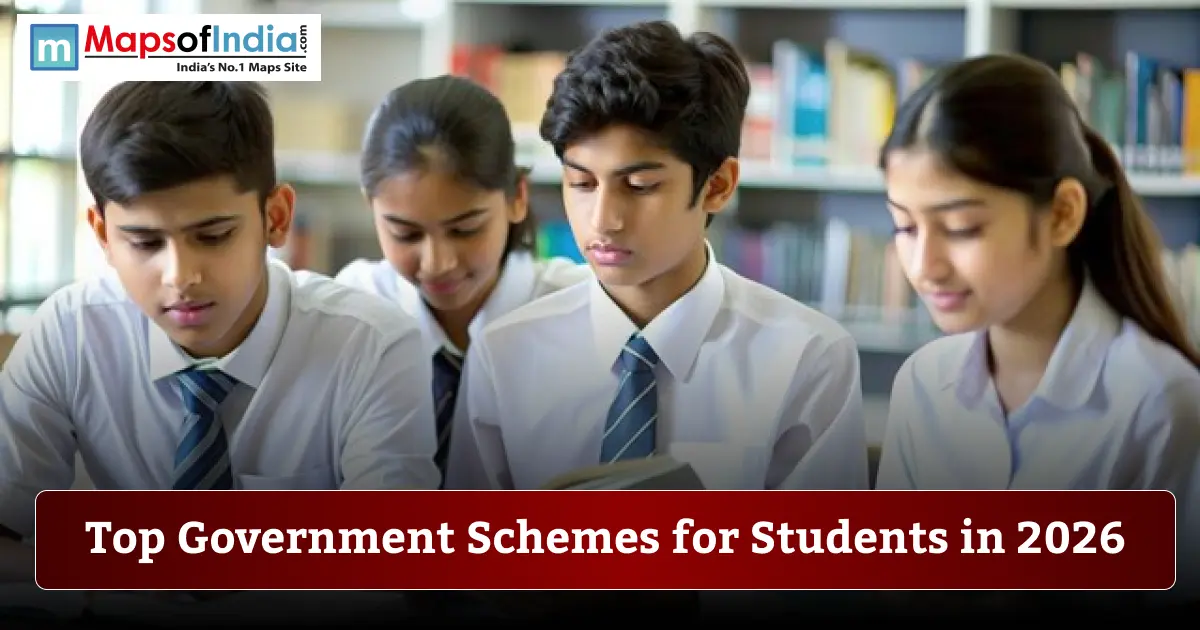
In 2026, the government came out with different financial aid packages targeting college-going young learners. Some of these schemes include: These different types of scholarships benefit not only school-going students but also those who are currently pursuing higher education through colleges or other institutions of education. Students also get the benefit of this facility if they are female, belong to a particular religious minority group or have any kind of physical/mental disability. It is for the 2026-27 academic cycle. Please check the official sites for the latest guidelines and dates of application.
What Are Government Schemes for Students?
Types of Schemes (Scholarship, Loan-Linked, Welfare, Skill Development)
The government schemes for students in 2026 can be categorized into a few categories. Others give direct cash scholarships directly to a bank account. Others provide "loan-linked support" by lowering the interest, but not by granting cash. A smaller group looks after welfare, such as paying hostel fees or providing devices for students with disabilities; a few are related to skill development and vocational training, as well as academics.
Who Is Eligible in General (Income, Category, Merit Criteria Overview)
There are typically three criteria that come into play when determining eligibility. Most schemes have a ceiling of income between ₹2.5 lakh per year and ₹8 lakh per year, with family income placed at the centre of them. Category is also important, as there are many schemes that are targeted at SC, ST, OBC, EBC, DNT or minority communities. Merit caps things off, whether measured by board exam percentages or, in the case of renewals, through ongoing academic performance.
Top Government Schemes for Students in 2026
Scheme Name | Eligibility | Benefit | Application Mode | Official Portal |
| PM YASASVI | OBC/EBC/DNT, Class 9-12 | Up to ₹1,25,000/year | Online | scholarships.gov.in |
| Post-Matric Scholarship | SC/ST/OBC/Minority, Class 11+ | Maintenance + fee reimbursement | Online | scholarships.gov.in |
| Central Sector Scheme of Scholarships (CSSS) | Top 20th percentile, all categories | ₹12,000-20,000/year | Online | scholarships.gov.in |
| AICTE Pragati | Girl students, technical courses | ₹50,000/year | Online | scholarships.gov.in |
| AICTE Saksham | Students with 40%+ disability | ₹50,000/year | Online | scholarships.gov.in |
| PM Vidyalaxmi | Admission to top-ranked HEIs | Collateral-free loan up to ₹10 lakh, with interest subsidy | Online | pmvidyalaxmi.co.in |
National Scholarship Portal Schemes
The National Scholarship Portal, or NSP, works as the single-window gateway for most central government schemes for students. Rather than applying separately to each ministry, students register once and apply for whichever scheme fits their category and course.
PM YASASVI Scholarship
Run by the Ministry of Social Justice and Empowerment, this scheme supports OBC, EBC, and DNT students. Class 9-10 students can receive up to ₹75,000 a year, while Class 11-12 students in Top Class Schools can receive up to ₹1,25,000 annually. Selection runs purely on merit now, based on the previous year's board marks, since the earlier entrance test was scrapped for this cycle. Applications typically stay open through the middle of the year on the NSP.
Post-Matric Scholarship for SC/ST/OBC Students
This is really a family of related schemes rather than one single scholarship, covering SC, ST, OBC/EBC/DNT, and minority students from Class 11 onward, including diploma, degree, postgraduate, and even PhD courses. Income ceilings sit around ₹2.5 lakh a year for SC and ST applicants, with other categories following their own scheme-specific limits. The 2026-27 window opened on 1 June 2026 through the NSP.
Central Sector Scheme of Scholarships (CSSS)
CSSS targets meritorious students regardless of category, provided their board exam marks fall within the top 20th percentile of their stream. Undergraduate students receive around ₹12,000 a year for the first three years, rising to ₹20,000 a year for postgraduate or professional courses in the later years. Applications generally open around July-August and run through October-November.
AICTE Pragati and Saksham Scholarship
Pragati supports girl students in AICTE-approved technical courses, while Saksham does the same for students with at least 40% disability. Both pay ₹50,000 a year, with family income capped at ₹8 lakh. Roughly 10,000 scholarships go out under Pragati each cycle, and around 1,000 under Saksham. The 2026-27 deadline sits at 31 October 2026.
PM Vidyalaxmi (Education Loan Scheme)
Unlike the scholarship schemes above, PM Vidyalaxmi is a loan-linked programme, not free money. It offers guarantor-free, collateral-free loans up to ₹10 lakh for students admitted to one of the top 860-ranked higher education institutions in India, paired with an interest subsidy that eases the repayment burden for eligible income groups. It works alongside the older Central Sector Interest Subsidy scheme rather than replacing it entirely.
Schemes by Student Category
Schemes for School Students
PM YASASVI covers Class 9-12 students directly, while various Pre-Matric scholarships support younger children from SC, ST, and minority households still in earlier grades.
Schemes for College/University Students
CSSS remains the broadest option here, open to general-category students purely on merit and income, alongside category-specific Post-Matric schemes for those from SC, ST, OBC, or minority backgrounds.
Schemes for Girl Students
AICTE Pragati leads this category for technical courses specifically, and several Post-Matric and CSSS schemes also reserve a portion of slots for female applicants, sometimes as much as 50%.
Schemes for SC/ST/OBC/Minority Students
The Post-Matric Scholarship family and PM YASASVI cover most of this ground, alongside standalone Top Class Education schemes aimed at students entering premier institutions.
Schemes for Students with Disabilities
AICTE Saksham directly targets this group within technical education, requiring at least 40% documented disability alongside the standard income ceiling.
How to Apply for Government Student Schemes
Documents Required (Income Certificate, Caste Certificate, Aadhaar, Bank Details)
All of the schemes will request the basic set of documents. Be prepared to submit an income certificate, caste/community certificate (if applicable), Aadhaar details, Aadhaar-linked bank account and recent mark sheets or admission proof.
Step-by-Step Application Process (via National Scholarship Portal or Scheme-Specific Portal)
Sign up for a One-Time Registration on the NSP by providing your Aadhaar and mobile number. After that, choose the particular scheme that you are eligible for and complete the educational and personal information, upload the required documents and submit. Save the application ID for status tracking later.
Common Mistakes That Lead to Rejection
A mismatched Aadhaar and bank account tops the list of avoidable errors, since it blocks the Direct Benefit Transfer entirely. Missing institute verification, incomplete OTR, and applying after a scheme's deadline also derail otherwise eligible applicants regularly.
Important Dates and Deadlines for 2026
Scheme | Application Opens | Last Date |
| PM YASASVI | June 2026 | Around July-August 2026 |
| Post-Matric Scholarship | 1 June 2026 | Varies by state/category |
| CSSS | July-August 2026 | October-November 2026 |
| AICTE Pragati/Saksham | Mid-2026 | 31 October 2026 |
Dates above reflect the current cycle as reported, though scheme windows frequently get extended, so always confirm live deadlines directly on scholarships.gov.in before applying.
Conclusion
Between PM YASASVI, the Post-Matric Scholarship family, CSSS, AICTE Pragati and Saksham, and PM Vidyalaxmi, most Indian students have at least one relevant option worth applying for in 2026. Income ceilings, category requirements, and deadlines all vary scheme to scheme, so it pays to check eligibility carefully rather than assuming one scheme rules everything out.
Frequently Asked Questions
Which scheme is the largest in the government for the education of students?
At present, PM YASASVI provides some of the highest amounts of up to ₹1,25,000 in a year to eligible Class 11-12 students in Top Class Schools.
How to determine eligibility for a government scheme?
Go to the scholarships.gov.in website, read the description of each scholarship, check the eligibility criteria, and then compare the academic qualification, family income, and category with the published criteria.
Are there any government schemes for private college students?
Yes, in most cases, provided the institution is recognised or approved by AICTE (if applicable). While there are general guidelines, there are scheme-specific rules, so be sure to check the eligibility of your institution before making an application.
Does a single place exist for all scholarships?
Largely yes. Most central schemes are available on the National Scholarship Portal, while some state-specific and loan schemes, such as PM Vidyalaxmi, are available on their own portals.
How can I get in if the application deadline has passed?
Usually, late applications are not accepted, and deadlines are sometimes extended. Therefore, it is a good idea to check the portal even after the deadline has passed.
Do these schemes need to be repaid?
There are many scholarships, such as PM YASASVI, CSSS, and Pragati, that do not require repayment. PM Vidyalaxmi is, however, a loan scheme and hence the amount borrowed needs to be repaid even with the subsidy on interest.
May I submit more than one scholarship application?
There is some variation between schemes. If you receive another scholarship, some will exclude you from applying formally, so do not apply to a number of these schemes.