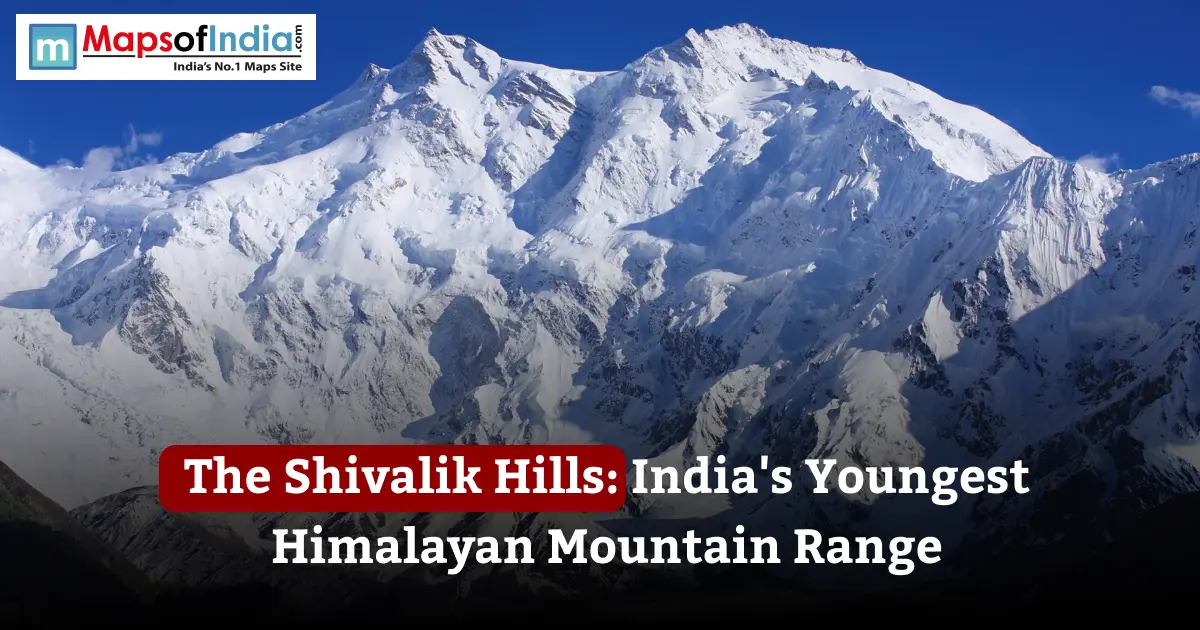
The Shivalik Hills are the newest part of the Himalayan mountain system, stretching along the base of the mountains from northwest to east. Unlike the snowy peaks that many imagine when they think of the Himalayas, the Shivaliks are small soft-rock hills. New enough that they are still changing, breaking apart and shaping the land between the mountains and the plains. This article talks about why the range is seen as the youngest part of the Himalayas, what it's made of and why it's important far beyond just geology. From helping water come back into the ground to having some of the best fossil collections in Asia.
What Are the Shivalik Hills?
The Shivalik Hills, also written as Siwalik, are called the Outer Himalayas, Sub-Himalayas or Churia/Chure Hills in Nepal. It is the southernmost of the three parts of the Himalayas. They sit directly between the Indo-Gangetic plains to the south and the Lesser Himalaya (Himachal range) to the north, acting like the first step up from flat land into the real mountains.
Where Are the Shivalik Hills Located?
States and regions in India
In India, the Shivalik range goes through Jammu and Kashmir, Himachal Pradesh, Punjab, Haryana, and Uttarakhand, continuing east with strength into Uttar Pradesh. The range is not always one strong wall. Its thickness and strength change a lot from place to place.
Extent beyond India
The Shivaliks don't end at India's borders. The range goes west into Pakistan and east through Nepal, where it is called the Churia or Chure Hills, and altogether stretches 2,400 km from the Indus area to places near the Brahmaputra basin, passing through India, Nepal, Bhutan and Pakistan along the way.
Why Are the Shivalik Hills Called the Youngest Range?
How the Himalayas formed
The Himalayas are there because the Indian tectonic plate has been colliding with the Eurasian plate for about 50 million years, a slow crash that is still pushing the mountains higher today.
The three ranges
That crash created three main belts, each formed at a different time. The Himadri, or Greater Himalaya, is the northernmost and oldest, home to the snowy peaks. The Himachal, or Lesser Himalaya, is in the middle, usually lower and formed a little later. The Shivalik, or Outer Himalaya, is the youngest and southernmost of the three, bordering the plains.
Geological age of the Shivalik
The Shivaliks weren't pushed up from rock the way the higher ranges were. They were formed from dirt. Rivers coming from the rising Himalaya carried lots of sand, silt and stones over millions of years, which built up in an area and was later turned into hills. Geologists say the Siwalik dirt layers are 16 to 5.2 million years old, with the layers that have fossils going from 18 million to 600,000 years ago. Making the range, in geological terms, very young.
Geology and Rock Composition of the Shivalik Range
Sandstone, clay and conglomerate
The Shivaliks are made of sandstone, clay and conglomerate. Soft, weakly held-together rock is different from the hard, strong rock that makes up the Greater Himalaya. This softness is why the range breaks down easily and why its sides are seen as weak.
Frontal thrusts and seismic activity
The Shivalik range is next to the Himalayan Frontal Thrust, part of the fault system where the Indian plate keeps pushing under the Eurasian plate. This makes the whole Shivalik area a place where the Earth moves, and it can have earthquakes when the pressure along these faults gets high.
Erosion and landslides
Because the rock here is not tight, the Shivaliks break down much faster than the ranges behind them. Heavy rains often cause landslides and big loss of soil, a problem that affects how roads are built and where people live along the foot of the hills.
Height, Landscape and Physical Features
Elevation range
Shivalik heights are usually between 600 and 1,500 meters, sometimes going up to 2,000 meters in some parts of the east. Small compared to the Himalayas but still an important first step between the ground and the higher mountains.
Duns and valleys
Between the Shivalik and the Lesser Himalaya are a number of areas called Duns. Dehradun is the most famous. These valleys formed when dirt from the mountains filled in the space between the two ranges, making fertile land between two mountain areas.
Bhabar and Terai at the foot of the hills
South of the Shivaliks is the Bhabar, a narrow area with big stones and rocks where the water from the hills goes underground. That same water comes up again south in the Terai, a wet area that is the real start of the Indo-Gangetic plains.
Rivers and Water Systems of the Shivalik Region
Many small streams, called raos in the language, cut through the Shivalik range, getting much bigger during the rainy season and drying out for most of the year. Larger steady rivers start deeper in the Himalaya, like the Ganga, Yamuna, Sutlej and Beas. Go through the range through cuts on their way to the plains. Beyond what you can see, the Shivaliks help recharge groundwater that gives water to the plains below, supporting farming and drinking water.
Fossils and Palaeontological Importance
Why the Shivalik is a fossil treasure
Mountain areas anywhere have as many fossils as the Shivalik. The range's dirt layers, laid down for 18 million years, have kept the remains of big animals like elephants, horses, rhinos and giraffe-like Sivatherium, as well as early apes such as Sivapithecus, crocodiles and others from the Miocene to the Pleistocene periods in great detail.
Siwalik Fossil Park, Suketi
The Siwalik Fossil Park, also called the Suketi Fossil Park, is in Sirmaur district, Himachal Pradesh. Not Haryana, a mistake that often happens online. It was named a National Geological Monument in 1974. It has fossils from about 1 to 1.5 million years ago, along with life-sized models of the animals that lived here and a fossil museum added in May 2014. As with all protected places, it is best to check with the tourism or forest authorities for the latest hours and access before visiting.
Wildlife, Forests and Protected Areas
The Shivalik has trees like sal and other kinds of forests, with some dry areas having bushes. It is home to animals like elephants, leopards, and in some places, tigers. Several protected areas are in or near the range, including Rajaji National Park in Uttarakhand and Kalesar National Park and the Khol Hi-Raitan Wildlife Sanctuary in Haryana, as well as the Shivalik Elephant Reserve that covers parts of Uttarakhand and Uttar Pradesh. Cutting down trees and conflicts between people and animals are issues across the whole area, driven by the same pressure from people and changes in land use that affect the plains nearby.
Why the Shivalik Hills Matter: Climate, Water and People
Role as a barrier and climate influence
As the mountain that monsoon winds hit, the Shivaliks help create some of the biggest rainfall in the foothill area, changing the climate between the dry plains and the wetter mountains beyond.
Groundwater and agriculture
The Bhabar-Terai area is not just a geological thing. It helps bring water back into the ground and supports the water needed for farming over a big part of the plains far beyond the hills themselves.
Settlements, cities and tourism
Chandigarh is built right against the Shivalik foothills. That is not a mistake. Like other cities in the area, it takes advantage of the cooler air and the water that the hills offer. The range also has hill stations and places for religious visits; the Trikuta Hills, home to the Vaishno Devi shrine in Jammu and Kashmir, are part of the Shivalik system, bringing in millions of visitors every year, along with many people who come for nature trips along the range.
Shivalik vs. Himachal vs. Himadri: Key Differences
In terms of age, the Shivalik is the youngest of the three ranges, made of dirt that built up over 16 million years or so, while the Himachal (Lesser Himalaya) is older and the Himadri (Greater Himalaya) is the oldest, made of rock that has been rising for tens of millions of years. In height, the Shivalik stays low between 600 and 1,500 meters; the Himachal goes much higher into the 1,500 to 5,000 meter range; and the Himadri is the tallest, with peaks that often go above 6,000 to 8,000 meters. The rocks are similar. The Shivalik is made of weakly held sandstone, clay and stones; the Himachal from harder dirt and changed rock; and the Himadri from strong granite and gneiss. Snow cover shows the height difference clearly: the Shivalik rarely, if ever, has snow; the Himachal has snow in the higher parts, and the Himadri has snow all year and active glaciers. Geographically, the three ranges are in line, with the Shivalik being the outermost southernmost edge closest to the plains and the Himadri being the northernmost edge deepest into the mountains.
The same loosely held rock that makes the Shivaliks geologically interesting also makes them very easy to damage. Illegal stone crushing and sand mining have taken away plants. Made slopes unstable in many areas, making natural erosion and landslides even more likely because of the heavy rains during the monsoon season. Cutting down trees, whether for farming, firewood, or building cities, takes away the layer of soil that holds these hills together. At the same time, cities like Dehradun and Chandigarh are growing fast, and this growth is pushing buildings deeper into areas that are very weak and not safe. This is a problem between wanting to build and needing to protect the environment. It is still not solved.
Conclusion
The Shivalik Hills might be the lowest and not the most exciting of the ranges, but they are not the least important. They are new, made of layers of rock and fossils, and they play a quiet but very important role in bringing water back into the ground and keeping the environment healthy across the whole area near the mountains. Learning why they are called the range in the Himalayas tells us a lot about how mountains are formed and also about the hills themselves.
Frequently Asked Questions
1. Which is the Himalayan range?
The Shivalik Hills, also called the Outer Himalaya, are the youngest of the three ranges that run side by side. They were created from river dirt over about 16 million years.
2. Where are the Shivalik Hills located?
In India, the Shivalik range goes through Jammu and Kashmir, Himachal Pradesh, Punjab, Haryana and Uttarakhand. It goes west into Pakistan and east into Nepal, where it is called the Churia or Chure Hills.
3. What is the average height of the Shivalik Hills?
Shivalik heights are usually between 600 and 1,500 meters, and sometimes they reach 2,000 meters in some parts in the east.
4. Why are the Shivalik Hills called the Outer Himalayas?
They are called the Outer Himalayas because they are the southernmost and outermost of the three ranges that run parallel. They are closest to the flat lands of the Indo-Gangetic plains.
5. Are the Shivalik Hills made of rock?
Yes. The Shivaliks are made of sandstone, clay, and big rocks stuck together, which are all soft and not very strong. This is different from the rock found in the Greater Himalaya.
6. Which fossils are found in the Shivalik Hills?
The Shivaliks have fossils from the time of the Miocene to the Pleistocene. These include elephants, horses, rhinos, a giraffe-like animal called Sivatherium and early apes like Sivapithecus. The Siwalik Fossil Park, in Suketi, Himachal Pradesh, is one of the places to see these fossils on display.