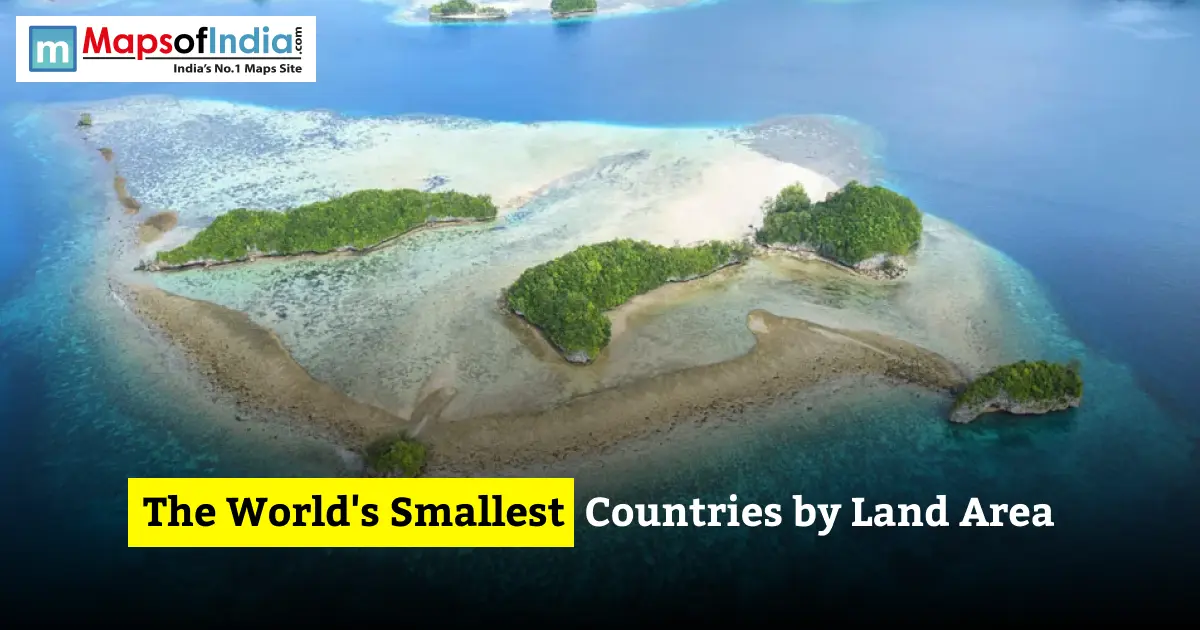
Vatican City is the smallest country in the world, at roughly 0.44 km². Smaller than most urban parks. It's followed by Monaco, Nauru, Tuvalu, and San Marino as the smallest sovereign states on Earth. This list ranks the world's countries by land area, explains how and why countries end up this small, and breaks down the smallest nations region by region.
Which Is the Smallest Country in the World?
Vatican City, at about 0.44 km², is the smallest country in the world by land area. It's also the most populous sovereign state on Earth, home to fewer than 1,000 people, entirely enclosed within the city of Rome. Despite its size, Vatican City is an independent state with its own government, currency, postal service, and head of state. The Pope.
What Are the 10 Smallest Countries in the World by Land Area?
The ten smallest countries in the world by land area are Vatican City, Monaco, Nauru, Tuvalu, San Marino, Liechtenstein, the Marshall Islands, Saint Kitts and Nevis, the Maldives, and Malta.
1. Vatican City – 0.44 km² (0.17 mi²), Southern Europe
2. Monaco – 2.02 km² (0.78 mi²), Western Europe
3. Nauru – 21 km² (8.1 mi²), Oceania
4. Tuvalu – 26 km² (10 mi²), Oceania
5. San Marino – 61 km² (24 mi²), Southern Europe
6. Liechtenstein – 160 km² (62 mi²), Western Europe
7. Marshall Islands– 181 km² (70 mi²), Oceania
8. Saint Kitts and Nevis – 261 km² (101 mi²), Caribbean
9. Maldives – 300 km² (116 mi²), South Asia
10. Malta – 316 km² (122 mi²), Southern Europe
Figures vary slightly between sources depending on whether they measure land area or include territorial water and reclaimed land, so always cross-check against a current reference like the CIA World Factbook before citing exact numbers.
Smallest Countries in the World Explained One by One
Vatican City: the country in the world
Entirely surrounded by Rome, Vatican City is both the smallest by area and the smallest by population, with roughly 800 residents. It's a monarchy governed by the Pope, and despite its size, it has outsized global influence as the seat of the Roman Catholic Church.
Monaco: the populated principality
A monarchy on the French Riviera, Monaco packs around 38,000 people into just over 2 km², making it the most densely populated country on Earth. Monaco has grown 20% since the 1860s through land reclamation from the sea and is widely known as a tax haven and luxury tourism destination.
Nauru: the island nation
A single raised coral island in Micronesia, Nauru is both the island country and the smallest republic in the world, with a population of around 12,000. Its economy once relied heavily on mining, which has since left large areas of the island environmentally degraded.
Tuvalu: a lying Pacific nation
Made up of nine atolls and reef islands, Tuvalu has a population of roughly 11,000 and an average elevation of just under 2 metres, making it one of the countries most immediately threatened by rising sea levels.
San Marino: one of the world's republics
Surrounded entirely by Italy, San Marino traces its founding to 301 AD. Claims to be the world's oldest surviving republic. It operates in a customs union with the European Union despite not being a member itself.
Liechtenstein: the Alpine microstate
A landlocked principality between Switzerland and Austria, Liechtenstein uses the Swiss franc, shares a customs union with Switzerland and has built one of the highest per-capita incomes in the world through finance and light manufacturing.
Marshall Islands, Saint Kitts and Nevis, Maldives and Malta
The Marshall Islands, a Pacific nation of atolls and islands, relies heavily on a Compact of Free Association with the United States. Saint Kitts and Nevis in the Caribbean pioneered the Citizenship by Investment industry in 1984. The Maldives, an Indian Ocean archipelago of atolls, depends heavily on tourism and, like Tuvalu, faces serious climate vulnerability. Malta, a Mediterranean island nation with a colonial and strategic history, has leveraged its location and EU membership into a sizable finance and tourism economy.
Land Area vs. Total Area: How Country Size Is Measured
Rankings of the world's countries can shift slightly depending on whether a source measures land area alone or total area, which includes inland water. Most reputable rankings, including those drawn from the CIA World Factbook and UN data, rely on land area as the measure, which is why this list uses that basis throughout. Differences of a square kilometre between sources are usually just a matter of whether reclaimed land, inland water, or rounding conventions are applied slightly differently.
Smallest Countries by Region
Smallest Country in Europe
The smallest country in Europe is Vatican City at 0.44 km². The smallest country in the world overall.
Smallest country in Asia
The smallest country in Asia is the Maldives at around 300 km², spread across more than a thousand coral islands in the Indian Ocean.
Smallest country in Africa
The smallest country in Africa is Seychelles at 455 km², an archipelago nation in the Indian Ocean off East Africa.
Smallest countries in Oceania and the Pacific
The smallest country in Oceania is Nauru at 21 km², followed closely by Tuvalu at 26 km². Both are ahead of the next-smallest Pacific nations.
Smallest countries in the Americas and the Caribbean
The smallest country in the Americas is Saint Kitts and Nevis at 261 km², a sovereign state in the Western Hemisphere.
Smallest Countries by Land Area vs. Population
The smallest country by area isn't always the smallest by population. Vatican City holds both titles. Smallest by area and by population, with under 1,000 residents. Further down the list, the ranking shifts: Tuvalu, despite being larger by area than Nauru, has a smaller population (around 11,000 versus Nauru's roughly 12,000), making it one of the least populous countries in the world even though it isn't the smallest by land.
Why Are Some Countries Small?
Several forces explain why these nations never grew larger or merged into states. Historically, countries like Vatican City, San Marino and Monaco are survivors of Europe's age of city-states and small principalities. They are units that predate the modern nation-state and simply never got absorbed into their larger neighbours. Geography explains much of the rest: island and atoll nations like Nauru, Tuvalu and the Marshall Islands are small because they sit on small landmasses with no room to expand.
Economically, these microstates have found a range of ways to sustain themselves despite their size. Tourism drives much of Monaco, Malta and the Maldives' economies. Finance and favourable tax regimes support Monaco and Liechtenstein. Saint Kitts and Nevis, along with Pacific nations, generate meaningful government revenue through citizenship-by-investment or passport programmes. Pacific island states like Nauru, Tuvalu and the Marshall Islands also lease out fishing rights in their exclusive economic zones, a revenue source disproportionate to their tiny land area. Several microstates, including San Marino and Liechtenstein, rely on customs unions with larger neighbours rather than operating fully independent trade and currency systems.
Challenges and Advantages of Being a Country
Being small carries genuine risk alongside its advantages. Climate vulnerability is severe for low-lying atoll nations. Tuvalu's government has gone as far as developing plans to preserve a "digital nation" and has signed a landmark climate-mobility agreement with Australia, anticipating that parts of its population may eventually need to relocate as sea levels rise. Heavy reliance on neighbours is a practical reality for landlocked or enclave states like Vatican City, San Marino and Liechtenstein, which depend on their surrounding countries for everything from currency to basic infrastructure. Limited natural resources constrain options for many of these states, particularly isolated Pacific nations.
On the other hand, small size brings real advantages too: favourable tax regimes have made Monaco and Liechtenstein wealthy out of proportion to their size; tourism appeal gives island and historic microstates an outsized draw relative to their population; and several of these nations, Vatican City most of all, punch well above their geographic weight in global diplomacy and soft power.
Conclusion
Vatican City, Monaco and Nauru top the list of the world's countries by land area, with the rest of the top ten split between European microstates and Pacific or Caribbean islands. What they lack in size, many of these nations make up for in global influence, economic resilience, or outright strategic importance. Proof that a country's footprint on the map says very little about its footprint on the world stage.
FAQs
What is the smallest country in the world?
Vatican City is the smallest country in the world, at approximately 0.44 km², and is also the least populous sovereign state on Earth.
What is the smallest country in the world by population?
Vatican City is also the country by population with fewer than 1,000 residents making it smallest by both area and population simultaneously.
What is the smallest country in Europe?
Vatican City is the smallest country in Europe and also the smallest in the world overall.
What is the smallest island country in the world?
Nauru, at 21 km², is the smallest island country and the third-smallest country overall, located in Micronesia in the Pacific Ocean.
Is Vatican City a country?
Yes. Vatican City is a sovereign, internationally recognized, independent state with its own government, its own legal system, its own currency, and its own head of state despite being the smallest country in the world.
What is the smallest country in Asia?
The Maldives, at 300 km², is the smallest country in Asia, made up of more than a thousand coral islands in the Indian Ocean.
How many countries are more than 1,000 square kilometres?
Two dozen sovereign countries are smaller than 1,000 km² in land area, spanning European microstates, Pacific island nations, and small Caribbean states; the exact count can shift slightly depending on the source and measurement method used, so it is worth verifying against a current reference before citing a precise figure.