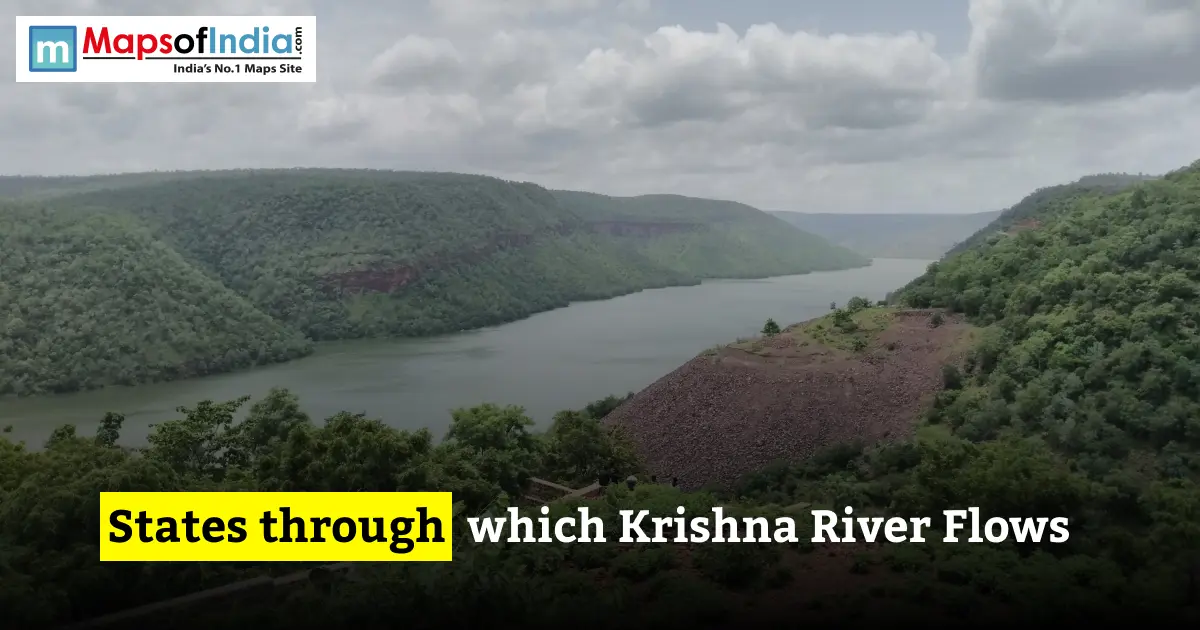
The Krishna River flows through Maharashtra, Karnataka, Telangana and Andhra Pradesh before emptying into the Bay of Bengal. Starting near Mahabaleshwar in Maharashtra, the river travels 1,400 km across India. It is a source of water for agriculture, irrigation, hydropower and several major settlements.
Krishna River States at a Glance
The Krishna River states list includes:
- Maharashtra – Origin and upper course
- Karnataka – middle course
- Telangana – Lower course
- Andhra Pradesh – Lower course and mouth
| State | Stretch/Role | Basin Share |
| Karnataka | Major middle course | 43.8% |
| Maharashtra | Origin and upper course | 26.6% |
| Telangana | Lower-middle course | 19.8% |
| Andhra Pradesh | Lower course and delta | 9.8% |
These percentages refer to the Krishna River basin, not the percentage of the river's physical length in each state.
About the Krishna River
Origin and Source
The Krishna River starts near Jor village in Maharashtra's Satara district, at Mahabaleshwar in the Western Ghats. Its source is 1,337 metres above sea level. From Maharashtra, the river flows eastward through Karnataka, Telangana and Andhra Pradesh before reaching the Bay of Bengal.
Length and Course
The length of the Krishna River is 1,400 km. The river generally flows eastward across the Deccan Plateau. Major tributaries such as the Bhima, Tungabhadra, Koyna, Ghataprabha, Malaprabha and Musi add to its flow.
Significance as India's Fourth-Longest River
The Krishna is one of India's rivers and is an important interstate river system. Its basin covers 2.59 lakh square kilometres, supporting agriculture, irrigation and hydropower across southern India.
Complete List of States the Krishna River Flows Through
Maharashtra– Origin State
Maharashtra is the origin state of the Krishna River. The river starts near Mahabaleshwar. Flows eastward through the state's region. Important tributaries associated with its course include the Koyna, Panchganga, Dudhganga and Varna.
The river's upper basin is important for irrigation, agriculture and water storage. After flowing through Maharashtra, the Krishna enters Karnataka, where it travels through a portion of its basin.
Karnataka
Karnataka contains 43.8% of the Krishna River basin. The river enters Karnataka from Maharashtra. Continues eastward through the part of the state.
Important locations associated with the river system include Almatti, Bagalkot and Raichur. Major tributaries such as the Ghataprabha, Malaprabha and Tungabhadra contribute significantly to its water flow.
The Karnataka stretch is particularly important for irrigation and hydropower, with projects such as the Almatti Dam playing a role in water management.
Telangana
Telangana forms a part of Krishna's middle course. After flowing through Karnataka, the river enters Telangana. Continues eastward toward Andhra Pradesh.
Krishna is important for irrigation and water supply in Telangana. Major projects associated with the river system include Srisailam and Nagarjuna Sagar. The Musi is another tributary flowing through Hyderabad before joining the Krishna.
Andhra Pradesh– Delta & Mouth
Andhra Pradesh contains the course of the Krishna River and its delta region. After passing through Telangana, the river enters Andhra Pradesh. Continues toward the Bay of Bengal.
Vijayawada is one of the cities associated with the river. The Krishna Delta is highly productive because of its soils and extensive irrigation network, particularly supporting paddy cultivation.
The river eventually empties into the Bay of Bengal on the Andhra Pradesh coast.
Krishna River Map– Route Visualization
A Krishna River map should show its route from Jor near Mahabaleshwar in Maharashtra → Karnataka → Telangana → Andhra Pradesh → Bay of Bengal. Major tributaries such as Bhima, Tungabhadra, Koyna, Ghataprabha, Malaprabha and Musi can also be marked to provide a picture of the river system.
Major Tributaries of Krishna River
Left-Bank Tributaries
Important left-bank tributaries include:
- Bhima
- Musi
- Munneru
- Paleru
The Bhima is the longest tributary of the Krishna by length. It starts in the Western Ghats. It flows through Maharashtra and Karnataka before joining the Krishna near Raichur.
Right-Bank Tributaries
Major right-bank tributaries include:
- Koyna
- Panchganga
- Dudhganga
- Ghataprabha
- Malaprabha
- Tungabhadra
The Tungabhadra is one of the important tributaries and is formed by the Tunga and Bhadra rivers.
Krishna River Basin– Key Facts
The Krishna River basin covers 2.59 lakh sq km or 7.9% of India's geographical area. It extends across Maharashtra, Karnataka, Telangana and Andhra Pradesh. Has agricultural importance.
| Basin Fact | Details |
| Basin area | About 2.59 lakh sq km |
| River length | About 1,400 km |
| Source | Near Jor, Maharashtra |
| General direction | Eastward |
| Outfall | Bay of Bengal |
| Basin states | Maharashtra, Karnataka, Telangana, Andhra Pradesh |
| Largest tributary | Bhima |
Importance of Krishna River
Agricultural & Irrigation Significance
Krishna is vital to agriculture across India. Its reservoirs and irrigation systems provide water to farming areas. The Krishna Delta in Andhra Pradesh is particularly productive. It is known for paddy cultivation, contributing to the region's reputation as an important rice-producing area.
Hydroelectric Projects and Dams
Major projects on the Krishna system include Almatti Dam in Karnataka, Srisailam Dam, and Nagarjuna Sagar Dam. These projects support irrigation, water storage and hydroelectric power generation.
Interstate Water Disputes
The Krishna is shared by states, leading to disputes over water allocation. The Krishna Water Disputes Tribunal (KWDT) was established to adjudicate disputes concerning the sharing of Krishna River waters. Following the creation of Telangana in 2014, water-sharing between Telangana and Andhra Pradesh became a part of the dispute.
Krishna River vs Godavari River
| Feature | Krishna | Godavari |
| Approx. length | 1,400 km | 1,465 km |
| Source | Western Ghats, Maharashtra | Western Ghats, Maharashtra |
| General direction | East | South-east/east |
| Outfall | Bay of Bengal | Bay of Bengal |
| Main-course states | 4 | 3 |
| Basin area | About 2.59 lakh sq km | About 3.02 lakh sq km |
| Major tributary | Bhima | Pranhita |
The Godavari is longer. Has a basin, while both are major east-flowing peninsular rivers.
Conclusion
The Krishna River flows through Maharashtra, Karnataka, Telangana and Andhra Pradesh. It starts near Mahabaleshwar, travels 1,400 km, and finally reaches the Bay of Bengal. Its extensive tributaries, agricultural regions, dams and irrigation projects make it one of India's important rivers.
FAQs
1. How many states does the Krishna River flow through?
The Krishna River flows through four states: Maharashtra, Karnataka, Telangana and Andhra Pradesh. It starts in Maharashtra and passes through Karnataka and Telangana. It reaches Andhra Pradesh before emptying into the Bay of Bengal.
2. Where does the Krishna River start?
The Krishna River starts near Jor village in Maharashtra's Satara district, near Mahabaleshwar. Its source is located in the Western Ghats at an elevation of 1,337 metres.
3. Where does the Krishna River end/meet the sea?
The Krishna River meets the Bay of Bengal on the coast of Andhra Pradesh. After flowing through Maharashtra, Karnataka and Telangana, it enters Andhra Pradesh. Continues through its course and delta before reaching the sea.
4. What is the length of the Krishna River?
The Krishna River is 1,400 km long. It starts in the Western Ghats of Maharashtra. Flows generally eastward through Karnataka, Telangana and Andhra Pradesh before emptying into the Bay of Bengal.
5. What is the Krishna Water Disputes Tribunal?
The Krishna Water Disputes Tribunal is a body established to resolve disputes over the sharing of Krishna River waters between states. Its proceedings have addressed water allocation among the states sharing the Krishna basin, including issues involving Telangana and Andhra Pradesh.
6. Which is the tributary of the Krishna River?
The Bhima is the tributary of the Krishna River by length. It starts in the Western Ghats. It flows through Maharashtra and Karnataka before joining the Krishna near Raichur. It is one of the tributaries of the Krishna River system.