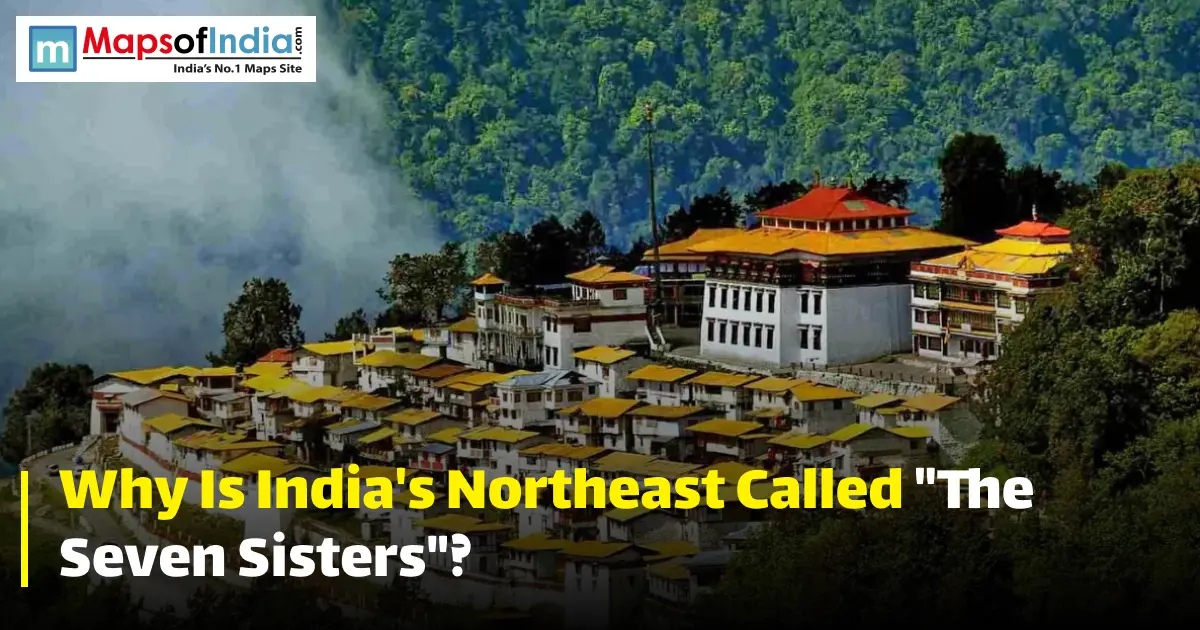
India's Northeast is called the "Seven Sisters" because of seven states. Assam, Arunachal Pradesh, Manipur, Meghalaya, Mizoram, Nagaland and Tripura. They share geographic, cultural and political ties. The phrase was coined in January 1972 by Tripura-based journalist Jyoti Prasad Saikia during a radio talk show timed to coincide with the creation of several of these states.
| State | Capital |
| Assam | Dispur |
| Arunachal Pradesh | Itanagar |
| Manipur | Imphal |
| Meghalaya | Shillong |
| Mizoram | Aizawl |
| Nagaland | Kohima |
| Tripura | Agartala |
The Origin of the Term
Who coined it and when?
The name is younger than most people assume. It didn't emerge from geography or colonial-era mapmaking. It was coined on air in January 1972 by Jyoti Prasad Saikia, a journalist based in Tripura, during a radio talk show. He later expanded the idea into a book, The Land of Seven Sisters (1976), which cemented the name in memory beyond that original broadcast.
Why was 1972 the turning point?
That year, the North-Eastern Areas (Reorganization) Act, 1971 came into force, reshaping the region overnight: Manipur and Tripura became states, Meghalaya was carved out as a new state, and Mizoram and Arunachal Pradesh were established as Union Territories (they would go on to attain full statehood only in 1987). Amid this reshuffling, Saikia reached for an image that would stick. Seven states, bound together, sharing infrastructure, ethnic overlaps and a single narrow route connecting them to the rest of the country.
The original meaning behind "sisters"
The metaphor wasn't chosen for prettiness. These states depend on one another in ways that go beyond convenience. Assam's plains, for instance, rely on rivers that originate in the hills of Arunachal Pradesh and Nagaland. All seven share a connecting corridor to the mainland and share overlapping tribal, linguistic and colonial-era histories. Calling them "sisters" rather than simply "the northeastern states" captured that interdependence in a way a bureaucratic label never could.
List of the Seven Sister States
- Assam
- Arunachal Pradesh
- Manipur
- Meghalaya
- Mizoram
- Nagaland
- Tripura
Geography of the Seven Sister States
Location and borders
The region sits in India's easternmost corner. Shares international borders with four countries. China to the north, Myanmar to the east, Bangladesh to the south and west and Bhutan to the northwest. 99% of the region's boundary is international, which is part of why it holds such strategic weight for India.
The Siliguri Corridor
All seven states are connected to the rest of the mainland by a narrow strip of land in West Bengal. The Siliguri Corridor, nicknamed the "Chickens Neck" for its shape about 22 kilometres wide at its narrowest point. Every road and rail link between the Northeast and the rest of India passes through this corridor, which is why the region's fate has always felt collectively tied together.
Why are they considered isolated?
Beyond the corridor, the terrain itself adds to the sense of separation. The states are boxed in by the Brahmaputra and Barak valleys, the Patkai range and dense hill systems, with flat land connecting them to peninsular India. This isolation is a reason the "sisters" framing took hold; it described a region that genuinely functioned as a connected unit somewhat apart from the rest of the country.
Is Sikkim Part of the Seven Sisters?
Why Sikkim is called the "Eighth sister"
Sikkim occupies a position in this story. It joined the Indian Union in 1975. Three years after Saikia coined the term. And geographically, it doesn't touch any of the seven sister states directly; West Bengal sits in between. For that reason, Sikkim is sometimes informally called the " sister" or often the "brother" of the seven, acknowledging its place in the broader Northeast without folding it into the original seven.
Key differences between Sikkim and the Seven Sisters
Sikkim's history diverges sharply from the seven states. It was a kingdom until 1975, rather than a colonial-era province reorganized into statehood, and it isn't part of the contiguous landmass the "sisters" label was built around. Administratively, Sikkim was only added to the North Eastern Council in 2002, decades after the original seven states were grouped together.
Cultural and Ethnic Identity of the Region
Tribal communities and languages
The Seven Sisters are home to more than 200 recognised tribes, from the Khasi and Garo of Meghalaya to the Naga tribes of Nagaland, the Mizo of Mizoram and the Bodo and Ahom-descended communities of Assam. Linguistically, the region is just as layered. Tibeto-Burman, Austroasiatic and Indo-Aryan language families all overlap here, meaning neighbouring valleys can sound nothing alike. This is part of why grouping them under one nickname always undersells how different each state actually is from the next.
Shared history and political ties
Despite that diversity, the seven states share overlapping threads of history. Much of the region fell under an administrative unit for a period, and post-independence, several states were carved out of what was originally undivided Assam. That shared lineage, combined with security and connectivity challenges, is what gives the "sisters" idea its practical basis, even if each state's cultural identity remains distinct.
Why the Term Still Matters Today?
Tourism and Regional Branding
"Seven Sisters" has become a shorthand in tourism and media. A single memorable name for a region that would otherwise require listing seven state names every time. Travel itineraries, government campaigns and cultural festivals routinely lean on the phrase because it does the work of introducing a region in two words.
Criticism and Debate Around the Term
Not everyone in the region embraces it equally. Some scholars, including anthropologist Dolly Kikon, have pointed out that the name was coined for convenience during the 1970s reorganization. A useful outsider label rather than an organic, self-chosen identity. The concern is that "Seven Sisters" can flatten the region into an aesthetic of misty hills and tribal exoticism when, in reality, it holds dozens of languages, religions and political histories. It's worth holding both truths at once: the term is an understood shorthand, and it's also an incomplete one.
Quick Facts About the Seven Sister States
- Area: 2,55,000 sq km or about 7% of India's total land area
- Combined population: roughly 45 million (2011 census), about 3.7% of India's population
- Largest state by area: Arunachal Pradesh (~83,743 sq km)
- Smallest state by area: Tripura (~10,486 sq km)
- Most populous state: Assam by a wide margin
- Only Christian-majority state among the seven: Mizoram
- Number of indigenous tribes across the region: 200+
Conclusion
The "Seven Sisters" name endures because it's memorable and, in a practical sense, accurate. Seven states bound by geography, a shared connecting corridor and overlapping histories. It's also a starting point. Each state carries its languages, faiths and stories, and the label works best as an introduction to the region rather than a summary of it.
FAQs
1. Which are the Seven Sister states of India?
Assam, Arunachal Pradesh, Manipur, Meghalaya, Mizoram, Nagaland and Tripura.
2. Who gave the name "Seven Sisters" to Northeast India?
Jyoti Prasad Saikia, a journalist from Tripura, during a radio broadcast in January 1972.
3. Why is Sikkim called the sister?
Because it is geographically and administratively linked to the Northeast. Joined India in 1975 after the term was coined and doesn't directly border any of the seven states. So it's informally called the " sister" or "brother" instead.
4. What is the capital of each Seven Sister state?
Dispur (Assam), Itanagar (Arunachal Pradesh), Imphal (Manipur), Shillong (Meghalaya), Aizawl (Mizoram), Kohima (Nagaland). Agartala (Tripura).
5. Are the Seven Sister states landlocked?
Yes, all seven are landlocked, with no access to the sea. They border neighbouring countries instead. China, Myanmar, Bangladesh and Bhutan.
6. What connects the Seven Sister states to mainland India?
The Siliguri Corridor, a strip of land in West Bengal, 22 km wide at its narrowest point, sometimes called the "Chickens Neck."