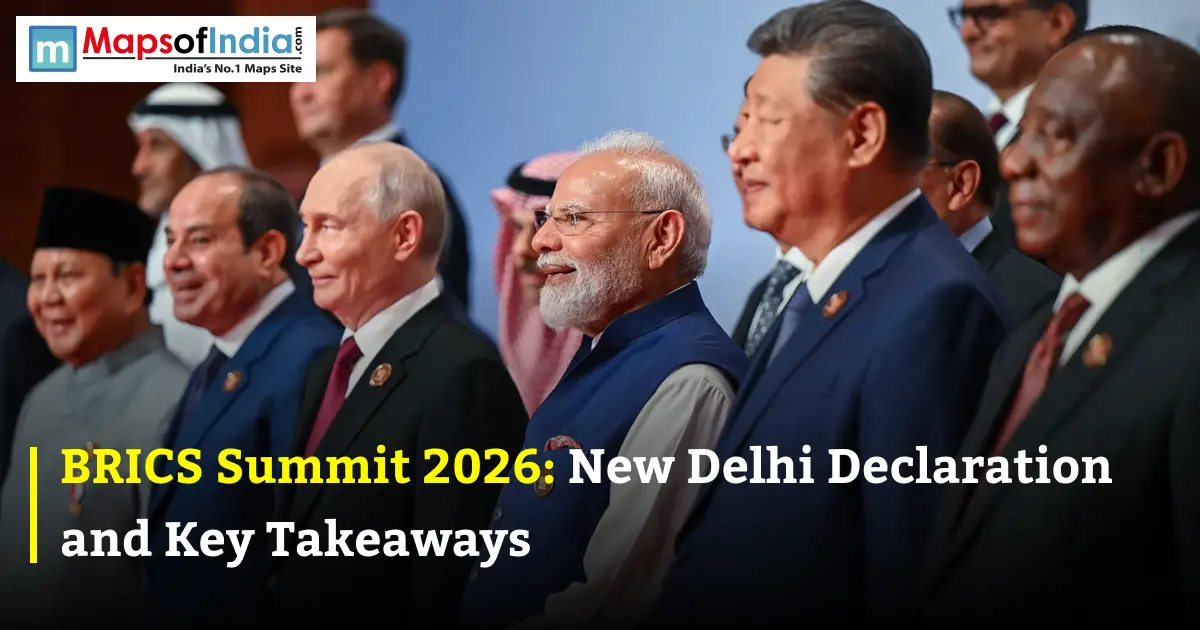
Under India's chairmanship, the 18th BRICS Summit was held in New Delhi on 12-13 September 2026. The summit brought together representatives of the enlarged 11-member BRICS grouping at a time of serious geopolitical tensions, trade conflicts, wars, and a shifting of the global economic order. The meeting ended with the adoption of the New Delhi Declaration, which contained a comprehensive statement on international peace and security, trade and economic cooperation, technology, artificial intelligence, health, climate change and reforms of global institutions.
The summit, which took place under the theme 'Building for Resilience, Innovation, Cooperation and Sustainability', was an important milestone in the development of BRICS. As the BRICS Chair in 2026, India emphasized action-oriented cooperation and the concerns of developing countries and the Global South.
What Is the New Delhi Declaration?
The key coordinated result of the 2026 BRICS Summit is the New Delhi Declaration. It highlights the points of consensus among the member countries even where there are big differences of opinion on foreign policy.
It covered various topics such as global governance, international trade, terrorism, conflicts, economic cooperation, artificial intelligence, digital public infrastructure, health, agriculture, energy, and sustainable development. The document also reiterated BRICS' support for a more representative and multipolar international system.
One of the most important aspects of reaching consensus was the fact that it involved countries with varying strategic interests, making it a challenging process. The statement thus adopts sensitive language in a balanced manner on various geopolitical issues.
BRICS Calls for Reform of Global Institutions
The reform of the global institutions' functioning to better reflect the new economic and political power shifts was one of the key messages of the New Delhi Declaration.
BRICS affirmed its support for comprehensive reform of the UN, including more representation for developing countries in the UN Security Council. The grouping also demanded reform of international financial institutions like the International Monetary Fund (IMF) and the World Bank.
India has consistently argued that developing countries should have a greater role in decisions affecting the global economy and international security. Prime Minister Narendra Modi also called on the Global South to move from being a “rule-taker” to a “rule-shaper.”
Opposition to Unilateral Tariffs and Trade Restrictions
Trade and economic cooperation were also major subjects of discussion at the summit. The New Delhi Declaration raised concerns over unilateral tariff and non-tariff measures that may create barriers to international trade and supply chains.
The statement, which did not mention the United States by name, criticized "unilateral protectionist and coercive economic measures" and urged a "more stable, predictable and fair global trading environment. BRICS also expressed support for more economic cooperation, such as cross-border payments, and the greater use of local currencies in trade.
The issue was even more pertinent given the impact of the changing tariff policies and increasing trade tensions of some BRICS members.
Focus on Global Conflicts and Peace
The summit was held amid ongoing tensions in West Asia and the conflict between Russia and Ukraine. BRICS leaders urged caution, dialogue and diplomatic means in all disputes, but abstained from using language that would directly point fingers at certain countries in the most sensitive ones.
The statement voiced concerns about spiralling tensions in the Middle East, calling for the protection of civilians, respect for international law and regional stability. It also voiced concerns about the humanitarian situation in Palestine and reaffirmed support for a two-state solution and Palestinian statehood.
On the Ukraine conflict, the declaration emphasized dialogue, consultation and diplomatic efforts rather than adopting strongly accusatory language.
Stronger Cooperation on Technology and AI
There was a convergence of technology and artificial intelligence that was identified as an important area of cooperation. In the declaration, the importance of AI governance was acknowledged, and international cooperation was called for to ensure that the new technologies bring inclusive and sustainable development.
The summit also showcased India's journey with Digital Public Infrastructure (DPI). The declaration welcomed the BRICS Science and Research Repository, envisaged as a platform for knowledge storage and sharing among BRICS countries. The emphasis on technology highlights the ever-increasing significance of digital systems in the fields of finance, public services, health care and economic development.
Health, Agriculture and Sustainable Development
Another priority area of India's agenda in the BRICS was health cooperation. The declaration highlighted the importance of enhancing early-warning systems and risk-informed planning to strengthen preparedness and response capacities.
The declaration also emphasized cooperation in the field of agriculture, food security, energy and climate action. BRICS members called for increased cooperation in the field of sustainable agriculture and digital technologies, taking into account the specific development requirements of member states.
Energy security and critical minerals were also discussed, focusing on the energy supply chain's resilience and diversification. The group highlighted the need for sustainable development and acknowledged the energy demand in developing countries.
India's Role in the 2026 BRICS Summit
The 2026 summit was significant for India because it marked the country's fourth BRICS chairship. India wanted to make its presidency more action-oriented, development-oriented, and Global South-oriented.
One of the most important diplomatic successes of the summit was that BRICS members adopted a joint declaration despite disagreements among them, especially with respect to matters concerning conflicts with other countries in the enlarged BRICS grouping. The summit also served as a platform for India to address issues like terrorism, maritime security, digital infrastructure, healthcare and economic resilience.
Modi termed the summit as a time for the BRICS to see a new phase of maturity and stressed that the group was not a bloc against the West. Rather, he presented BRICS as an avenue for cooperation among emerging economies and developing nations.
What the BRICS Summit 2026 Means for the Future
The New Delhi Summit illustrated the growing strength as well as the intricacies of BRICS. The extended grouping now accounts for a large proportion of the world's population and economic production, making it a major factor in trade and financial relations, energy and international governance.
Meanwhile, its diverse membership can cause difficulty in achieving agreement on its key geopolitical issues. The spirit of the New Delhi Declaration has proved that the nations of the BRICS can continue to have a dialogue and they can find some common principles even though they have competing interests.
The summit was a chance for India to assert its voice on the international stage and to champion issues of cooperation around trade, technology, health, sustainability and global institutional reform on behalf of the Global South. However, the impact of the 2026 declaration will depend on the success of the commitments being translated into action in the next few years.
FAQs
1. What was the main outcome of the BRICS Summit 2026?
The main outcome of the BRICS Summit 2026 was the adoption of the New Delhi Declaration. The declaration outlined the group's shared positions on global governance, international peace and security, trade, economic cooperation, technology, health, climate action and sustainable development. It also reaffirmed BRICS' commitment to a more representative and inclusive global order.
2. What is the New Delhi Declaration 2026?
The New Delhi Declaration is the joint outcome document adopted at the 18th BRICS Summit in New Delhi on September 12, 2026. It contains 140 points covering issues such as UN reform, international trade, tariffs, sanctions, artificial intelligence, energy, food security, healthcare, climate change and cooperation among BRICS members.
3. What did BRICS decide on trade and tariffs in 2026?
BRICS expressed concern over unilateral tariff and non-tariff measures that can disrupt international trade. The declaration reaffirmed support for a rules-based multilateral trading system with the World Trade Organization at its core. BRICS members also supported greater economic cooperation and efforts to facilitate cross-border payments and investment.
4. What did the BRICS Summit 2026 say about global governance?
The BRICS countries called for reforms to global institutions to make them more representative and responsive to present-day realities. The declaration specifically reiterated support for UN reform, including reform of the UN Security Council, and greater representation for developing countries in international institutions such as the IMF and World Bank.
5. What was India's role in the BRICS Summit 2026?
India hosted and chaired the 18th BRICS Summit in New Delhi under the theme “Building for Resilience, Innovation, Cooperation and Sustainability.” During its 2026 chairship, India promoted cooperation in areas including trade, technology, health, sustainable development, innovation and the priorities of the Global South. The summit also highlighted India's role in building consensus among the expanded BRICS membership.
6. Did BRICS create a common currency at the 2026 summit?
No. The 2026 New Delhi Declaration did not announce the creation of a common BRICS currency. Instead, BRICS focused on strengthening financial cooperation, including cross-border payment systems and greater use of national currencies in trade.
7. What issues were discussed at the BRICS Summit 2026?
The summit addressed a broad range of issues, including international peace and security, trade and tariffs, terrorism, global governance, AI and emerging technologies, energy security, food security, healthcare, climate change, sustainable development and cooperation among developing economies. The declaration also addressed conflicts and tensions in West Asia.
8. Who will host the BRICS Summit in 2027?
China will host the 19th BRICS Summit in 2027. The New Delhi Declaration formally expressed support for China's BRICS chairship and the holding of the next summit in China.