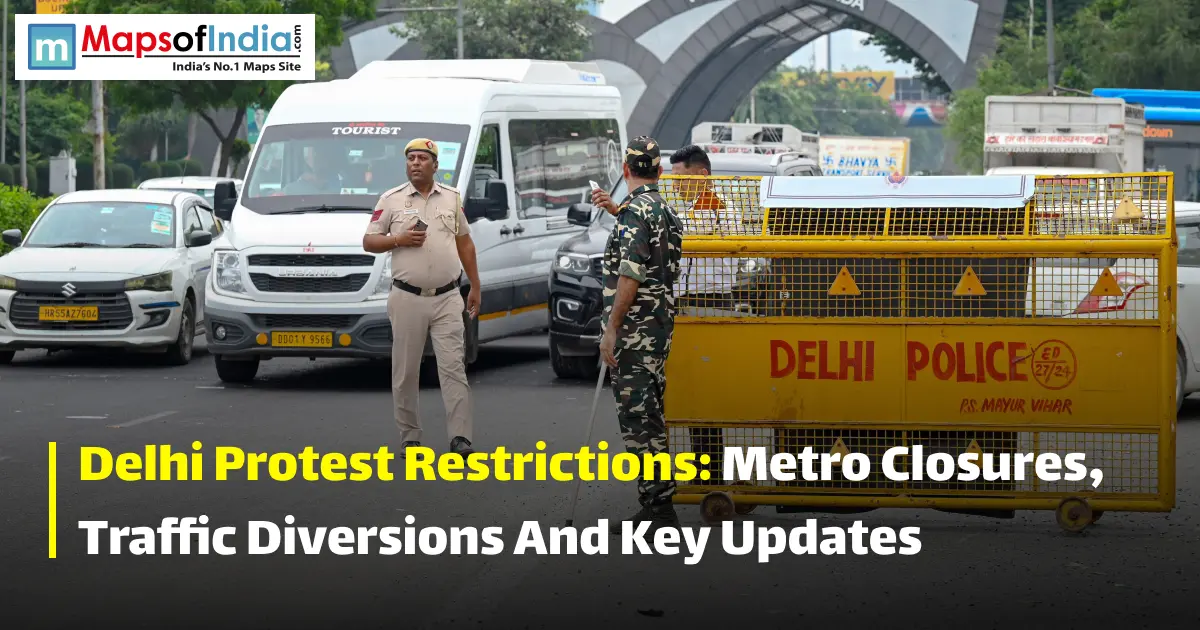
Delhi is witnessing heightened security and temporary transport restrictions on Monday, 12 October 2026, as opposition parties prepare for a protest march to the Supreme Court over allegations of electoral malpractice. The Delhi Metro Rail Corporation (DMRC) has closed the gates of six metro stations in the central area of the city, and the Delhi Traffic Police has advised commuters that there may be congestion and diversions on several key roads. Vehicles are also getting stuck in water in some parts of the capital due to waterlogging and breakdowns on some parts of the roadways during the rains.
The restrictions will be put in place to help with security arrangements and the movement of the public during the demonstrations. Avoid travelling during the periods marked in the official announcements, particularly for commuters, office workers, students and visitors.
Delhi Metro Closures on 12 October 2026
The DMRC has declared the temporary closure of entry/exit points of six metro stations on 12 October from 6 am to 4 pm for security reasons. The move affects prime areas of central Delhi such as Connaught Place and government offices.
The six affected stations are:
- Patel Chowk
- Janpath
- Rajiv Chowk
- Mandi House
- Central Secretariat
- Barakhamba Road
However, as per the DMRC advisory, interchange facilities will be kept open at these stations. Passengers can travel to other metro lines from these stations, but during the stated period, they will not be able to travel to and from the metro network from these closed stations.
The closures are temporary and can be amended as per the situation as assessed by the security agencies. The time of 4 pm is the announced time, and passengers are advised to check for any updates from the DMRC before travelling.
How the Metro Restrictions May Affect Commuters
The Blue Line and Yellow Line meet at Rajiv Chowk, and the Yellow Line and Violet Line meet at Central Secretariat. Passengers with residential, commercial, or government offices to go to may be affected by restrictions at these stations.
If possible, travellers travelling to Connaught Place, Janpath, Patel Chowk, Janpath and Mandi House should use stations close by that are operational. But it is not just alternative stations that may see a surge in ridership, especially during rush hour.
Travellers should give extra time for walking between stations and their destination points. If you are travelling for meetings, exams, medical appointments, or train and flight connections, please check your travel plans before you depart.
Delhi Traffic Diversions and Roads to Avoid
The Delhi Traffic Police has issued a notice warning that the movement of traffic could be hampered at several places due to the current law and order situation. Restrictions and diversions may be imposed as needed on the ground, starting at 6 am.
Some main roads and junctions are identified and marked in Central and New Delhi.
These include:
- Connaught Place and Barakhamba Road: Traffic may be disrupted around the Outer Circle, Barakhamba Road junction and nearby intersections.
- Mandi House and Central Delhi: Movement around Mandi House, Ashoka Road and adjoining junctions may be affected.
- Jantar Mantar and Sansad Marg: Security arrangements may influence traffic around Jantar Mantar Road, Jai Singh Road and Sansad Marg.
- Patel Chowk and Rail Bhawan: Commuters should anticipate possible restrictions around Patel Chowk, Gol Dak Khana and Rail Bhawan.
- ITO and DDU Marg: Traffic restrictions have also been announced in connection with a demonstration near DDU Marg, with disruption expected around the designated protest area.
- Dhaula Kuan and Ring Road: Motorists should allow extra time when travelling through these busy corridors, particularly if diversions or additional congestion develop.
- Jhandewalan and Panchkuian Road: These areas are among the locations where traffic movement may be affected by the announced restrictions.
Other identified crossovers are Shankar Road–Vande Matram T-point, Lodhi Road Flyover, Neela Gumbad roundabout, Madarsa T-point and Sardar Patel Marg–Panchsheel Marg crossing. Based on the situation, traffic police have identified about 30 places where restrictions or diversions have been put in place. This is not to say all the listed roads will be closed all day.
Motorists are advised to avoid non-essential journeys through affected areas, follow diversion signs and comply with instructions issued by traffic police. Drivers should not rely solely on their usual navigation routes because temporary barricades and road restrictions may change the quickest available route.
Why Are Protest Restrictions in Place in Delhi?
The bans are tied to an organised INDIA bloc protest march to the Supreme Court. The Congress has called the march to protest against electoral irregularities and its opposition to the Chief Election Commissioner, Gyanesh Kumar. Opposition leaders have made allegations of “vote chori” which demand investigations and accountability. These are allegations by political parties and should not be regarded as findings of the political parties.
The planned march comes after days of protests in the capital. Authorities have put some security measures in place to ensure that there is control over the crowd and public order around sensitive areas.
This is a situation which could develop further as police and security organizations evaluate the situation throughout the day. Confirmed metro restrictions should be differentiated from roadways where traffic disruption is expected, but not confirmed.
Rain and Waterlogging Add to Traffic Problems
Traffic delays and problems due to the rain are also hampering the movement of vehicles on some roads in the city, apart from the restriction of movement due to the protests. Some roads are waterlogged; others have been reported as having vehicles break down and slow-moving traffic.
The Delhi Traffic Police has put the blame on the disruptions on the Ring Road towards Ashram, as several vehicles were reported to be on the verge of breaking down near Sarai Kale Khan. The waterlogging on Ansari Road and vehicles trapped in the area near Monkey Bridge have also disrupted traffic flow. The traffic police have also reported a truck breakdown at Seelampur Flyover on GT Road, which has led to traffic congestion on the road towards the ISBT area as of 12 October. These incidents could result in further delays other than those that are related to protest arrangements.
Avoid travelling towards railway stations, bus terminals and the airport at the last minute. If traffic is diverted onto adjacent roads, even routes outside of the main protest area may have a slower speed.
Essential Travel Advice for Delhi Residents
People travelling across Delhi on 12 October should take a few precautions to avoid unnecessary delays.
- Check metro status: Confirm station entry and exit arrangements through official DMRC announcements before travelling.
- Check live traffic updates: Consult the Delhi Traffic Police website and official social media channels for current diversions and congestion alerts.
- Choose alternative routes carefully: Avoid affected central Delhi junctions where possible, but verify that the alternative route remains accessible.
- Plan extra travel time: Rain-related congestion and temporary security checks may make journeys longer than usual.
- Follow police instructions: Do not cross barricades or enter restricted areas to save time.
- Confirm onward connections: Passengers travelling to airports and railway stations should check their departure schedules and leave earlier than usual.
The Delhi Traffic Police lists WhatsApp assistance at 8750871493 and traffic helplines at 1095 and 011-25844444. These channels can help commuters seek assistance and obtain relevant traffic information.
When Will Metro and Traffic Restrictions End?
The closure will be ongoing until 4 pm on 12 October 2026 at the six metro stations. The DMRC, however, says it will look into the matter and provide additional updates as per the requirements of the security agencies.
Restrictions on the road may not be in sync with metro closures. Diversions can be added, lengthened, or removed as a result of crowd flow and security considerations. As such, the time for reopening of the metro should not be seen as a sign of the fact that all the roads in the central area of Delhi will get back to normal at the same time.
There should be a word of caution for the passengers on the official update before embarking on an evening journey, especially when traveling through government districts of Connaught Place, Mandi House, Janpath or adjoining districts.
Key Takeaways: Delhi Protest Updates Today
On 12 October, Delhi's transport system is being influenced by three factors: an opposition protest march planned to be held in the city, temporary closures of metro stations and the threat of rain which can cause congestion.
Patel Chowk, Janpath, Rajiv Chowk, Mandi House, Central Secretariat and Barakhamba Road will be closed, but interchange will be available till 4 pm. The central Delhi stations, Connaught Place, ITO and other major junctions may be affected by traffic diversions which will vary during the day.
When travelling to or from a station, commuters should check on the station access, road access, and local weather-related issues. Changes in the announced arrangements should be confirmed with official announcements from the DMRC and Delhi Traffic Police.
FAQs
1. Which Delhi Metro stations are closed today, 12 October 2026?
Entry and exit facilities at six Delhi Metro stations—Patel Chowk, Janpath, Rajiv Chowk, Mandi House, Central Secretariat and Barakhamba Road—are scheduled to remain closed from 6 am to 4 pm on 12 October 2026 due to security arrangements. Interchange facilities remain available, according to the DMRC advisory.
2. Why are Delhi Metro stations closed on 12 October 2026?
The Delhi Metro station restrictions have been introduced for security reasons ahead of an opposition INDIA bloc protest march to the Supreme Court. The demonstration concerns objections to the Special Intensive Revision (SIR) of electoral rolls and allegations raised by opposition parties regarding voter-list changes.
3. Which roads are affected by Delhi traffic diversions today?
Traffic movement may be affected at 30 identified locations across Delhi, including Mandi House, Dhaula Kuan Flyover, Jhandewalan, Panchkuian, ITO-area roads, Connaught Place, Patel Chowk, Rail Bhawan and Lodhi Road Flyover. The Delhi Traffic Police has advised commuters to check live updates because diversions depend on on-ground conditions.
4. When will Delhi Metro station restrictions end today?
The announced entry and exit restrictions at the six affected Delhi Metro stations are scheduled to end at 4 pm on 12 October 2026. However, the timing may be subject to review by security agencies. Passengers should check the latest DMRC announcements before travelling.
5. Why are protests taking place in Delhi on 12 October 2026?
Opposition parties under the INDIA bloc have called for a protest march to the Supreme Court over their objections to the Special Intensive Revision of electoral rolls. They have raised concerns about voter-list changes and made demands concerning Chief Election Commissioner Gyanesh Kumar. These are the stated concerns and demands of the protesting parties.
6. How can commuters check live Delhi traffic updates today?
Commuters can check the official Delhi Traffic Police website and its social media channels for traffic diversions, road restrictions and congestion alerts. The published advisory also lists WhatsApp assistance at 8750871493 and traffic helplines at 1095 and 011-25844444.
7. How can I travel across Delhi during the protest restrictions?
Commuters should check Delhi Metro station access and traffic advisories before starting their journeys. Avoid non-essential travel through affected areas, consider alternative routes where practical, allow extra travel time and follow police instructions. Travellers heading to the airport or railway stations should check their connections and plan for possible delays.