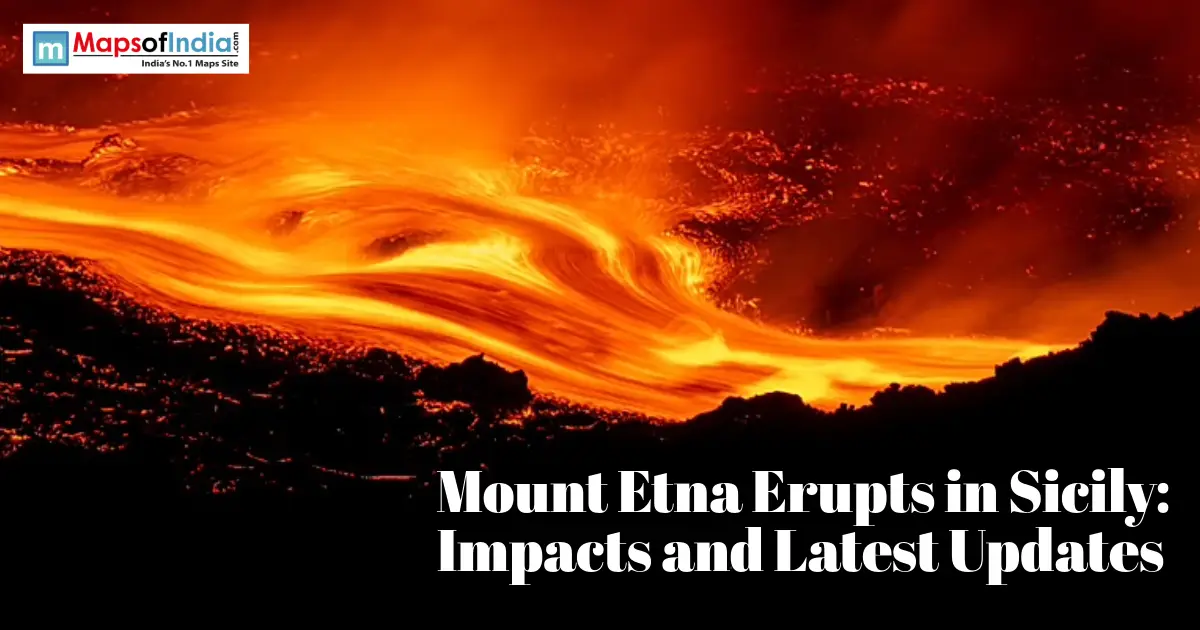
Mount Etna, one of Europe's highest and most active volcanoes, has erupted again in Sicily, Italy, creating spectacular lava and ash displays while disrupting air travel in the region. The next stage of the volcanic activity started on August 6, 2026, and lasted until mid-August, with repeated emissions of ash and lava. The eruption has been intriguing for international spectators due to its effects on Catania Airport, tourism and transport in Sicily.
The volcano's aviation colour code remained at orange, with an alert from Italy's National Institute of Geophysics and Volcanology (INGV) on 19 August to continue to closely monitor Etna. INGV has published a few updates on volcanic activity since the latest episode started.
Mount Etna Eruption in Sicily
Mount Etna is situated on the east coast of Sicily, near Catania. It is the highest active volcano in Europe and is famous for its frequent eruptions, which can be small explosive ones or major ones with lava fountains, ash clouds and lava flows.
The latest big incident started on August 6. Activity in the volcano increased during the next few days, and explosions and ash were observed from the summit area. The eruption also had lava activity, and thus was a large event in the middle of Sicily's summer tourist season.
The August activity was remarkable in terms of its continuity, experts said, compared with a lot of past events. The continued production of volcanic ash was also important due to its impact on aviation in eastern Sicily.
Volcanic Ash Disrupts Flights
Air travel is the worst affected aspect of the Mount Etna eruption right now. Volcanic ash poses significant hazards to aircraft as it can cause damage to the engine and disrupt aircraft systems. Ash began to blow into the airspace over eastern Sicily, prompting temporary closures of Catania airport several times.
Catania Airport is one of the busiest airports in Italy and also a major airport for tourists visiting Sicily. Hundreds of flights were either cancelled or rerouted during the most disruptive time. Between August 6 and 12, about 36% of nearly 2,000 flights scheduled were cancelled, and over 600 flights were rerouted.
The incident took place at the height of summer vacation, when Sicily is busy with both local and international tourists. The closure and restrictions thus applied to Catania airport impacted not only travellers who arrived by aeroplane from abroad but also those who used to fly in from other airports in Sicily.
Catania Airport Operations Resume
Catania Airport had a number of temporary suspensions due to changes in ash concentration. In one phase, the airport was shut down for several days in a row, thus causing one of the most evident aviation interruptions related to Etna in recent years.
After downgrading the volcanic aviation alert to orange on August 15, operations restarted. With a drop in volcanic activity and ash conditions, both arrivals and departures resumed.
But the activity of Etna is still being monitored. The volcano was struck by a red and then an orange alert during the eruption and again on 19 August, as reported by INGV. This means that conditions can change and aviation authorities can introduce additional restrictions when there is an increase in ash emissions.
Impact on Tourism and Transportation
The eruption has occurred during one of the most active travel seasons of the year in Sicily. Tourists and residents and businesses who rely on air connectivity found themselves in difficulties due to flight cancellations and diversions.
Those travelling through the disruption experienced delays, rerouting and airport cancellations. The alternative airports on Sicily were also under strain as commuters looked to alternative routes to and from the island.
Ground transportation was also impacted. There were fewer direct flights, so people used more trains, buses, taxis and rental cars. The airport disruption affected passengers, who were helped by Italian railway company Trenitalia, which introduced extra trains.
The event has also raised the profile of the risk of the Catania transport system with the frequent volcanic activity of Catania's Mount Etna. Volcanic activity has the potential to become an aviation concern quickly in the near vicinity of the volcano (such as the airport) when the wind blows the volcanic material toward the airport.
Ash Cloud Reaches Beyond Sicily
Mount Etna's eruption did not affect just its immediate vicinity. The ash from the volcano was spread far from Sicily by the winds, and reports indicate that ash went as far as Malta and North Africa.
Even an ash cloud from the Etna volcano over Malta on 11th August caused some flights to be cancelled. It was an illustration of the impact that volcanic eruptions can have even beyond the immediate vicinity of the volcano, especially when the ash is thrown into the air and spreads across long distances.
Is Mount Etna Still Erupting?
The Italian volcanological authorities are monitoring the activity of Mount Etna constantly. Over the past few days, from August 16 to August 19, INGV has been providing several updates regarding the activity of the volcano and the changing conditions for aviation. In the most recent update (on 19 Aug), the aviation colour code was updated to ORANGE.
This doesn't necessarily mean there is the same level of immediate disruption from the volcano all the time. The activity of Etna is explosive and can change rapidly, with some phases of the eruption being more explosive, with lava flows or ash emissions, and other phases being less explosive. Authorities therefore continue to monitor seismic activity, volcanic emissions, ground deformation and other indicators.
Why Is Mount Etna Important?
Mount Etna is not only a major geological feature but also an important part of Sicily's landscape, tourism and culture. Its slopes support agriculture, while the volcano attracts visitors interested in geology, hiking and volcanic landscapes.
At the same time, its frequent eruptions demonstrate the challenges faced by communities living near active volcanoes. Although many eruptions do not directly threaten populated areas, volcanic ash can disrupt aviation and transportation even when lava remains away from towns.
The latest eruption is another reminder that volcanic activity can have consequences far beyond the volcano itself.
Latest Mount Etna Eruption Updates
As of August 20, 2026, Mount Etna remains under observation following its prolonged period of activity. On August 19th, the most recent INGV aviation colour code was orange. After several closures and restrictions, Catania Airport has reopened, but travellers are urged to verify flight information as conditions may vary should the emission of volcanic ash be strong.
The Mount Etna eruption has thus turned into an international travel and natural events story. The spectacular lava and ash activity underscores the fact that Etna is one of the most active volcanoes in Europe, but the volcano's most direct impact on people so far has been on aviation. Further flight restrictions and/or changes in the volcanic alert level may be needed if monitoring by the Italian authorities continues.
FAQs
1. Why is Mount Etna erupting in Sicily?
Mount Etna is an active volcano, and its eruptions occur as magma and volcanic gases rise through cracks beneath the volcano. The latest activity has produced lava and significant volcanic ash.
2. When did the latest Mount Etna eruption start?
The latest major Mount Etna eruption in Sicily began on August 6, 2026, when intense volcanic activity developed around the Voragine summit crater. The eruption produced lava fountains, ash emissions and later lava flows, leading to major flight disruptions in the region.
3. Is Mount Etna still erupting?
Mount Etna remains under monitoring following its recent activity. Volcanic conditions can change quickly, so authorities continue to track ash emissions, lava flows and seismic activity.
4. Did the Mount Etna eruption affect flights?
Yes. Volcanic ash from Mount Etna disrupted flights at Catania Airport, leading to cancellations, delays and diversions during the peak summer travel period.
5. Is it safe to travel to Sicily during the Mount Etna eruption?
Travel to most parts of Sicily can continue, but conditions around Mount Etna may change. Visitors should check local volcanic alerts and their flight status before travelling, particularly when using Catania Airport.
6. Where is Mount Etna located?
Mount Etna is located on the east coast of Sicily, Italy, near the city of Catania. It is one of Europe's highest and most active volcanoes.
7. How has the Mount Etna eruption affected Sicily?
The eruption has caused volcanic ash, flight disruptions and travel difficulties, particularly around Catania. Ash has also been carried beyond Sicily by winds, affecting parts of the wider Mediterranean region.